Thru the Walls
There is something particular about confronting a wall. Not the kind you can simply turn away from, but the kind that follows you, that exists inside the architecture of thought itself. "Thru the Walls" understands this kind of entrapment intimately. It is the tenth track on Death Grips' 2011 mixtape Exmilitary, and it arrives in the album's second half like a pressure finally releasing. But release, here, does not mean relief. It means rupture.
When the Walls Close In
Death Grips officially formed on December 21, 2010, in Sacramento, California, just months before Exmilitary landed on the internet as a free download in April 2011.[1] The group arrived fully formed: MC Ride (Stefan Burnett) supplying vocals that alternated between a shout and a howl, drummer Zach Hill providing rhythms drawn from a career in avant-garde noise rock with his duo Hella, and producer Andy Morin assembling production from disparate samples and synthesizers in his Sacramento studio.[2]
The album was structured around a loose concept: an ex-military addict experiencing paranoia, delusions of grandeur, and a total dissolution of the boundary between self and chaos.[1] This narrative arc lends Exmilitary something rare in experimental hip-hop: an emotional through-line you can follow even when the music is actively resisting comprehension. By track ten, the listener has survived beatdowns, fugitive chases, drug-induced spirals, and confrontations with an indifferent social order. "Thru the Walls" arrives as a culmination of that accumulated pressure.
MC Ride's pre-Death Grips life helped shape what this music would become. He studied visual arts at Hampton University before leaving and returning to Sacramento, where he worked at bakeries and restaurants while making music and painting.[2] His art, visual and lyrical alike, traffics in the psychological intensity of someone trying to translate private suffering into something communicable. The wall in the song is partly a metaphor for that gap between internal experience and the external world.
Inside the Architecture of Thought
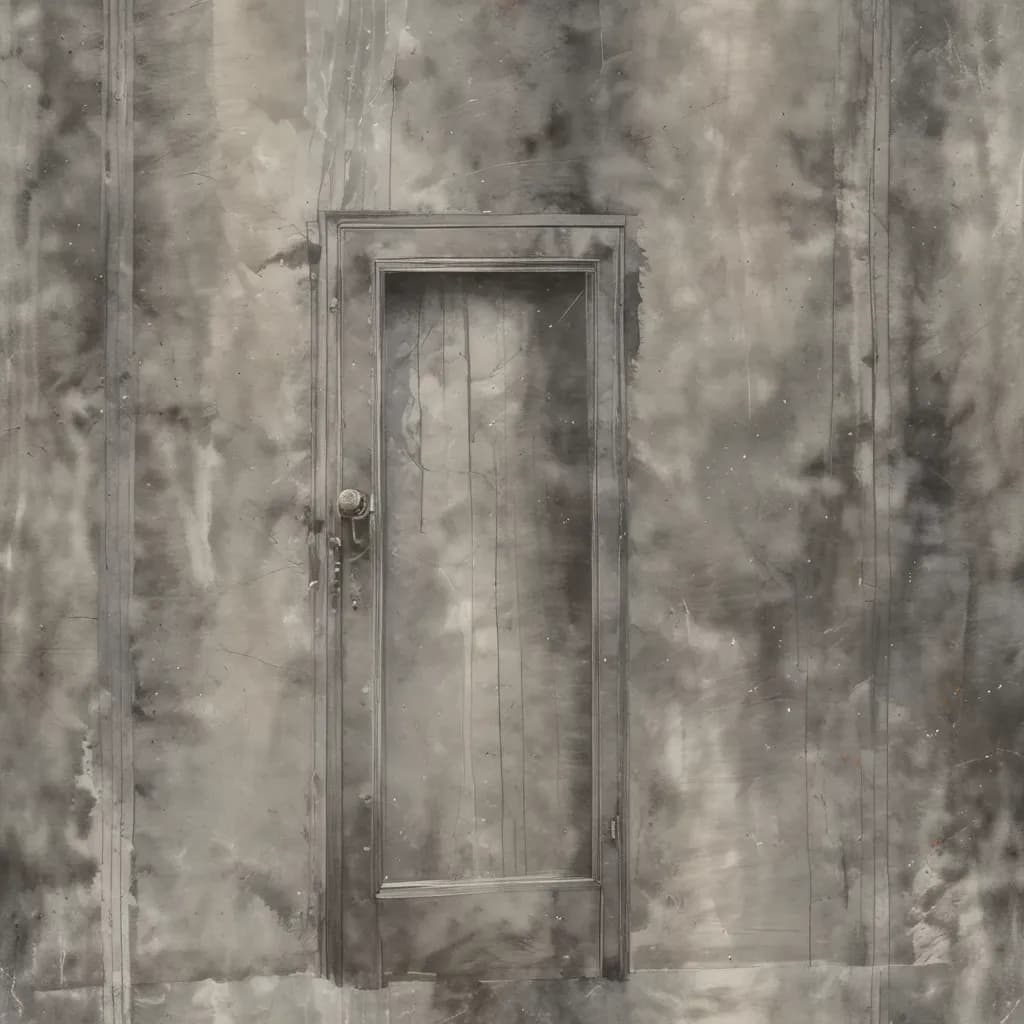
The title announces the song's central contradiction: a wall, by definition, stops you. To go through it, not around or over, requires a kind of force that defies normal physics. This is the emotional register the song operates in throughout. The narrator articulates a desperate need to transcend confinement, expressed with the urgency of someone who has already exhausted every rational option.
The lyrics engage directly with altered states and four-dimensional consciousness, suggesting a mind that has broken through the three-dimensional prison of ordinary perception, or believes it has. This ambiguity between genuine transcendence and psychiatric crisis runs through the track like a fault line. The song cannot tell you which it is, and that uncertainty is the point.
The album's loose narrative describes its protagonist as experiencing delusions of grandeur alongside paranoia and violence.[1] Within that context, "Thru the Walls" reads as the most inward-facing moment: less about external confrontation than about what happens inside a mind pushed to its limit. The desperation in MC Ride's delivery is not the desperation of someone being chased. It is the desperation of someone trying to become someone else.
A Collage of Escape
What makes the song's thematic work particularly effective is the way the production reinforces it. Death Grips drew on four distinct sources for the track: Sun Ra's 1973 cosmic jazz touchstone "Space Is the Place," a recording by Ariel Pink's Haunted Graffiti, an internet recording of a comedic "Mental Health Hotline" voicemail menu, and audio lifted from the video game Half-Life 2.[3]
This collage is not random. Sun Ra's Afrofuturist vision was explicitly about transcendence through music, about using sound to escape the limitations imposed by a hostile world on Black Americans. To sample him here is to place the song inside a long tradition of Black artistic strategies for surviving confinement. Ariel Pink's lo-fi haze contributes the texture of suburban dissociation, a different kind of entrapment than Sun Ra's but entrapment nonetheless.[3]
The Mental Health Hotline recording inserts darkly ironic commentary: systems designed to contain and process psychological distress, rendered absurd through their own bureaucratic logic. And the Half-Life 2 Combine soldiers, enforcers of an alien occupation, add a science-fiction dimension to the song's sense of oppressive surveillance.[3] Together these samples form a portrait of a mind reaching in every direction at once: toward the cosmic, the mundane, the clinical, and the apocalyptic.
The Drowned in Sound review of the album described it as functioning like "a well-oiled army cell" operating at "100 per cent anguish."[4] That description fits "Thru the Walls" particularly well, because the anguish here is organized. It is not noise for its own sake but noise assembled with intent.
The Margins of Viability
Exmilitary arrived at a moment when independent hip-hop was fracturing in many directions at once. Death Grips offered something more extreme than most of their contemporaries: a noise-rap aesthetic that treated genre conventions as obstacles to blow through rather than parameters to work within.[5]
"Thru the Walls" is not the album's most famous track. That distinction belongs to "Guillotine" or "Takyon (Death Yon)." But it occupies an important structural position. It is the album's most explicitly psychedelic and cosmic moment, the point where the paranoid fugitive narrative briefly dissolves into something approaching a spiritual experience, or a convincing simulation of one.[1]
The album's complicated sample clearance history has meant that Exmilitary has been repeatedly pulled from streaming platforms, limiting its formal recognition even as its influence spread throughout independent music.[1] This accessibility problem is part of what makes Death Grips a cult phenomenon rather than a mainstream one. Their audience finds them because it goes looking, not because the music comes to it.
Survival Mentality
In an early interview with The Quietus, MC Ride observed that what some people call mental illness can also be seen as a survival mentality to others.[6] This framing invites a reading of "Thru the Walls" in which the narrator's altered states are not signs of breakdown but strategies for coping with a world that would otherwise be unbearable. Going through the walls, in this interpretation, is not pathology but praxis.
There is also a more autobiographical reading available. Ride, Morin, and Hill were Sacramento residents making music entirely outside any established industry structure, releasing Exmilitary for free and building an audience with no label support and near-zero media presence.[2] The walls they went through were partly metaphorical: the walls of an industry that would not have signed them, of genre conventions that would have constrained them, of a city that functioned as the seat of California's governing apparatus while remaining economically inhospitable to its creative class. The song's aggressive push against containment resonates differently when you know that the people making it were operating at the absolute margins of viability.
That a portion of "Thru the Walls" was later itself sampled by Death Grips in another track is telling.[3] Even within their own catalog, they treated this track as raw material worth returning to, worth breaking down and rebuilding. The wall has more than one purpose. You go through it, and then you build with the pieces.
The Walls Are Not Permanent
"Thru the Walls" endures because the thing it describes never goes away. The experience of confinement, whether imposed by circumstance, psychology, social system, or the architecture of the mind itself, is universal enough that Death Grips' extreme sonic response feels proportionate to it. The samples they chose speak to centuries of strategies for transcendence, to internet-age irony, to the science-fiction dystopia that late capitalism has come to resemble.
The urgency in MC Ride's vocals speaks to something older and simpler: the brute determination to not remain contained. The song does not promise that breaking through will be comfortable or that anything good waits on the other side. It only insists that staying put is not an option.
The walls, the song insists, are not permanent. They only feel that way.
References
- Exmilitary - Wikipedia — Album overview, concept, release history, sample clearance issues, and critical reception
- Death Grips - Wikipedia — Band formation, member biographies, and career trajectory
- Thru the Walls - WhoSampled — Complete breakdown of samples used in the track: Sun Ra, Ariel Pink, Mental Health Hotline recording, and Half-Life 2
- Exmilitary Review - Drowned in Sound — 9/10 review describing the album as operating at 100 per cent anguish like a well-oiled army cell
- Are Death Grips the Most Important Hip-Hop Act of the Decade? - Highsnobiety — Cultural impact of Death Grips on experimental hip-hop and independent music
- Death Grips Interview - The Quietus — Early 2011 interview including MC Ride on mental illness as survival mentality and Exmilitary's themes