Tornado Warnings
There is something quietly devastating about the moment a person receives a clear warning and decides to ignore it anyway. Not out of ignorance, not because the signal was ambiguous, but because the alternative -- walking away from someone who makes you feel something -- seems worse than whatever the storm might bring. "Tornado Warnings" by Sabrina Carpenter locates precisely that moment and refuses to look away from it.
A Real Storm, A Real Choice
Released on July 15, 2022, as part of Carpenter's fifth studio album emails i can't send on Island Records[1], "Tornado Warnings" carries the weight of a very specific, very real afternoon. During a period of turbulent personal and professional upheaval, Carpenter found herself at a park with someone she knew was not good for her. While they were there, sitting on a seesaw as the light dimmed, her phone issued an actual tornado warning. Then hail began to fall. A second warning arrived. She stayed. The following day, sitting across from her therapist, she said nothing about any of it.[2]
That incident became the song. Co-written with Julia Michaels, JP Saxe, and Jorgen Odegard[3], the track uses the literal weather event as both narrative and metaphor, building outward from a true moment of willful blindness into something broadly recognizable about why people choose to remain in the eye of something dangerous.
The biographical context amplifies the song's resonance considerably. In January 2021, Olivia Rodrigo released "drivers license," which became one of the most viral singles in recent memory. Fan speculation immediately centered on a supposed love triangle involving Rodrigo, actor Joshua Bassett, and Carpenter. The "blonde girl" referenced in Rodrigo's lyrics was widely interpreted as Carpenter, and the internet responded with prolonged cruelty. Death threats, harassment campaigns, and the label "homewrecker" attached itself to her name across social media.[4] Carpenter addressed the situation with her own single "Skin" later that month, but the damage to her public image was, for a time, severe.[5]
emails i can't send is the album that grew from that period. Carpenter described it as a "time capsule" of her experiences[6], and the record traces an arc from the public wound inward, through progressively more intimate emotional territory. Most tracks process different facets of the fallout. "Because i liked a boy" confronts the harassment head-on. "Tornado Warnings" takes the opposite approach, turning inward to examine not what others did to her but what she chose to do to herself.
Running Toward the Storm
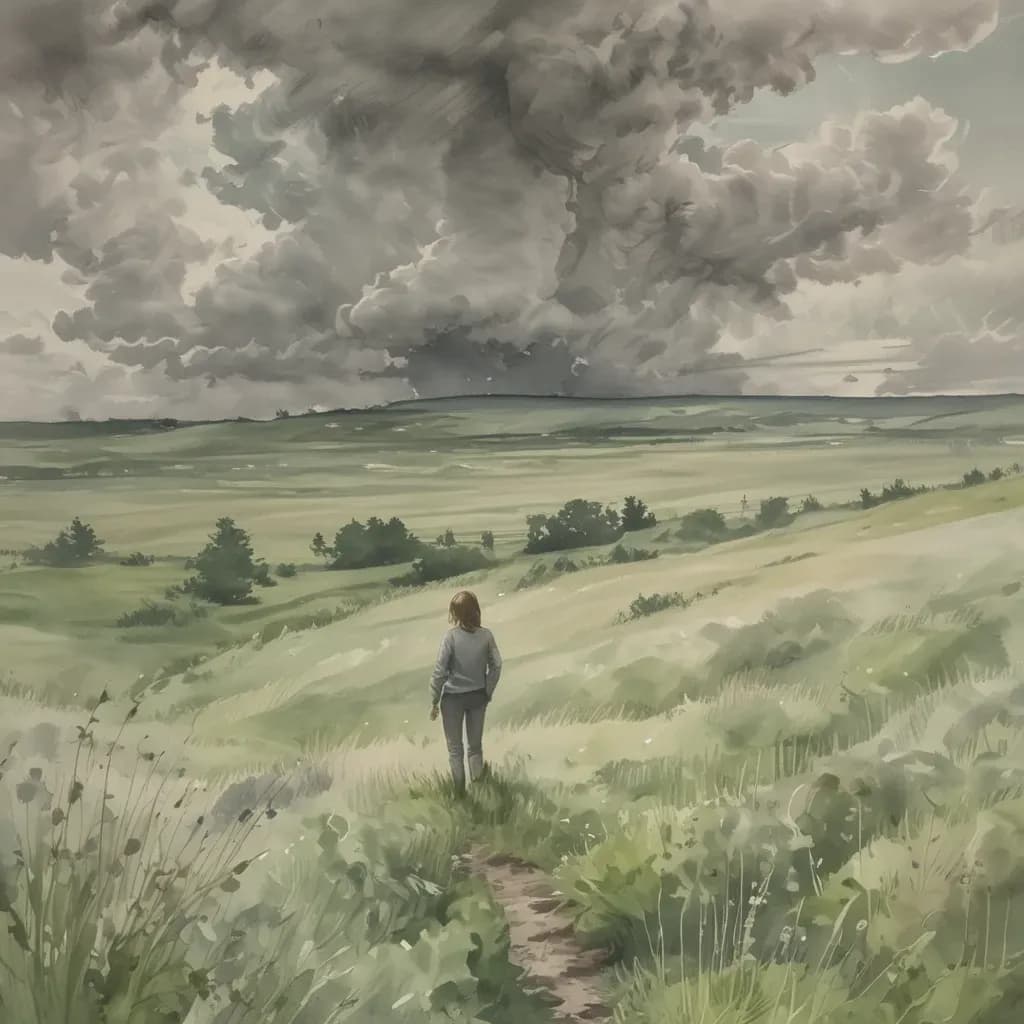
The title does most of the conceptual work before the first note plays. In the song's logic, a tornado warning is not a passive fact of weather but a clear, unambiguous instruction: take cover. The narrator receives one and stays put. Then receives another. The song refuses to treat this as a tragedy that happened to her. It treats it as a choice she made, with full information.
This is what gives "Tornado Warnings" its moral complexity and its staying power. It is not a breakup song, not strictly speaking, because the relationship it describes has not ended. It is a song about the active decision to remain in something you have correctly diagnosed as harmful. The narrator is not a victim of circumstances; she is an architect of her own undoing, and she knows it. Rather than framing herself as someone acted upon, Carpenter positions the narrator as the one who kept choosing the storm.[3]
The seesaw image in the song's opening is especially well-chosen. Two people balancing in the dark on a playground seesaw, each dependent on the other for equilibrium, neither willing to get off first. It is a physical model of co-dependency: you stay because leaving means the other person falls, but also because staying means you keep getting your moment in the air. The park setting places the narrator in a space associated with childhood and innocence, a world where real danger still feels abstract. Into this space arrives an alert from the adult world: a warning she is not prepared to receive.
The production by Jorgen Odegard keeps the arrangement relatively spare and intimate, allowing Carpenter's voice to carry the emotional specificity of the lyrics without theatrical amplification. There is no dramatic despair in her delivery, no wailing or performed anguish. She narrates her own complicity with a clear-eyed, rueful quality, as though describing something she has already processed enough to see clearly but has not yet fully let go of. The restraint is part of the point.
The Therapy Scene
If the tornado metaphor is the song's central image, the therapist scene is its most quietly courageous moment. In the second verse, Carpenter describes sitting across from her therapist the day after the park and saying nothing about what had transpired. She was afraid, the song suggests, of being judged for her choices. She had been going to therapy to work through precisely this kind of situation, but when the moment arrived to actually disclose it, she withheld the truth.[2]
The admission is a small thing, narratively, but it opens up something much larger. It acknowledges that seeking help and actually accepting help are two completely different activities. A person can sit in a therapist's office every week and still carefully curate what gets said, protecting the parts of themselves that most need to change. The song does not condemn this behavior, but it does name it plainly, which is its own kind of reckoning.
Carpenter told Capital FM that the song contains one of her favorite lyrics on the entire album. She explained that it captured a time when she felt she was giving so much mental space to other people and other things that there was nothing left for herself.[7] That framing, the experience of being psychically colonized by someone else's presence, resonates through the whole song, and especially through the therapist detail: she cannot even give herself the space to be honest in the room designed specifically for that honesty.
Confessional Pop and the Complicity Tradition
"Tornado Warnings" arrived at a moment when confessional pop songwriting was experiencing a critical rehabilitation. The viral success of Rodrigo's debut album SOUR had helped create space for artists to be more honest and specific about romantic failure than the genre had encouraged for years. The broader cultural appetite for emotional directness in pop music was real and growing.
But "Tornado Warnings" stands slightly apart from that wave. Where much of the confessional pop of that era emphasized victimhood and righteous pain, Carpenter's song insists on the singer's own complicity. She is not the wronged party here, at least not straightforwardly. She is the person who received the warning and stayed. This refusal to flatten herself into a sympathetic victim is what makes the song stand out within emails i can't send and within the broader landscape of personal songwriting.[8]
The song also touches a genuine nerve around mental health culture and its limits. The specific detail of lying to the therapist, of performing the process of healing while protecting the core wound, acknowledges something that self-help discourse tends to smooth over: awareness of your problems does not automatically translate into willingness to address them. You can know something is bad for you and choose it anyway. You can understand your own patterns and repeat them regardless. "Tornado Warnings" takes this seriously rather than treating self-knowledge as the solution.
Critical reception to the album as a whole supported this reading. Rolling Stone placed emails i can't send at number 44 on its best albums of 2022 list, while Billboard ranked it at number 19[1]. Vogue called it "the most fully realized vision of Carpenter the musician and the most rounded portrait of Carpenter the human being yet," a description that applies especially well to songs like this one, where she does not perform a tidier version of herself.
Alternative Readings
Some listeners have focused less on the self-implication angle and more on the song as a straightforward celebration of intensity. By this reading, "Tornado Warnings" is less a song about bad choices and more a song about the irresistible pull of a certain kind of connection, the kind that feels worth the risk of the storm. The narrator is not so much deluding herself as consciously accepting the cost. Desire, the argument goes, is not obligated to be strategic.
This reading is not wrong, exactly, but it softens what the therapist detail makes sharp. Choosing danger knowingly is one thing; being unable to tell your therapist about it is another. The song seems aware of this distinction. It is not quite a celebration of recklessness, and it is not quite a lament about it either. It lives in the honest middle, where a person knows what they are doing, keeps doing it, and cannot fully explain why.
The Warning That Came and Went
What "Tornado Warnings" ultimately captures is not the drama of a bad relationship but the quieter, harder truth of a human being who knows better and chooses not to act on that knowledge. It is a song about self-betrayal, about sitting on a seesaw in the dark while the sky turns green and deciding, again, to stay.
That decision is not romantic in the conventional sense. It is just recognizable. Most people who have been somewhere they could not make themselves leave will find something true in Carpenter's admission. The warning came. The knowledge was there. She stayed anyway. And then she sat in a room designed for honesty and said nothing about it.
The fact that this level of candor came from a former Disney Channel actress, someone trained to project brightness and polish, makes the song part of the larger artistic reclamation that emails i can't send represents. It arrived when Carpenter needed to prove she was more than a tabloid footnote. What she offered instead was a song that looked unflinchingly at herself and found not a victim, not a villain, but something far more honest: a person who needed to be somewhere she knew she should not have been.[6]
References
- Emails I Can't Send - Wikipedia — Album context, release date, critical reception, track listing
- Sabrina Carpenter on Healing Through Songwriting - Nylon — Samsung concert interview where Carpenter revealed the real tornado warning incident and therapist story
- Tornado Warnings: Unpacking the Emotional Twister - Song Meanings and Facts — Detailed thematic and lyrical analysis including songwriter credits and song structure
- Sabrina Carpenter - Wikipedia — Biographical context including Girl Meets World, label history, and the 2021 public controversy
- Painful Inspiration Behind 'emails i can't send' - Capital FM — Background on the real-life events and Olivia Rodrigo fallout that inspired the album
- Sabrina Carpenter on Perceptions and Vulnerability - Rolling Stone — Artist interview about the album as time capsule and personal turning point
- Sabrina Carpenter Explains Favourite Lyrics - Capital FM — Carpenter names this as one of her favourite lyrics on the album and explains its meaning
- 3 Years Later: emails i can't send Marked a Turning Point - Collider — Retrospective on the album's significance and Carpenter's refusal to play a victim