Two Heavens
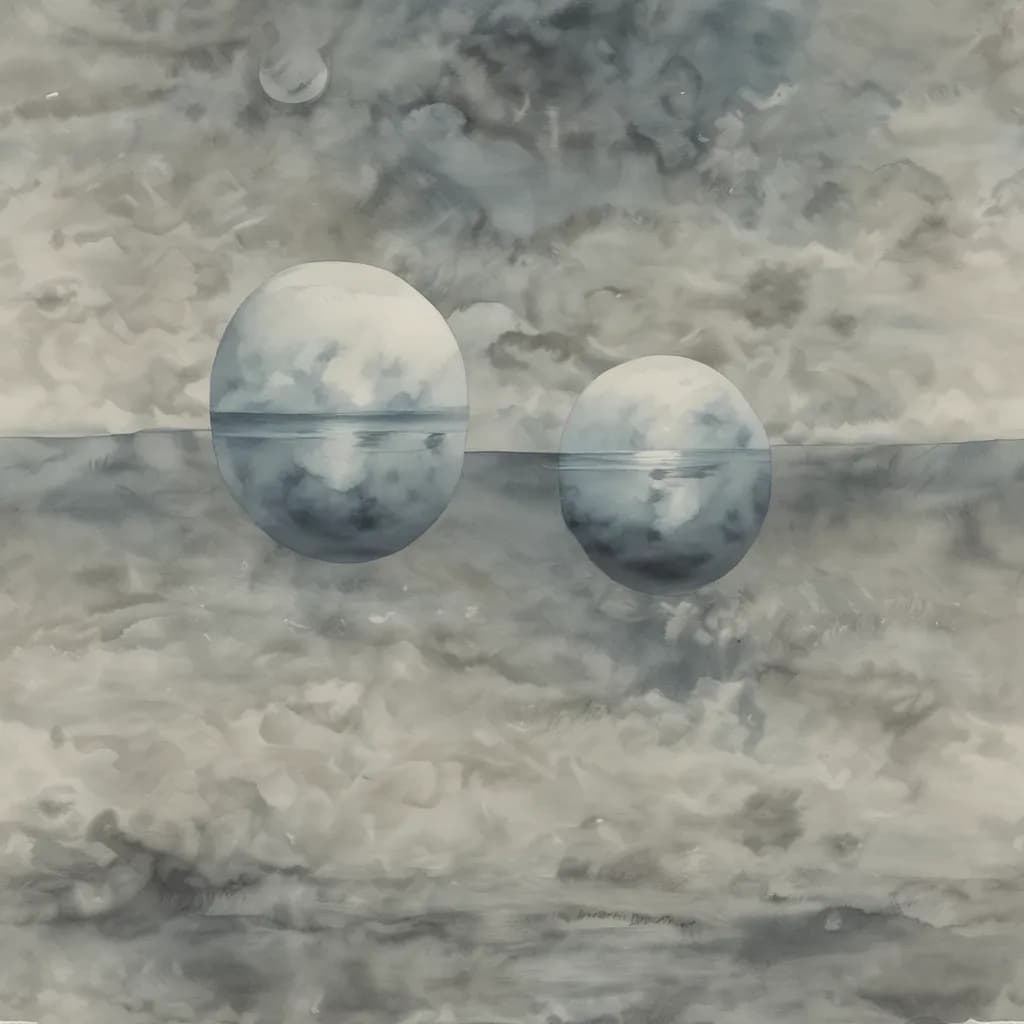
There are religions built on fear. The promise of hell, the weight of damnation, the cosmic ledger that tallies every transgression -- these are not just theological constructs but instruments of control, systems that keep the ungovernable in line. Death Grips' "Two Heavens," the third track on their 2013 record Government Plates, begins from a startling premise: what if none of that exists? What if there is no hell at all, only two heavens?
The question is not asked softly. In under three minutes, MC Ride (Stefan Burnett) delivers a compressed philosophical declaration rooted in centuries-old warrior philosophy, meta-commentary on his own vocal style, and the group's ongoing project of building a mythology entirely outside the reach of institutional control. It is one of the most concentrated moments in Death Grips' catalog: a track that manages to be about ancient Japanese swordsmanship, the architecture of moral fear, and the spiritual logic of total self-sovereignty all at once.
The Moment It Was Made
By late 2013, Death Grips occupied a peculiar position in music culture. The Sacramento trio -- MC Ride on vocals, Zach Hill on drums, and Andy Morin handling production and keyboards -- had survived a career arc that would have broken most acts.[1] After signing to Epic Records in 2012 and releasing The Money Store to widespread critical acclaim, they deliberately leaked their follow-up No Love Deep Web without label authorization, triggering their dismissal from the label. They founded their own imprint, Third Worlds, and made Government Plates entirely on their own terms.[2]
The album dropped without announcement on November 13, 2013, as a free download, with music videos for all eleven tracks uploaded simultaneously.[2] No press campaign, no singles, no conventional marketing. It arrived at a charged cultural moment: Edward Snowden's revelations about NSA mass surveillance had broken earlier that year, and the album title -- "Government Plates," referencing the unmarked vehicles of surveillance infrastructure -- read as both political metaphor and confrontational provocation.
The period was also defined by theatrical institutional confrontation. At a Lollapalooza afterparty, Death Grips failed to appear on stage; fans who arrived found pre-recorded music playing and, reportedly, a fan's suicide note projected overhead.[1] Crowd members destroyed what they believed was Hill's drum kit. The band later clarified it was a children's toy. Whether this constituted performance art, deliberate chaos, or both, it reinforced their identity as actors in an elaborate, ongoing confrontation with the music industry and its audiences.
Musashi and the Two-Sword Philosophy
The song's title and philosophical core draw directly on Miyamoto Musashi's seventeenth-century martial treatise, The Book of Five Rings (Go Rin No Sho).[3] Musashi developed a two-sword fighting style he called "Niten Ichi-ryu," which translates roughly as "Two Heavens as One," synthesizing offense and defense into a unified method. The treatise is organized into five books named for classical elements: Earth, Water, Fire, Wind, and Void.[3] A lyrical reference to the number five in the song connects directly to this structure, and the central declaration -- that the speaker inhabits two heavens with no hell at all -- maps the warrior's transcendence of fear onto a personal moral cosmology.
The underlying logic is elegant. Musashi's warrior philosophy held that the fighter who has genuinely made peace with death becomes ungovernable -- freed from the fear that makes most people controllable. MC Ride's version of this moves from the battlefield to the moral and spiritual realm. If you do not believe in hell, you cannot be threatened with it. If you cannot be threatened with damnation, the entire apparatus of behavioral control that religious institutions represent loses its grip on you.
Two heavens -- a doubled blessing in place of a binary moral universe -- is not just a theological position. It is a declaration of radical, unchallengeable interiority. To live in two heavens is to have burned away the fear that makes the threat of hell effective, and to have discovered, on the other side, not emptiness but surplus.
The Interior Turn in a Record About Surveillance
"Two Heavens" sits in productive tension with the album surrounding it. Government Plates is, at its surface, an album about external surveillance and institutional power -- government vehicles that watch without being watched, a panopticon that arrived at the culturally charged moment of the Snowden revelations. But "Two Heavens" makes the interior turn. Its question is not whether the government is watching you, but whether external observation, however total, can access the thing that actually matters.
The warrior who has transcended fear of death and damnation is not merely ungovernable in a political sense. He is ungovernable in the deepest sense: no external authority has jurisdiction over him, because the leverage point that authority requires -- the threat of punishment, the promise of reward -- simply does not apply. The two-heavens cosmology is also a two-heavens defensive posture. Ride arrives at the third track of this surveillance record and declares, in effect, that surveillance has nowhere to go.
This connects to the album's title song, "Government Plates" (also on this record), which establishes the surveillance framework through sonic and lyrical disorientation. "Two Heavens" answers it with a philosophical counter: the subject of surveillance who has reorganized their relationship to fear cannot be reached.
The Sonic Architecture
Musically, "Two Heavens" is built on a deliberately claustrophobic architecture.[4] Zach Hill's rhythmic approach cycles through a tripartite structure: pixelated, glockenspiel-like tones, aggressive tom strikes, and an atmospheric release -- then repeating.[3] FACT Magazine's reviewer described the song as driven by Hill's "erratic whims,"[5] while Tiny Mix Tapes characterized the result as "almost intentionally scary."[4] The groove does not so much develop as it accumulates pressure.
MC Ride's vocal delivery on Government Plates is notably more fragmented than on The Money Store, and "Two Heavens" exemplifies this approach. His syllables arrive heavy and deliberate, carrying maximum weight per word. Pitchfork's Best New Music review of the album noted that it seemed to provide "the power" while leaving listeners to "provide the politics" -- a description that fits "Two Heavens" precisely.[6] The song's pressure comes from the groove and the vocal weight, not from lyrical elaboration.
Reflexivity and Self-Mythology
"Two Heavens" is also unusually self-aware, even by Death Grips' standards. Its opening lines include a moment of meta-commentary in which Ride reflects on his own habit of rapping deliberately off-beat, acknowledging his "single-strike cadence slip" as a chosen stylistic technique rather than a limitation.[3] This self-referential move is consistent with the band's broader posture: they regularly fold awareness of their own mythologized persona into the work itself, making the art partly about the conditions of its own creation.
The song also contains a reference to Hella, Zach Hill's long-running math-rock duo that predates Death Grips.[3] This kind of internal cross-referencing reinforces the sense of Death Grips as a totalized creative system -- a project that absorbs and incorporates the full genealogy of its members rather than presenting itself as a band in the conventional sense. To reference Hella inside a Death Grips song is to remind the listener that the mythology runs deeper than the albums.
A Sample and Its Genealogy
"Two Heavens" samples "Drag Rap" (also known by the beat name "Triggaman") by The Showboys, a New York rap group from 1990.[7] The Triggaman beat became one of the most prolifically sampled rhythmic foundations in hip-hop history, forming the bedrock of the New Orleans bounce music scene through decades of reinterpretation. By incorporating it here, Death Grips situate "Two Heavens" within a longer lineage of confrontational Black American music that uses rhythm as a primary form of cultural assertion.
The genealogical thread runs from Sacramento experimental noise-rap to New York 90s rap to New Orleans bounce -- an unlikely but coherent lineage. The sample is not window dressing; it grounds the song in a tradition of music that takes confrontation and bodily presence as its organizing principles, and that has always operated in resistance to the systems it moves through.
Why It Resonates
Critical reception for Government Plates was divided along a predictable fault line.[8] Those who came expecting the dense lyrical assault of The Money Store found the album "a little defanged," in the phrasing of one Consequence of Sound reviewer.[8] But for listeners attuned to its logic, "Two Heavens" was among the most philosophically coherent moments in the band's catalog -- a brief, dense declaration delivered with the weight of total conviction.
The song's resonance extends beyond the Snowden moment in which it was made. The anxiety it addresses -- the sense of being watched, managed, and controlled by systems too large and diffuse to confront directly -- has only intensified in the years since 2013. "Two Heavens" offers no practical solution to surveillance or institutional power. What it offers instead is a philosophical position: the person who has genuinely transcended the fear of punishment cannot be governed through that fear. Which is, at minimum, a starting point.
Other Ways to Hear It
The Musashi reading is not the only available interpretation. The declaration of two heavens can also be heard as descriptive rather than philosophical -- not a position one arrives at through discipline, but an experience one finds oneself in. The doubled-heaven metaphor, on this reading, suggests an ecstatic present tense: not a future state to be earned but a current condition, the sense of already inhabiting the reward rather than deferring it.
This reading makes the song less about warrior philosophy and more about secular transcendence -- the experience of having burned away the internal censor, the self-monitoring function that fear produces, and of discovering that the other side of that burning is not emptiness but doubled abundance.
These readings are not mutually exclusive. Both describe a person who has reorganized their relationship to fear -- whether fear of death, damnation, or social judgment -- and found, on the other side of that reorganization, something unexpected and excessive. Two heavens, not one. The surplus of a life lived without the architectures of anticipated punishment.
Ungovernable
"Two Heavens" is three minutes of Death Grips at their most compact and philosophically precise. The album title that frames it may be about surveillance and external power, but this track goes somewhere more personal: the question of whether any external authority, governmental or divine, has actual access to the interior life of someone who has genuinely relinquished the fear that makes control possible.
Miyamoto Musashi spent decades developing his two-sword style and his treatise on strategy. The organizing insight was austere: master yourself completely, and external adversaries become a secondary concern. MC Ride arrives at something parallel from a different direction, through the logic of a moral cosmology that refuses hell. What remains, in both cases, is the same: two heavens, and nothing to fear.
Government Plates was released in a year when the idea of ungovernable privacy felt urgently relevant. It still does.[6]
References
- Death Grips - Wikipedia — Band biography including the Epic Records saga and Lollapalooza incident
- Government Plates - Wikipedia — Overview of the album's recording, release, and critical reception
- Two Heavens - Death Grips Wiki (Fandom) — Song-specific details including Musashi reference, Hella mention, sample identification, and cadence commentary
- Government Plates Review - Tiny Mix Tapes — Describes Two Heavens as claustrophobic and almost intentionally scary
- Government Plates Review - FACT Magazine — Critical review describing Hill's erratic rhythmic approach and the album as vital
- Government Plates Review - Pitchfork (Best New Music) — Best New Music review noting the album provides the power while listeners provide the politics
- Two Heavens - WhoSampled — Identifies the Drag Rap / Triggaman sample by The Showboys
- Government Plates Review - Consequence of Sound — Roundtable review with divided opinions on the album's sparse approach