USA
Most albums ease the listener in. Post- opens with a few seconds of a friendly voice, and then "USA" arrives like a door kicked open: seven and a half minutes of anger, fatigue, suspicion, and, somewhere near the end, a strange and tentative togetherness.[1][2] It is the kind of song that sounds like a speech someone rehearsed in the car and then delivered anyway.
Jeff Rosenstock has described the record as one about feeling betrayed and bullied, and he has said he tried to keep it from becoming hyper-political.[2] "USA" is where that balancing act is most visible. It is plainly about a country, yet it keeps returning to small, human-sized scenes. The result is less a protest song than a portrait of a person trying to work out who is on the other side of the fence.
A song written in the wreckage
Rosenstock was already a veteran of the DIY punk world by the time this song appeared. Born in 1982 and raised in Baldwin, Long Island, he started his first band in the mid-1990s and then spent years fronting Bomb the Music Industry!, a group that gave its music away and helped define a donation-based, anti-careerist ethos.[4] He also founded Quote Unquote Records on the same principles.[4] His solo breakthrough came with Worry. in 2016.[1][4]
The material for "USA" took shape in the shadow of that period. Rosenstock has said that about half of Post- was partly written during the Worry. era, and that the other half came together right after the 2017 inauguration, in the mountains upstate.[2] Much of it was written in the Catskills, in a friend's trailer, with a notebook and with the internet and social media on his phone deliberately switched off.[1][3] That retreat followed a trip to Washington, D.C. to protest the inauguration and to attend the Women's March.[1]
There is an odd footnote to the song's creation. An earlier version had been recorded on a digital recorder that was stolen during a stop on a San Francisco tour. Rosenstock has joked that the lost lyrics were probably bad, and that losing them was a kind of favor.[1] It is a small reminder that the finished piece is a rewrite, made with a clearer head and a quieter room.
Three movements, one mood
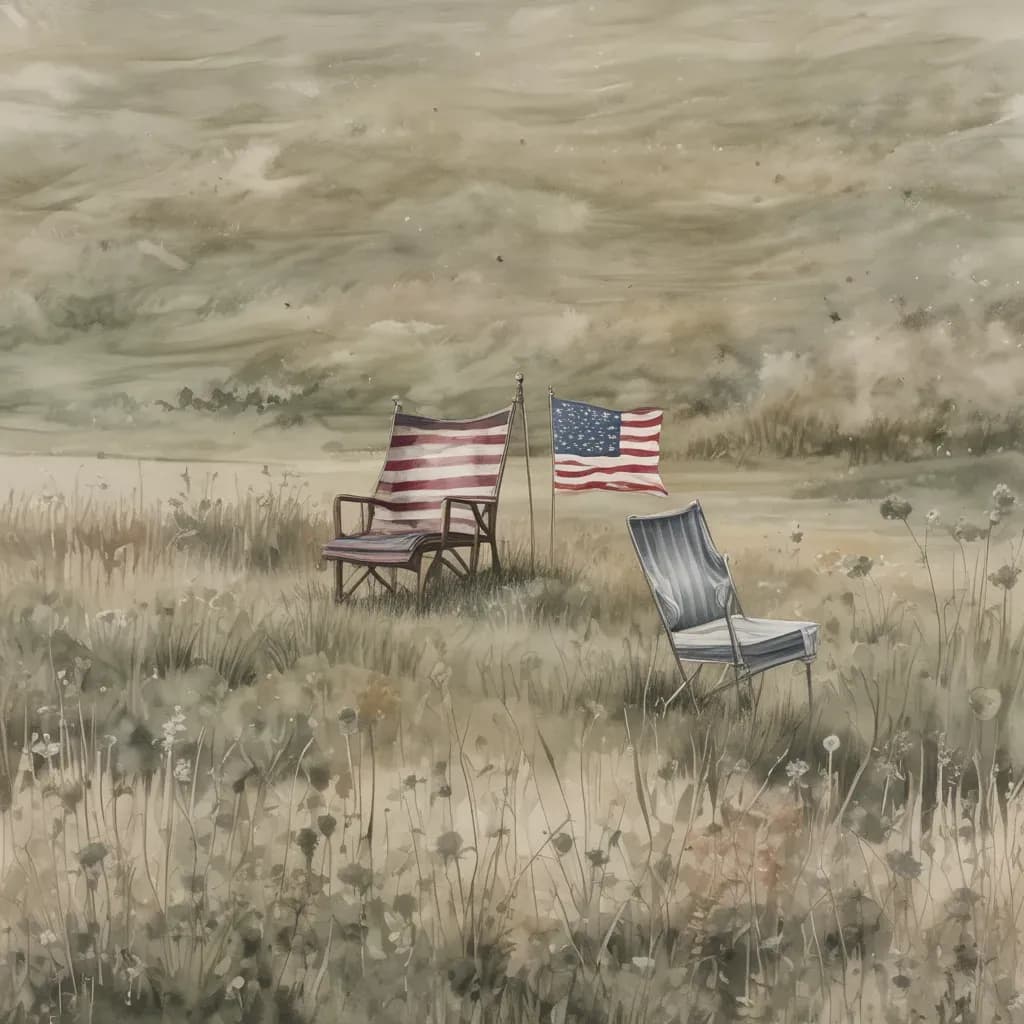
The structure of "USA" tells the story as much as any description of its words. It begins with a furious, fast-moving section. It then dissolves into a long, ambient passage in the middle, broken up by a weary, repeated mantra about exhaustion and boredom. Finally it swells back into a rallying cry with handclaps and cheerleader-style chanting.[2]
That shape mirrors a recognizable emotional cycle. First comes the shock and the rage. Then comes the numbness, where outrage curdles into a flat, spaced-out tiredness. Last comes the weak, stubborn impulse to gather anyway. Rosenstock has said that the spacious middle came from his first serious attempt to leave room in the music, an idea that began as a plan for an ambient record with punk in the middle and ended up the other way around.[1][5]
The placement of such a sprawling track at the front of an album was a choice he acknowledged as unusual. He called it a weird one to put first, and compared its ambition to the suite of connected songs that closes Worry.[2] In that sense "USA" is both an overture and a thesis statement: a record that will not stay in one register for long.
The promise that went sour
At the heart of the lyric is the language of the American promise. The chorus describes being offered something grand, a sky full of possibility, and finding that the reward is tiredness and boredom.[1] It is a compact, almost deflating way to describe a generation raised on the idea of upward motion and handed stagnation.
This is where the song sidesteps simple partisanship. The narrator is not only angry at a politician or a party. He is looking at neighbors, at ordinary families in ordinary cars, and wondering which of them cast the vote that changed everything. He asks them, in effect, to be honest about it.[1] The tension is intimate rather than abstract. The enemy might be anyone you pass on the highway, and the possibility of that is its own kind of injury.
Track Seven's Jade Curson called the song a tirade of bewilderment, exhaustion, and betrayal, and labeled the album a post-Trump, post-2017 record.[5] That reading fits the emotional weather of the piece, though Rosenstock himself has been wary of being pinned to a single administration. He told the same interviewer that he did not want to keep talking about the president and would rather focus on policy and the coming midterm elections.[5]
"Et Tu, USA" and the final chant
The song's title has its own small story. Rosenstock initially planned to call it "Et Tu, USA," a reference to the famous line of betrayal attributed to Caesar, and then shortened it because the longer name sounded like a bit much for the first track on a record.[1] The original title is still the key to the finale.
Late in the song, a crowd of voices takes up a chant that many listeners heard as a profane brush-off aimed at the country. Rosenstock clarified that the chant is actually the abandoned title, the betrayal question, shouted in unison.[1] The ambiguity is the point. A single sound can be read as contempt or as heartbreak, and the song allows both. Being betrayed by something you love is not so different from hating it.
The shout is also communal. Backing vocals and claps on the record came from friends and collaborators, including Laura Stevenson, Chris Farren, and members of PUP.[3] That sense of a room full of people, rather than a lone narrator, softens the despair. The song ends with a group, not a loner.
Recording a feeling quickly
The sessions were fast. Right after Thanksgiving in 2017, Rosenstock and his band recorded in the Bay Area in a marathon 86-hour session.[2] The record was made primarily at Atomic Garden Studios in Palo Alto, with additional recording in Brooklyn and in East Durham, New York, and Jack Shirley handled recording, production, and mixing.[3]
The speed matters to how the song feels. There is a rawness to the performance that suits a piece about being too tired to be polite. Then there was the release itself. Rosenstock planned all along to drop the album without warning on January 1, 2018, as a kind of benediction after a strange year.[2] It arrived free to stream and pay-what-you-want to download, with ten percent of digital proceeds going to relief efforts in Puerto Rico.[1][3] Even the way the song reached the world echoed the generous, anti-industry approach of his earlier bands.
Other ways to hear it
A political reading is the obvious one, and it is supported by the timing and by the interviews. But the song can also be heard as a personal reckoning. Rosenstock was entering his mid-thirties, a touring musician who had built a life in a scene that prizes community, and the sense of watching that shared optimism get tested is arguably as much a subject as any election.
There is also a more existential version. The song can be taken as a portrait of anyone who gave years of effort to an institution, a country, a scene, or a relationship, and then found it hard to recognize. Stripped of the specifics, it is about the dizzy moment when you realize that the thing you trusted may not have been looking out for you.
A third approach focuses on the music over the message. The long ambient gap in the middle is not only a mood piece. It forces the listener to sit inside the fatigue without the relief of a hook. Many punk songs rage and then end. This one lingers in the aftermath, which is arguably where the real emotional work happens.
Why it keeps resonating
Post- earned strong reviews, with an aggregate score of 88 on Metacritic, and it topped Billboard's Heatseekers chart.[3] But the lasting appeal of "USA" is less about statistics than about tone. It does not offer a clean ideological slogan. It offers a mood that millions of people recognized: anger that has worn down into exhaustion, and the odd, stubborn hope that shouting together might still accomplish something.
Rosenstock closes the song not with a solution but with a gathering. That is the honest, modest ending the previous seven minutes have earned. The country has let him down, he seems to say, and he is still here, with friends, making noise about it. For a listener worn out by the news cycle, that may be the most useful form of consolation a song can offer.
References
Keep reading
More Punk Rock
- Constant Headache Joyce Manor
- Perfect Mannequin Pussy
- Go (Carnaval De Luz) U2
- Silencio U2
- Disorder Joy Division
- Dig Me Out Sleater-Kinney