Warmest Shade Of Blue
Most love songs look outward. They study the other person, replay an argument, or count the hours until a phone rings. "Warmest Shade Of Blue" by Snoh Aalegra does something rarer for a singer so closely associated with romantic ache. It turns the lens around and looks at the narrator herself, and what it finds is not a catastrophe but a surprising calm.
The song sits on Legendary Love, an album about a relationship and the person it forced her to become. This track is where she steps out of the story for a moment and simply looks in the mirror.
Where the song comes from
Legendary Love arrived on November 13, 2026, after roughly two and a half years of writing and recording.[2] Aalegra has framed the project around a connection she describes as a dated karmic bond that never fully materialised.[2] Her own summary of the album is the clearest statement of its purpose: she does not think the greatest love stories are measured by how long they last, but by who they ask you to become.[2]
That idea matters for this song. If a love story is measured by transformation, then a track about self-perception is not a detour from the album's subject. It is the subject, seen from the far side of the experience. Clash, announcing the record, pointed to it as the opening of a later chapter in her career, and a reflective song fits that mood.[3]
"Warmest Shade Of Blue" was written by Aalegra with Compass (Joel Compass, who is also credited as producer and musician) and Ethan Gruska.[1] A music video accompanied the release, which one listing dates to November 10, three days ahead of the full album.[1] Aalegra, who grew up in Sweden and is of Persian heritage, has long made records that treat heartbreak as cinematic material, so a quieter, more inward track gives the album a different register.[2]
The record's most contemplative moment
The one piece of direct commentary available about the song comes through its description as the most contemplative track on Legendary Love.[1] According to that account, the song is anchored by a particularly sharp memory, one in which the singer saw herself with unusual honesty.[1] She did not flinch at the flaws. Instead, she felt peaceful about the parts of herself she normally keeps out of view.[1]
That is a more unusual emotional beat than it might sound. Pop and R&B are full of songs about self-loathing and full of songs about self-confidence, and the two tend to be treated as opposites. This song sits between them. It is not a boast and it is not a confession of shame. It is acceptance, the quiet feeling of recognising yourself and deciding that what you see is allowed to stay.
She has also said she is glad she managed to capture that feeling in a recording.[1] The remark is telling. Moments of clear self-acceptance are fleeting for most people, and the act of putting one on tape turns a passing mood into something she can return to.
What the words describe
Lyric sites that carry the song break it into a short sequence of moods rather than a story with plot. It opens in an unfamiliar place, reached after a long absence, with the narrator moving through her days in a half-awake haze. She senses that something inside her is shifting, and she is more curious about it than frightened.[8]
The turn comes quickly. She admits she is losing her bearings, then admits, with some surprise, that she likes it. Being lost stops looking like failure and starts looking like relief, and she considers simply staying where she is.[8] Anyone who has left a long, consuming relationship may recognise that strange permission. For a while nobody expects anything from you, not even you.
The central image is a walk along anonymous roads where she belongs to no one in particular. She feels she has finally grown into an identity that fits, and she is aware that others read her as distant and icy. The title then does its correction: underneath the cool surface, she says, the opposite is true.[8]
A later passage sets a condition. She tells a would-be comforter to keep their soothing touch unless they truly mean to understand her, and she says the only thing that could disturb her new peace is her own past mistakes, not other people.[8] That detail keeps the song from sliding into easy self-help. Her calm is real, but it is guarded, and tenderness has to be earned rather than simply offered.
The refrain and chorus return unchanged at the end. Nothing is resolved because nothing needed to be. The song ends where it began, in a settled mood that has become a place to live.[8]
A song in an eighties room
The setting matters as much as the words. Legendary Love moves away from the neo-soul of her earlier records toward the polished sophisti-pop of the 1980s, with synths, drum machines and guitars recorded on gear from that decade.[4] Aalegra has said the love at the album's centre brought her back to the music she fell for growing up, with the same longing, romance and nostalgia that first made her dream of being an artist.[2]
Critics were split on how well that approach holds up. The Line of Best Fit felt the second half of the record leans on nostalgia as a formula, but singled out this track as one that largely succeeds, an unabashed eighties sound that still feels contemporary.[4] That Love Podcast heard the later songs as more varied in where they find warmth, and said this one turns inward, grouping it with "Karma" as a place where less settled feelings get room.[5] Ratings Game Music scored it four out of five.[7]
There is a fitting match between form and subject here. A blurred, glowing production is a natural home for a song about drifting through unfamiliar streets and feeling comfortable there. The sound itself is a kind of warm blue.
Blue as a temperature, not a mood
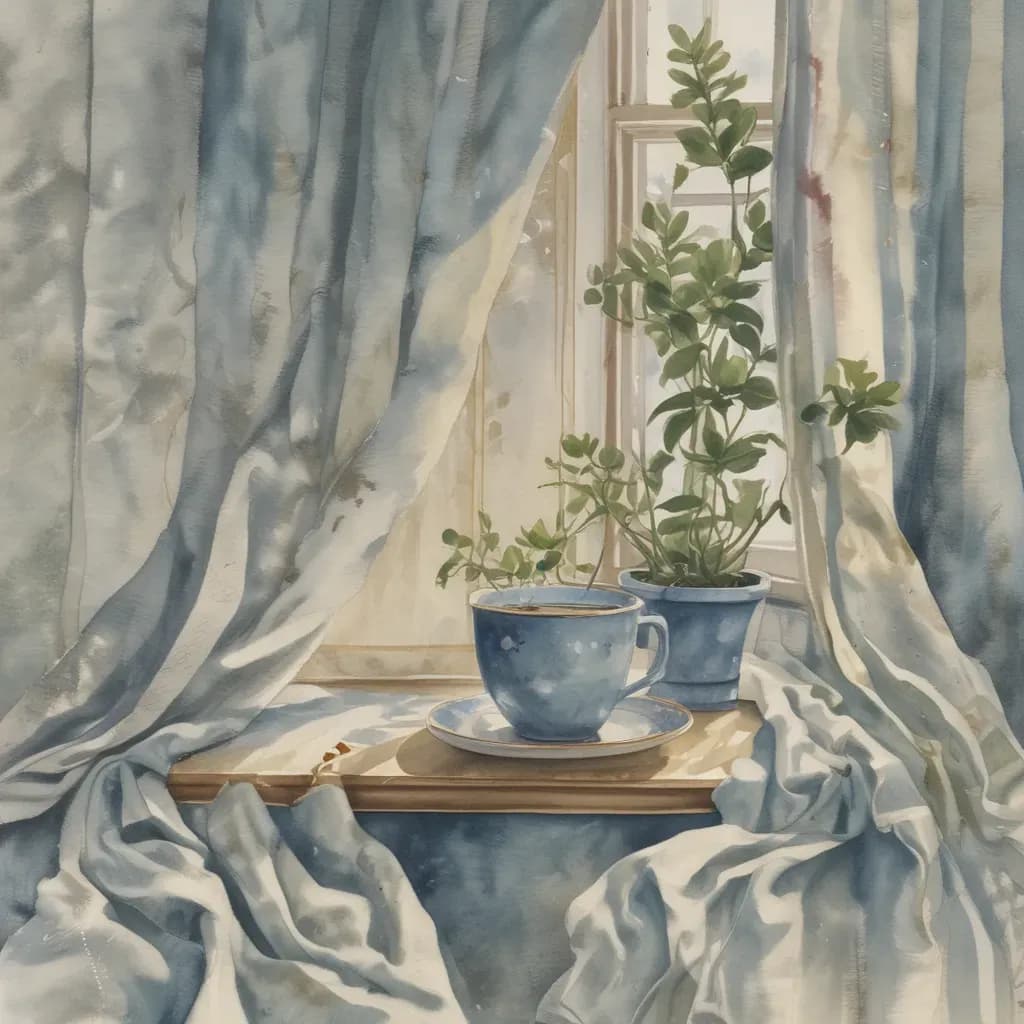
The title does its work before the music starts. In English, blue is the colour of sadness, and Aalegra's catalogue is deeply associated with feeling too much. Yet blue is a cool colour, and the title pairs it with warmth, setting two opposing signals against each other.[1]
That tension is the heart of the song's meaning. The narrator is describing a kind of sadness that has become gentle. It is blue without being cold. Where heartbreak songs tend to treat melancholy as an injury, this one treats it as part of her natural colouring, something that makes her who she is rather than something wrong with her.
The framing also carries a small joke. Aalegra has described herself as someone whose default expression can read as aloof, and the title answers that impression with a gentle correction: whatever the surface suggests, the temperature underneath is warm.[1] It is a self-deprecating way to say something tender, which suits an artist who has always paired vulnerability with composure.
Self-portrait after a relationship
Placed within the album, the song becomes a kind of aftermath. The larger narrative of Legendary Love concerns a bond that shaped her without ever fully taking shape.[2] A person who has been through that often emerges unsure of how much of herself was real and how much was performed for the relationship.
Read that way, the moment of honest self-recognition is a form of recovery. The narrator is no longer defining herself through someone else's attention. She is looking directly, noticing what is there, and finding it bearable, even likeable. Many listeners will recognise the feeling of catching your reflection on an ordinary day and realising you are no longer at war with it.
The Line of Best Fit's coverage of the album quoted Aalegra saying that every song holds a piece of who she was and who she became.[2] "Warmest Shade Of Blue" seems to be the piece that belongs to the second half of that sentence, the person who emerged.
Aalegra has told NPR that this love had no true beginning or ending, that it felt ancient and karmic, and that she sometimes wonders whether it happened at all or whether she dreamed it up.[6] A song about not quite knowing where you are, and being at peace with that, belongs naturally beside such a story.
Why it resonates
Songs about self-acceptance are easy to get wrong. They can sound like affirmation posters, or like a lecture. The strength of a track like this lies in its restraint. It describes a feeling that is small and specific, a flash of clarity and the calm that follows, and trusts the listener to supply the rest.
It also speaks to a particular kind of person: the one who is read as guarded, cool or unreachable by strangers, and who knows that the reading is wrong. Plenty of people carry a face that suggests distance while feeling warmth underneath. Hearing that mismatch named, lightly and without defensiveness, is a relief.
For an artist whose public identity has been built on longing, there is something quietly bold about releasing a song whose emotional payoff is contentment. It widens what a Snoh Aalegra song is allowed to feel like.
Other ways to hear it
One reading treats the song purely as a love song in disguise. The calm self-image might be the result of being truly seen by a partner, so that her acceptance of herself is borrowed from someone else's acceptance. In that interpretation, the warmth in the title is the warmth of being loved well.
Another reading is more solitary. The sharp memory at the song's centre may have nothing to do with a partner at all, and the calm may be something she arrived at alone. The album's own framing, which treats love as a force that changes you rather than a prize you win, supports this version.[2]
The reviewers' language points to a third reading. That Love Podcast describes the album as being about interpreting what remains after a relationship, not only the heartbreak itself.[5] On that view the song is less about self-portraiture than about inventory, the quiet counting of what survived.
A caution is worth stating plainly. Aalegra has said little about this specific track, and the lyric reading above comes from published lyric text rather than from her own explanation. Any interpretation beyond the broad outline is just that, and listeners may well hear something different as more interviews appear.
Conclusion
"Warmest Shade Of Blue" is a song about seeing yourself clearly and not looking away. Its power is in the contradiction of its title, a cool colour described as warm, a sad word described as comfortable. In the context of an album about the person a love story asks you to become, it works as a quiet portrait of the result: someone who has been through something large, and who can now look at her own reflection with something close to affection.
References
Keep reading
More by Snoh Aalegra
More R&B
- Purple Rain Prince
- 1999 Prince
- Little Red Corvette Prince
- When Doves Cry Prince
- Raindance Dave
- The Thrill Is Gone B.B. King