Warping
The Unraveling
There is a particular kind of dread that comes not from sudden catastrophe but from gradual dissolution. The sensation that your edges are softening, that the boundaries between self and noise are becoming negotiable. "Warping" by Death Grips is a song about exactly that: the slow, methodical collapse of coherent identity under pressure from within and without. It is one of the most deliberately paced tracks in the band's catalog, and that slowness is the point.
Track four on Bottomless Pit (2016), "Warping" runs just under three minutes, but it does more psychological work per second than most songs manage in five. MC Ride's vocal delivery is uncharacteristically restrained here, measured and almost hypnotic compared to his usual cataclysmic screaming. The production warps and lurches beneath him. The word in the title is not metaphor; it is diagnosis.
Return from the Void
To understand "Warping," you need to understand where Death Grips were when they made it. In July 2014, the Sacramento trio, consisting of Stefan Burnett (MC Ride), drummer and producer Zach Hill, and keyboardist Andy Morin, announced their breakup on Facebook. "We are now at our best and so Death Grips is over." They simultaneously dropped their double album The Powers That B into the void.[1]
The announcement was never entirely convincing as a genuine ending. By early 2015 the band signaled a return. They announced a world tour. They began recording new material. When they formally announced Bottomless Pit in October 2015, they did so through footage of Karen Black, the actress who had died in August 2013, reciting lines from a screenplay by Zach Hill. The posthumous messenger made the announcement feel less like a press release and more like a transmission from somewhere outside linear time.[2]
In March 2016, ahead of the album's release, the band conducted what they called "Interview 2016": a 32-minute video in which they sit with an interviewer while all audio from the actual conversation is stripped out, replaced with instrumental music. You watch mouths move. You hear nothing that was said. The message about the band's relationship to explanation and transparency was abundantly clear.[3]
The album leaked from the band's own SoundCloud on April 29, 2016, a full week before its official release date. Given the band's history of strategic self-sabotage (they were dropped from Epic Records after deliberately leaking No Love Deep Web without label permission), the accidental quality of the SoundCloud leak strained credulity.[2] The whole promotional cycle for Bottomless Pit was a lesson in controlled chaos, and that spirit permeates "Warping."
The Shape of Losing Shape
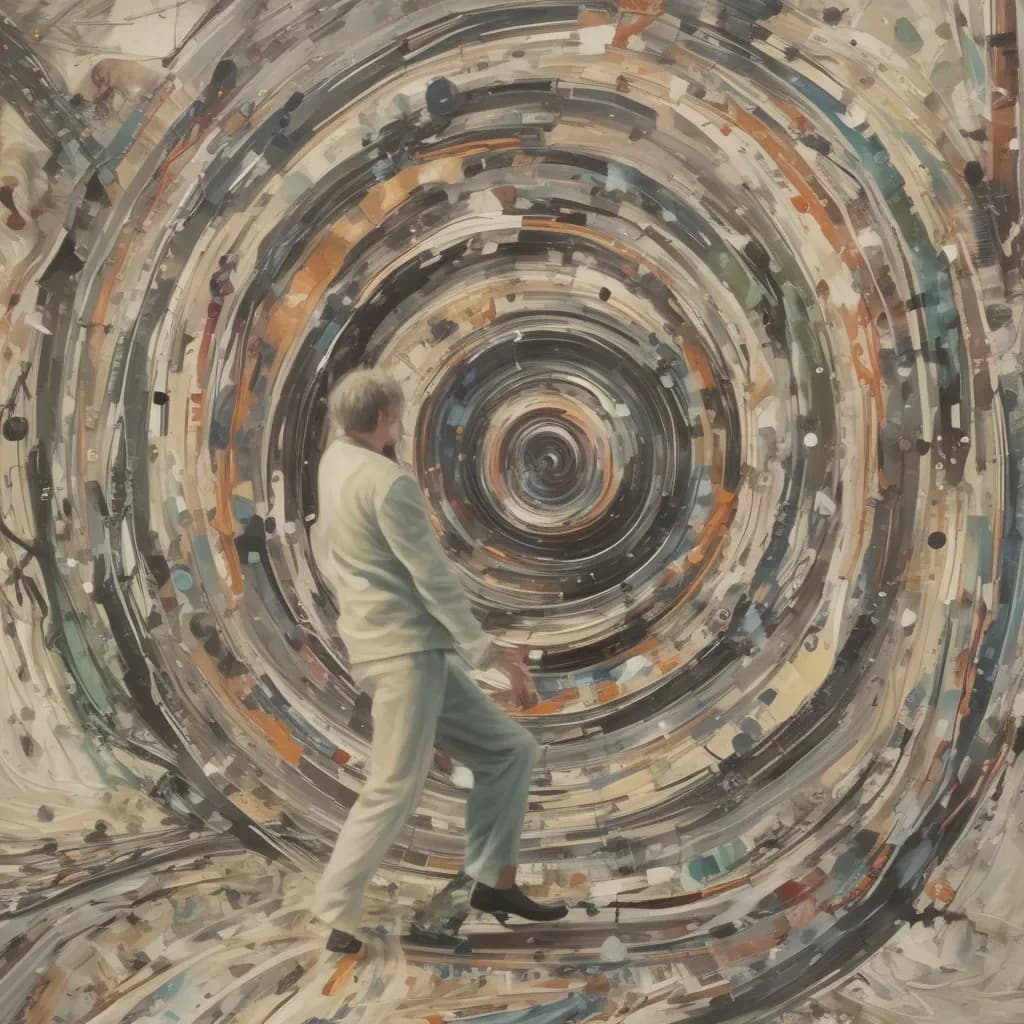
The most immediate thing about "Warping" is its sound. The production opens with what one reviewer described as eerie synth ribbons, a texture that recalls the unsettling introductions of horror soundtracks before the chaos begins.[4] High hats arrive and the beat lurches into something deliberate and slightly off-kilter, as if the track itself is losing its structural integrity while you listen to it. The sonic environment literally warps. The production does not merely describe the theme; it enacts it.
Pitchfork described MC Ride's performance across Bottomless Pit as his most athletic to date, and on "Warping" specifically noted the sensation of him "howling out in agony as the machines draw and quarter him."[5] The phrase is apt. There is a quality to this track where Ride sounds less like a performer delivering a song and more like a transmission from someone being taken apart by the systems they inhabit.
At the core of the song is the conceit of form itself collapsing. The narrator describes losing his groove, losing his form, the patterns and grooves that define a coherent self (or a coherent performance, or a coherent record) breaking down under accumulated pressure. The chorus functions as both confession and warning. "Warping" is what happens to things that have been subjected to heat or stress for too long.[6]
Distance, Violence, and the Cockpit Perspective
Critics and analysts have read "Warping" as exploring a specific and chilling perspective: the detached vantage point of someone conducting violence from a safe remove.[6] The imagery in the song has been interpreted as depicting a pilot, high above, watching the consequences of war play out far below, insulated from physical danger and, perhaps, from moral weight. The distance is not merely geographical. It is psychological, technological, ontological.
This reading slots perfectly into one of Death Grips' most persistent preoccupations: the way technology creates what you might call violence without proximity. The same impulse that animated their engagement with surveillance, social media, and institutional power across their catalog surfaces here in a more visceral, militarized form. Drone warfare, remote killing, the gamification of destruction through screens and interfaces, these are not explicitly named, but the architecture of the song suggests them. You can be the agent of catastrophic consequence without experiencing it. That is warping too.
Alongside this, the song is loaded with imagery that collides the primal and the contemporary.[6] References to a shaman's drawl and toothless, ancestral speech sit against imagery of psychotropic steel traps and technological entrapment. The juxtaposition is not decorative; it suggests that the mechanisms of control and altered consciousness have always existed, that what changes is only the form they take. The shaman and the drone operator are both in altered states. Both are instruments of something larger than themselves.
Where It Sits in the Album's Architecture
Spectrum Pulse noted that Bottomless Pit attacks multiple targets simultaneously: casual listeners, obsessive fans, and critics alike, while tracing something like a war narrative across its thirteen tracks.[7] "Warping" arrives at track four, early enough to feel like the album's interior is still forming, and its placement matters. The song functions as a moment of deliberate deceleration, a held breath, between more chaotic material. It is the eye of something.
Critically, the album was received as a return to form and a synthesis of the band's strongest impulses.[5][8] Where Jenny Death had leaned heavily into noise rock and The Money Store into textured electronic production, Bottomless Pit synthesizes both. "Warping" captures this synthesis in miniature: the production is dense and synthetic but organized around a rhythmic logic that Hill's drumming has always implied even without being explicitly present.
The Coog Radio reviewer who gave the album a 9.2 described "Warping" as containing "some of the darkest lyrics appearing in the album's forty minutes" and called MC Ride's overall performance on the record arguably the best of his career.[4] That praise is not incidental. Ride's restraint on this particular track is what makes its darkness land. Screaming everything turns everything into white noise. Speaking quietly about disintegration is something else entirely.
Why It Resonates
Death Grips occupy a peculiar position in contemporary music. They are genuinely avant-garde in their refusal of accessibility, and yet they have accumulated a vast and deeply engaged fanbase, many of whom are young people who find in the band's work an articulation of experiences that mainstream music cannot reach: dissociation, institutional violence, the texture of existing in an information environment that corrodes coherent selfhood.
"Warping" resonates because it takes that experience seriously at the level of form. The song does not just describe losing shape; it performs it. The lurching beat, the eerie synths, the measured vocal delivery that sounds like it might break into something terrible at any moment, all of it enacts the condition it names. You do not just listen to the song. You feel the warping begin.
In an era of algorithmic feeds, drone programs, remote work, and the constant mediation of experience through screens, a song about losing your form while the machines around you continue humming has aged into something uncomfortably current. Death Grips made it in 2015 and 2016, but the condition it describes has only become more pervasive. The warping has, if anything, accelerated.
Other Ways of Hearing It
The detached-violence reading is compelling, but it is not the only one. Listeners with experience of mental illness, addiction, or severe dissociation have noted that the song maps onto those experiences with uncomfortable precision. The imagery of being unable to hold a form, of rhythms and grooves slipping away, of inhabiting a body that no longer quite tracks with the environment, these are not only metaphors for techno-mediated warfare. They are descriptions of certain interior states.[6]
There is also a self-referential meta-level reading available. Death Grips had, in a sense, warped themselves out of existence in 2014 and then back into it in 2015. MC Ride is singing, on one level, about what it means to be an artist whose identity and form are perpetually in question, perpetually subjected to dissolution and reconstitution. The narrator losing his grooves is also a musician whose relationship to his own creative output is genuinely unstable.
The song resists any single frame. That resistance is characteristic. Death Grips have always been more interested in generating productive confusion than in supplying answers. "Interview 2016" was a 32-minute long joke about the impossibility of explaining what they do.[3] "Warping" is the musical equivalent: a song that gives you an intense, coherent experience while remaining committed to its own opacity.
The Form Holds, Barely
For a song about losing form, "Warping" is remarkably held together. It does not collapse. It threatens to collapse, and that sustained threat is what makes it so effective. By the time it ends, Ride and the production have walked right up to the edge of disintegration and then pulled back, slightly, just enough to remain a song.
That is the album's larger achievement, too. Bottomless Pit is Death Grips at their most structured, which is still considerably more chaotic than most of contemporary music, but the structure matters. The pit is bottomless only if there is a rim to look down from.[5]
"Warping" stands near the top of the album's achievement because it demonstrates something that aggressive music rarely allows itself: that restraint, properly deployed, can be more unsettling than noise. The machines are still running. The form is still, technically, intact. But something is very wrong. The grooves are slipping. The shape is going.
References
- Death Grips - Wikipedia — Band biography, discography, and career timeline
- Bottomless Pit - Wikipedia — Album history, release context, and track listing
- Death Grips Interview 2016 - Complex — Coverage of the silent video interview released ahead of Bottomless Pit, illustrating the band's media-averse approach
- Album Review: Bottomless Pit by Death Grips - Coog Radio — Detailed track-by-track review with specific analysis of Warping's production and lyrical content
- Bottomless Pit Review - Pitchfork — Pitchfork 8.1/10 review with analysis of individual tracks including Warping
- Warping: Decoding the Chaotic Reality - Song Meanings and Facts — Thematic analysis of Warping including the detached violence and identity collapse readings
- Album Review: Bottomless Pit - Spectrum Pulse — Critical review noting the pacing and thematic weight of Warping within the album
- Review: Death Grips Bottomless Pit Sounds Like No Punk on Earth - Rolling Stone — Rolling Stone review of the album
- Death Grips Reveal Bottomless Pit Release Date and Lyrics - Stereogum — Coverage of the pre-release lyrics ZIP and album announcement details