Alone
A song can open an album, and a song can open a concert. The Cure's "Alone" did both, and neither time did it hurry. For more than three minutes nobody sings at all. Guitars blur and swell, synthesisers move like weather, and the band takes its time arriving at the first word.[1][2] By the time Robert Smith's voice finally enters, the listener has already been told what kind of room this is: large, dim, and built for grief.
Now the song has a third home. On The Hunger Games: Sunrise on the Reaping soundtrack, a live recording titled "Alone (Live in Berlin 2022)" closes the record as track 29 of 29.[3] It is an odd, fitting place for it. A franchise about children sent to die for a nation's entertainment ends its latest musical collection on a seven-minute meditation on endings.
Where the song came from
Smith wrote "Alone" in 2019, during sessions for what was then a working album called Live from the Moon.[1] He has said he wanted to write about loneliness, but his early attempts struck him as flat and unpoetic. The breakthrough came when he went looking for the right opening line for the right opening song, and found one in a journal where he collects phrases: a reworking of the late Victorian poet Ernest Dowson's "Dregs."[1][4] The first verse leans heavily on that poem, and Smith later said the track was the one that unlocked the whole record. Once it was finished, he knew it was the opener, and the rest of the album came into focus around it.[4]
That album became Songs of a Lost World, released on 1 November 2024, the band's first full-length since 4:13 Dream in 2008.[1] "Alone" arrived five weeks earlier as the lead single, the first new Cure song in sixteen years.[1][2] The wait had been long enough that the band had already been playing it for two years. It debuted live on 6 October 2022 in Riga, the first night of the Shows of a Lost World tour, and it opened every show on that run.[1] The Berlin recording on the Hunger Games soundtrack comes from that same tour.[1][3]
The sound of a long approach
It helps to describe how the song moves, because the structure is part of the meaning. It runs 6 minutes and 48 seconds, and the instrumental introduction alone takes up more than half of that on the studio recording.[1] The pace is stately, even funereal, and Irish Times critic Ed Power heard it as less a rowdy comeback than a calm resetting of the band's terms.[2] Smith had described the album in advance as a "big wash of sound", and Power thought the phrase fitted this opening perfectly.[2]
The ingredients are familiar to anyone who knows the band's darker records: drums that circle rather than drive, distorted guitar, orchestral keyboards, and a triplet figure on piano and guitar that keeps the whole thing faintly unsteady.[1][4] Critics reached for Disintegration and especially its "Plainsong," as well as the bleak Pornography and Bloodflowers.[1] Others heard a link to the late David Bowie and the opening of Blackstar, another album made in the shadow of mortality.[1] The Guardian's Alexis Petridis and others placed it among the band's twenty greatest songs.[1]
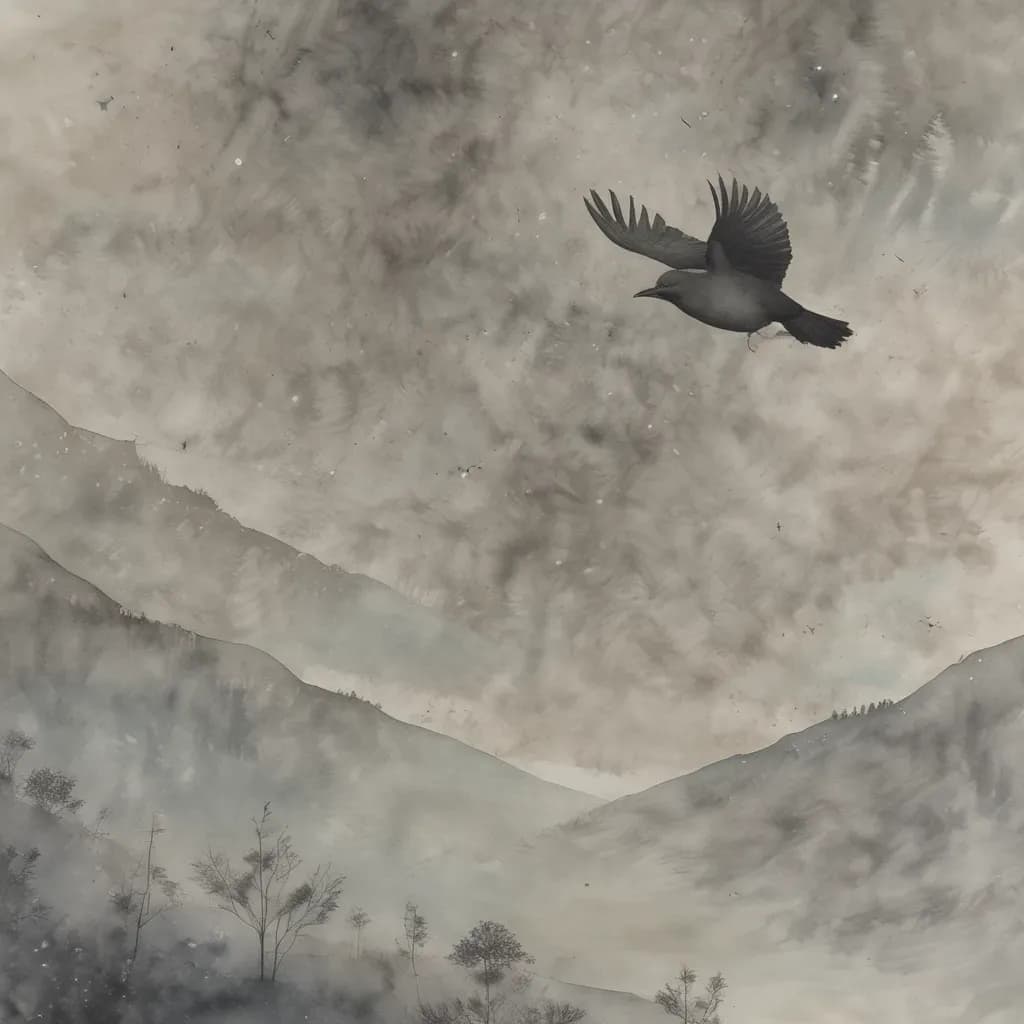
Something else is going on in that long instrumental, though. It performs the thing the song is about. A listener sits inside the sound for minutes before any human voice appears, and when the voice does come, it is fragile, layered with reverb, and seems to speak from some distance.[2][4] The music gives you isolation as an experience before the words name it.
Loneliness as a shared condition
The central idea is loneliness, and Smith has said as much. But "Alone" does not stage loneliness as a private misfortune. Its governing thought, as critics have read it, is closer to a law of existence: everything we make and everything we feel is ultimately carried by one person, and that is true even of the things we make together.[1][4] The line Smith took from Dowson's poem is a statement of this kind, and it sets the tone for everything that follows.
That is why the song can feel comforting despite being so dark. Ed Power's Irish Times headline called it a huge aching sigh of darkness that brings great comfort, and the comfort is real.[2] A song that tells you that you are alone, and tells you in a voice shared by thousands of people in a darkened arena, makes loneliness into something communal. The paradox is central to the Cure's appeal and has been since the band's earliest records.
The imagery that Smith adds to the Dowson material points the same direction: birds that fall from the sky, dreams that are dashed, a world that has lost its warmth and light.[1] The scene is not a breakup. It is a wider emptying out, as if the song's narrator has watched a lifetime of colour drain from the landscape and is trying to say so as gently as possible.
Age, time and the weight of loss
Smith was around sixty when he began the song. It is not hard to hear the passing of time in it, and several critics did. Emma Rayder, writing in Atwood Magazine, drew out themes of ageing, lost youth and love that is fading while the singer still holds on to it.[5] She also pointed back to Smith's 1989 remark that the heart of Disintegration was the horror of losing the ability to feel deeply as you grow older.[5] "Alone" can be heard as that same fear, revisited after thirty-five years, with more evidence on the table.
The album was also made during a period of real family loss. Smith's parents and his older brother died while the record was coming together, and critics such as Petridis and Clash's Sam Walker-Smart connected that grief to the song's preoccupation with mortality.[1][2] It is worth being careful here. Smith has not offered a line-by-line account of the song as a eulogy, and the song had its first draft in 2019, so it should not be read as a direct response to any one death. What the grief did, by most accounts, was give the whole project its emotional centre of gravity, and "Alone" is where that centre is first felt.[1][2]
Other critics read the song at a larger scale. Alex Burrows in Classic Rock heard an environmental theme, humanity watching the destruction of the Earth and unable to stop it.[1] Others heard death, friendship and time braided together.[1] Smith has described the record as an attempt to reach for nostalgia for a world that never happened, which is a good phrase for the particular ache here: it is not a longing for the past so much as for a past that was promised and not delivered.[4]
An elegy in a war story
So why does a song like this belong on a Hunger Games album? The tonal match is deeper than it first seems. The film adapts Suzanne Collins's prequel about Haymitch Abernathy's year in the arena, a story about a young man who loses nearly everyone he loves to a spectacle built for the Capitol's amusement. The soundtrack, executive produced by Dave Cobb, leans toward country and folk, with voices like Lizzy McAlpine, Kacey Musgraves, Stevie Nicks and Ella Langley.[3] Against that backdrop, The Cure's entry is the album's last word, and it is a bleak one.
Placed at the end, the song works as an elegy for the whole story. After 28 songs that tell the film's tale from various sides, "Alone" widens the camera and observes what survives when the games are over: survivors, each carrying their loss without help, whether or not anyone is nearby. The song needs no lyric about any character to say something similar.
There is a quieter point as well. A live version is, by definition, collective. The Berlin recording carries the presence of a crowd, an audience of strangers who came to be alone together.[3] Choosing a concert recording rather than the studio take for a movie about enforced spectacle and enforced solidarity gives the final track a layer of irony.
Reception and afterlife
Critics greeted the single warmly. The Irish Times, Guardian, Telegraph and Times each gave it four stars, and Clash and PopMatters each gave it nine out of ten.[1] Rob Sheffield of Rolling Stone called it the band's tour de force, and PopMatters described it as raw and visceral yet infused with celestial gravity.[1] It appeared on year-end lists from the Independent (number six), the Guardian, Stereogum and Consequence, among many others.[1] At the 68th Grammy Awards in 2026 it won Best Alternative Music Performance.[1] The sculpture that appears in its black-and-white lyric video, Janez Pirnat's 1975 work Bagatelle, has itself become part of the song's iconography.[4]
Other ways to hear it
Not everyone hears grief. For some, the instrumental first half is the point, a space where a listener can think rather than be told. For others, the song is political: a lament for a world already lost to carelessness. A third reading treats it as a love song in disguise, about someone who keeps loving a person or a self that is slipping away.[5] These readings are not rivals. The song is broad enough to hold all of them, which is one reason it has found so many listeners.
One more reading deserves mention, and it comes from the soundtrack itself. Heard as the final track of a Hunger Games record, "Alone" can be taken as a refusal. The franchise's central idea is that the powerful insist you must perform your suffering for others. A song that says the truest feelings are carried by one person, unwitnessed, quietly pushes back against that demand. The dark does not need an audience, and neither does the grief.
Conclusion
"Alone" is one of the longest approaches in The Cure's catalogue, and one of its most generous. It takes a bleak premise, that we each carry our own loneliness, and treats it as a shared fact worth sitting inside for seven minutes. Moving from an opening track in 2024 to the final track of a 2026 film soundtrack does not change that. It simply gives the song a new audience, one that arrives already familiar with loss. When the last note fades and the soundtrack ends, the song has done what it has always done: it has kept the listener company in the dark, and made sure they know they are not the only one there.
References
Keep reading
More Gothic Rock
- Lazarus David Bowie
- Black Stars Smashing Pumpkins
- Love Will Tear Us Apart Joy Division
- Atmosphere Joy Division
- Carrion Flowers Chelsea Wolfe
- Disorder Joy Division