Carrion Flowers
Most horror happens in the dark, but a particular kind of horror happens in the gap between dark and light, when the mind has surfaced but the body has not followed. You are awake enough to know where you are and too paralyzed to move, and the room feels occupied. Carrion Flowers is a song that lives in that gap, and it opens an entire album by asking the listener to step into it.
A note on the album before anything else. This essay was commissioned as a piece on a track from Hiss Spun, but the song does not appear on that record. It is the first track of Abyss, released two years earlier.[1][4] Everything below treats it as what it is, the doorway to Abyss.
Where the song comes from
Chelsea Wolfe released Abyss on August 7, 2015, through Sargent House, the label she had been with since 2012.[1][3] John Congleton, known for his work across indie and art rock, produced it, and it was recorded at Elmwood Recording Studio in Dallas.[1] Her longtime collaborator Ben Chisholm handled bass, guitar, keyboards and programming, and the lineup included Ezra Buchla on viola, Dylan Fujioka on drums, and guest guitar and lap steel from members of Russian Circles and True Widow.[1]
Carrion Flowers was the second single. Following the earlier release of Iron Moon, it premiered through NPR on June 2, 2015, and the writer Lars Gotrich called it dark and bottomless like a river at night, both beautiful and terrifying.[1] Northern Transmissions described the sound as hypnotic vocals over disorienting, industrial thuds.[2] At just under five minutes, it sets the terms for the hour that follows.
A song built on sleep paralysis
The key to Abyss is a biographical fact that Wolfe has never hidden. As a child and through her teenage years she suffered from sleep paralysis, severe enough to land her in the hospital for sleep studies.[3] Those experiences, in the account of her biographers, became raw material for Abyss and, later, Hiss Spun.[3]
Writers covering the single leaned on the same idea. Northern Transmissions noted that the boundary between waking and unconscious states had long been a quiet influence on her work, and that with Abyss she chose to confront it directly.[2] It is worth being careful here. The link between the song and sleep paralysis comes from critics and from Wolfe's general comments about the album, not from a line-by-line explanation she has given of this track. It is an informed reading, not a decoded confession.
Wolfe herself described the album to Rolling Stone as the feeling of dreaming, briefly waking, and then slipping back into the same dream.[1] That description fits the way the song moves. It does not build and release like a conventional rock single. It circles and sinks. The rhythm is heavy and mechanical, the vocal floats above it half in trance, and the arrangement seems to take away the floor beneath you rather than push you forward.
The afterlife as a blurry place
The second thing Wolfe said about the record is that its words carry a confusion that dreams carry, the feeling of being new to the afterlife and not yet sure of the rules.[1] That gives the opening track a particular role. It is less a story than a threshold, a place where the ordinary world is already receding.
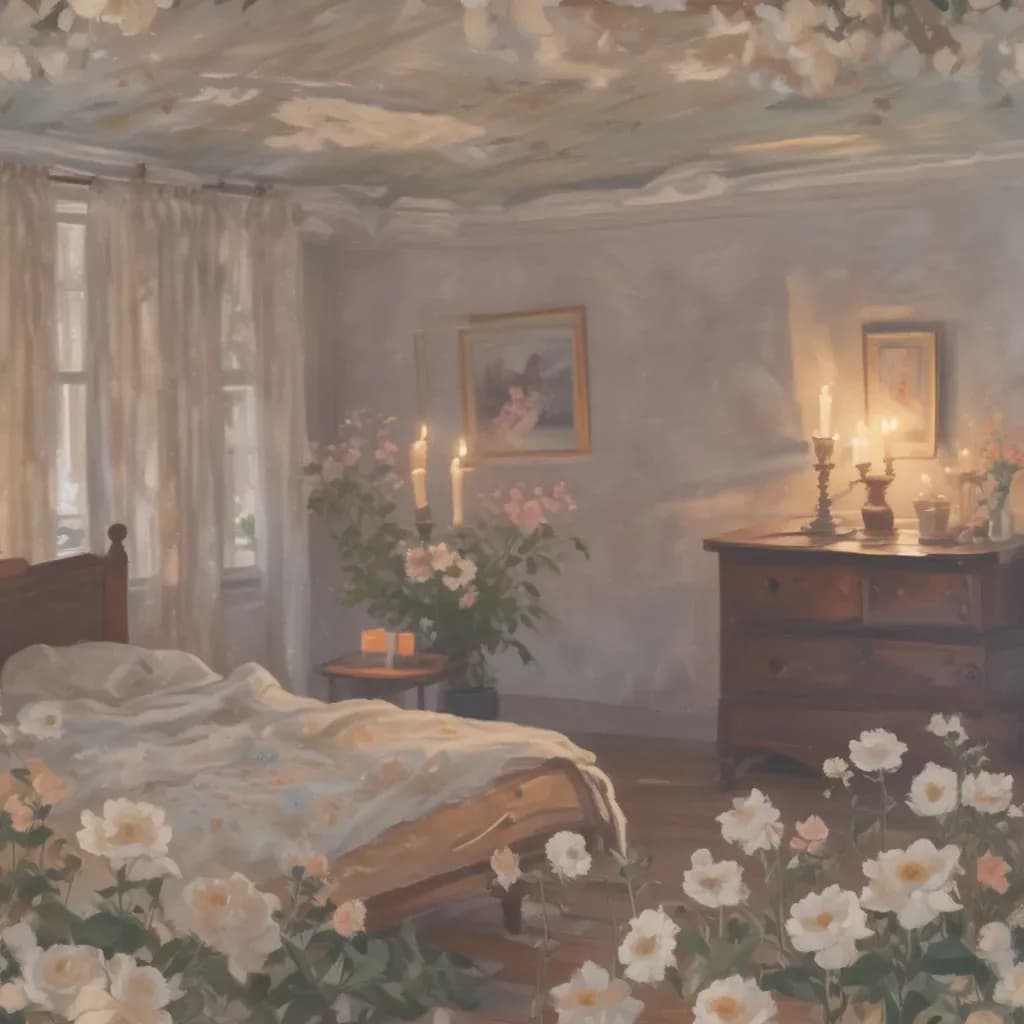
The title points the same way. Carrion is the flesh of something dead, the thing scavengers feed on. Flowers are what we bring to the dead and what grows from them. Putting the two words together creates a small, unsettling image of beauty rooted in decay, and that tension runs through the whole piece. The song is not asking you to be comforted by death, and it is not asking you to be repulsed. It holds both responses at once.
This is also a tradition Wolfe has deep roots in. She grew up in Northern California with a grandmother who introduced her to aromatherapy, Reiki and what she called other realms, and with a father who played in a country band and kept a home studio.[3] The idea that the physical world has thin places, and that the music can be a way through them, was part of her childhood vocabulary before she ever put it into dark, heavy songs.
Sound as meaning
It is tempting to read a song like this only through its words, but much of what Carrion Flowers says is said by the production. The industrial pulse that Northern Transmissions heard in it acts like a heartbeat heard through a pillow.[2] The low end is thick without being fast, so the song feels pressed down on you rather than rushing at you, which is exactly how sleep paralysis is usually described by people who have lived it.
Against that weight, Wolfe sings in a voice that is closer to a spell than a performance. Her earlier records leaned toward gothic folk and doom, and Abyss gathers those threads into something more unified.[3] The vocal is calm, even tender, and that calm is part of what makes the song frightening. A scream would at least be a response. Here, the narrator seems to have gone past the point of struggling.
Viola and layered strings, supplied on the record by Buchla and others in the circle around Wolfe, give the arrangement a faintly sacred quality.[1] The effect is of a hymn performed underwater, which suits a song about looking at death with open eyes.
It helps to remember how Abyss sits in her catalog. By 2015 Wolfe had moved from the lo-fi gothic folk of her early records toward a heavier, more electronic palette, and she was working with a producer, Congleton, who was not a metal specialist.[1][3] Opening with Carrion Flowers was a statement of confidence. Rather than easing listeners in with a familiar gesture, she began with the most disorienting track available.
That choice also shaped how the rest of the record is heard. After a song this stripped of reassurance, even the more melodic moments on Abyss carry a trace of the same dream logic. The opener works as a lens, and everything that follows is seen through it.
Why it resonates
Part of the song's appeal is that it gives shape to an experience many people have had and few can describe. Sleep paralysis is common, and it is a lonely thing to go through because no one else can see it. A song that renders the sensation faithfully, without melodrama, offers a kind of company.
There is also a broader resonance. The record arrived in a decade when heavy music was increasingly willing to speak openly about mental and physical vulnerability, and Wolfe was one of the figures who made that feel natural rather than performative. Her next album, Hiss Spun, would frame itself as a personal exorcism about anxiety, insomnia and addiction.[4] Carrion Flowers is where that candor first becomes this atmospheric and this complete.
The song also received an official video, which keeps its imagery tied to Wolfe's own visual language.[5]
Other ways to hear it
If the sleep paralysis reading is the most grounded one, it is not the only one. A listener coming to the song without the biography can hear it as a meditation on grief, with the flowers of the title as offerings at a graveside and the narrator as a mourner moving through a dream of the afterlife. That reading finds support in Wolfe's own talk of newness to the afterlife.[1]
Another reading hears the song as being about surrender. The slow tempo, the unhurried voice and the spacious arrangement all suggest someone who has stopped fighting what is happening to them. In that view, the song is about the strange peace that can arrive after fear has been exhausted, a peace that is not quite comfort but is something close to acceptance.
A third reading is metaphorical. The state between sleep and waking can stand for any life stage in which a person feels half present, whether through depression, addiction or heartbreak. Wolfe's later work, with its direct focus on those subjects, makes this reading plausible even if it was not the primary intent in 2015.[4]
There is a practical honesty in this, too. Wolfe has said little about what the song means word for word, and the best writing about it respects that silence. A track like this does not need a single authoritative key. Its power comes from the way each listener brings their own sleepless rooms, their own losses and their own fear of the dark, and finds that the song has already made space for them.
The door left open
Abyss is a long, immersive album, and Carrion Flowers does the essential work of persuading you to enter it. It tells you what kind of listening is required: slow, attentive, and willing to be unsettled. It also tells you that the unsettling will be beautiful, which is a more dangerous promise than simple darkness.
The song works because it trusts its subject. It does not rush to explain the dream or to wake you up from it. It lets the room stay strange, lets the weight stay on your chest, and lets the flowers grow from what has died. When it ends, it leaves the door open, and the rest of the album walks you through.
References
Keep reading
More Gothic Rock
- Lazarus David Bowie
- Black Stars Smashing Pumpkins
- Love Will Tear Us Apart Joy Division
- Atmosphere Joy Division
- Disorder Joy Division
- Alone The Cure