Most concert anthems invite you in. "Body to Body," the opening track of BTS's 2026 comeback album ARIRANG, begins with something more urgent: a command to be present. Put down the phone. Look up. Feel the room. In a pop landscape saturated with songs about longing and heartbreak, here is a song about the specific, irreplaceable electricity of sharing physical space with the people you love, and what it costs when you squander it staring at a screen.
After the Long Absence
The context of this song's creation is inseparable from its meaning. BTS spent nearly four years apart fulfilling South Korea's mandatory military service, the last member completing his service by mid-2025. Their reunion in Los Angeles for what became the ARIRANG recording sessions was itself an act of presence: seven people choosing to share the same room again after years of enforced separation. That experience appears to have sharpened the group's understanding of why gathering matters, and at what cost it can be lost.
"Body to Body" was produced by a team that included Diplo, Ryan Tedder, Pdogg, and the Picard Brothers[1], a roster that signals global pop ambitions balanced with in-house Korean sensibility. It is a pop-rap track built on kinetic, stadium-sized electronic production[2]. But the production makes a surprising pivot around the two-minute mark, when the driving pulse dissolves and a pansori-style choral arrangement of "Gyeonggi Arirang," one of the most beloved variants of Korea's unofficial national folk song, rises in its place[1]. It is a compositional choice so bold it reportedly divided the group itself.
The Case for Presence
RM leads the song in English[1], making the appeal direct and cross-cultural from the outset. He is talking to the person in the back of the stadium who has their phone up, and to the person in the front row whose attention is already somewhere else. The argument is simple: the moment in front of you cannot be archived adequately. You have to be in it.
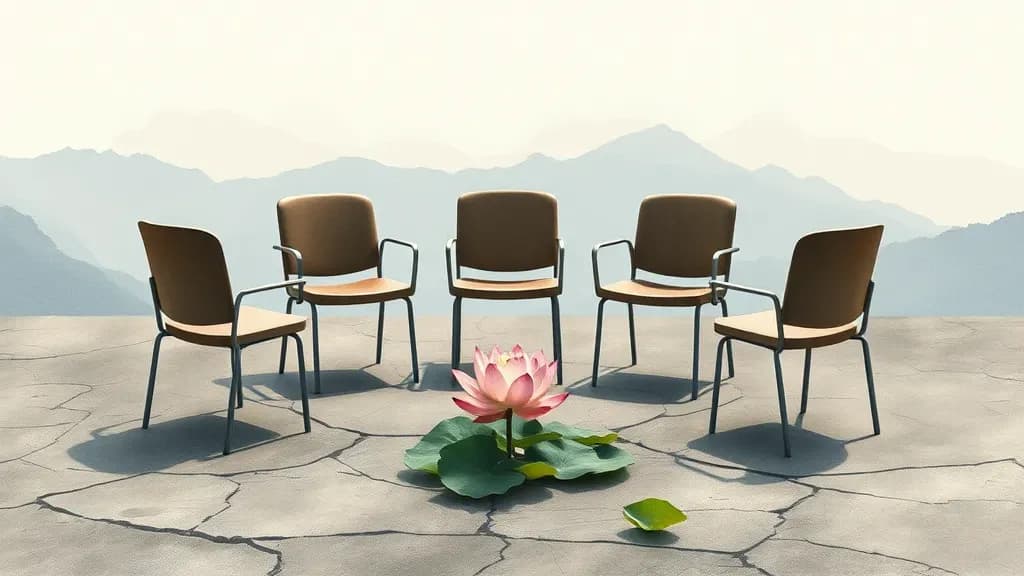
SUGA takes the argument to a deeper layer, addressing not just distraction but actively held hostility[3]. His verse calls on listeners to set aside anger, to enter the shared space as something closer to a clean slate. The lotus imagery woven into his section[4], a flower that blooms through mud, signals transformation through the act of release. The doolset lyrics blog notes this as a notable shift in SUGA's artistic posture: where earlier work tended to absorb and carry negative emotion inward, here he encourages its outward dissolution[4]. It reflects what four years of individual growth and then reunion had done to the members' sense of what they owed their audience, and themselves.
The song's imagery extends this into Korean communal tradition through a reference to 강강술래 (Ganggangsullae)[3], the ancient folk practice in which women gathered to dance in circles through the night. The connection between a concert crowd moving together and this centuries-old ritual form is not incidental. It reframes the BTS show not as product launch or spectacle, but as ceremony, a form of collective motion with deep cultural roots.
The Arirang Bridge
The pansori interlude is both the emotional center of the track and its most contested element. According to Korea Times reporting[5], during the Los Angeles songwriting camp the group and Pdogg tested versions of "Body to Body" with and without the Arirang sample in extended sessions. Some members worried the inclusion could feel overly direct, or be read by international audiences as an expression of excessive nationalism[5]. The debate reflected a genuine creative tension: how to claim Korean identity with full confidence without turning a pop record into a flag-waving exercise. The decision to include it was made collectively after the group returned to Seoul.
"Arirang" itself is among the most emotionally layered pieces of cultural material in the Korean repertoire. A folk song spanning centuries, it was sung during Japanese colonial occupation as a form of quiet resistance. It is one of the few cultural artifacts performed across both North and South Korea, a rare expression of shared identity across the divided peninsula. Rolling Stone described the compositional moment in "Body to Body" as one where "the ancient and the modern intersect"[6], giving the track an emotional weight no amount of electronic production could manufacture.
The track also incorporates a nod to "Hand in Hand," the theme of the 1988 Seoul Olympics[2], another landmark moment when Korea presented itself to a global audience. The reference creates a layered historical continuity: Korea in 1988, the folk traditions stretching back centuries before that, and BTS's own 21st-century global phenomenon, all braided into a single track.
Why It Matters
HYBE chairman Bang Si-hyuk, who championed the decision to name the album ARIRANG and hold its release concert at Gwanghwamun Square, the symbolic heart of Seoul, has described imagining a scene where foreign audiences sing "Arirang" together in a stadium[5]. "Body to Body" is the blueprint for that vision. It converts a centuries-old folk melody into a singable concert bridge, transmitting Korean cultural memory through the specific medium of a stadium crowd. This is cultural transmission in real time, happening not through classrooms or documentaries but through collective physical experience, bodies in the same space.
Members have spoken about what drew them back to Korean cultural roots after years of consciously building global crossover appeal. Jimin reflected on "what it means that all members are Korean" and described the Arirang choice as "meaningful but heavy"[7]. RM described Korean cultural elements as "an important keyword that connects us" and linked them to the group's sense of its own roots[7]. J-Hope said the group "infused Korean culture and spirit into the lyrics" with an intentional pull toward origin[7]. "Body to Body" is where those words meet their musical proof.
A Coincidental Metaphor
In the weeks after ARIRANG's release, the Philippine news service ABS-CBN reported that "Body to Body" falls within the recommended tempo range for hands-only CPR, approximately 100 to 120 beats per minute[8]. The report framed this as a practical health note, a minor viral curiosity alongside the song's commercial success. Whether the tempo alignment was intentional or coincidental, it handed the song an unplanned second meaning. A track called "Body to Body," built around the idea of being fully present with the people in the room with you, also happens to be calibrated at the frequency capable of restarting a stopped heart. As metaphors go, it is difficult to improve on.
The Song Opens the Door
"Body to Body" works as an overture in the classical sense: it announces every theme ARIRANG will carry. Korean identity, communal experience, the braided relationship of ancient tradition and contemporary production, the specific gravity of BTS's bond with their audience. The Hollywood Reporter's track-by-track breakdown described the album as BTS "honoring their roots while looking to the future"[2], and this opening track is where that balance is most precisely struck.
After years of separation, "Body to Body" is the sound of reunion, not as a sentiment, but as a physical, documented fact. Seven people returned to the same room. They wrote a song about why the room matters. They are asking you, in the most direct terms available to a pop record, to put your phone down and be in it with them.
References
- BTS 'Body to Body' Lyrics & English Translation: Meaning & 'Arirang' Sample Explained — Just Jared breakdown of Body to Body lyrics, production credits, and the Arirang sample
- BTS Honors Their Roots and Looks to the Future on Long-Awaited 'Arirang': A Track-By-Track Breakdown — Hollywood Reporter track-by-track breakdown including Hand in Hand sample and production notes
- The Meaning Of BTS' "Body To Body" Lyrics In English, Explained — Her Campus explainer covering SUGA's verse and the Ganggangsullae reference
- Body to Body – doolset bangtan — doolset's translation and lyrical analysis, including notes on SUGA's artistic evolution and lotus imagery
- Imagine foreigners singing 'Arirang': How Bang Si-hyuk persuaded BTS to include the traditional song — Korea Times report on the internal debate over including the Arirang sample and Bang Si-hyuk's vision
- BTS 'Arirang' Review: World's Biggest Band Nails Comeback — Rolling Stone review with commentary on the ancient/modern intersection in Body to Body
- BTS unveils 'ARIRANG', new era: interview — Korea Times member interviews with quotes from Jimin, RM, and J-Hope on Korean identity and roots
- BTS's new song 'Body to Body' doubles as lifesaving beat for hands-only CPR — ABS-CBN report on Body to Body's tempo falling within the CPR-recommended BPM range
- BTS "Body to Body" Meaning & Arirang Bridge Explained — Analysis of the Arirang bridge and Rolling Stone quote on the ancient/modern intersection