Chains of Love
There is a peculiar honesty in admitting that love can hold you prisoner. Not a casual metaphor, but a bone-deep acknowledgment that attachment can become a kind of captivity, one you would choose over freedom every time. "Chains of Love," the second single from Charli XCX's 2026 soundtrack album Wuthering Heights, takes this confession and transforms it into a gothic pop spectacle: orchestral, turbulent, and oddly euphoric in its surrender.
Released on November 13, 2025, the song arrived days before a striking music video and helped establish the emotional register of an album that would become Charli's most formally ambitious work.[1] It is a song about being unable to leave something that damages you, and about not wanting to. In its willingness to hold that contradiction without resolving it, the track achieves something most pop music carefully avoids: it tells the truth about obsessive love without a single note of irony.
From Brat Summer to Gothic Winter
The context surrounding this song's creation is almost as compelling as the song itself. Charli XCX arrived at this project in the immediate aftermath of Brat (2024), the Grammy-winning sixth studio album that had defined a cultural moment with its neon maximalism, hyperpop production, and feverish hedonism. "Brat summer" had entered the cultural vocabulary. Collins English Dictionary had named "brat" its word of the year. Charli had, in the language of pop stardom, peaked.
The invitation to make Wuthering Heights came in December 2024, when director Emerald Fennell approached Charli to contribute a single song to her film adaptation of Emily Bronte's 1847 gothic novel, starring Margot Robbie and Jacob Elordi. After reading the screenplay, Charli proposed something more ambitious: a complete companion album. The bulk of the material was written and recorded with producer Finn Keane during the Brat Tour (2024-2025), in rented studios across multiple cities, as Charli performed arenas every night and simultaneously constructed an entirely different artistic world by day.[2]
The creative pivot was intentional and complete. Charli described the sound she was after as "a world that felt undeniably raw, wild, sexual, gothic, and British."[3] She and Keane adopted a phrase from John Cale's description of The Velvet Underground as their guiding creative principle: every sound should be both "elegant and brutal."[4] That phrase captures the essential quality of "Chains of Love" precisely. It is both beautiful and abrasive, both grand and intimate, both rapturous and desolate.
Finn Keane brought an unconventional method to the album's string textures. Unable to play violin, he purchased a cheap instrument and recorded deliberately rough, scratchy passages in the studio booth, to Charli's initial bewilderment. These imperfect strings became part of the album's signature sound, a rawness that resists the polished sheen of mainstream pop and leans instead into something closer to the abrasive quality of genuine anguish.[4]
Love as Captivity
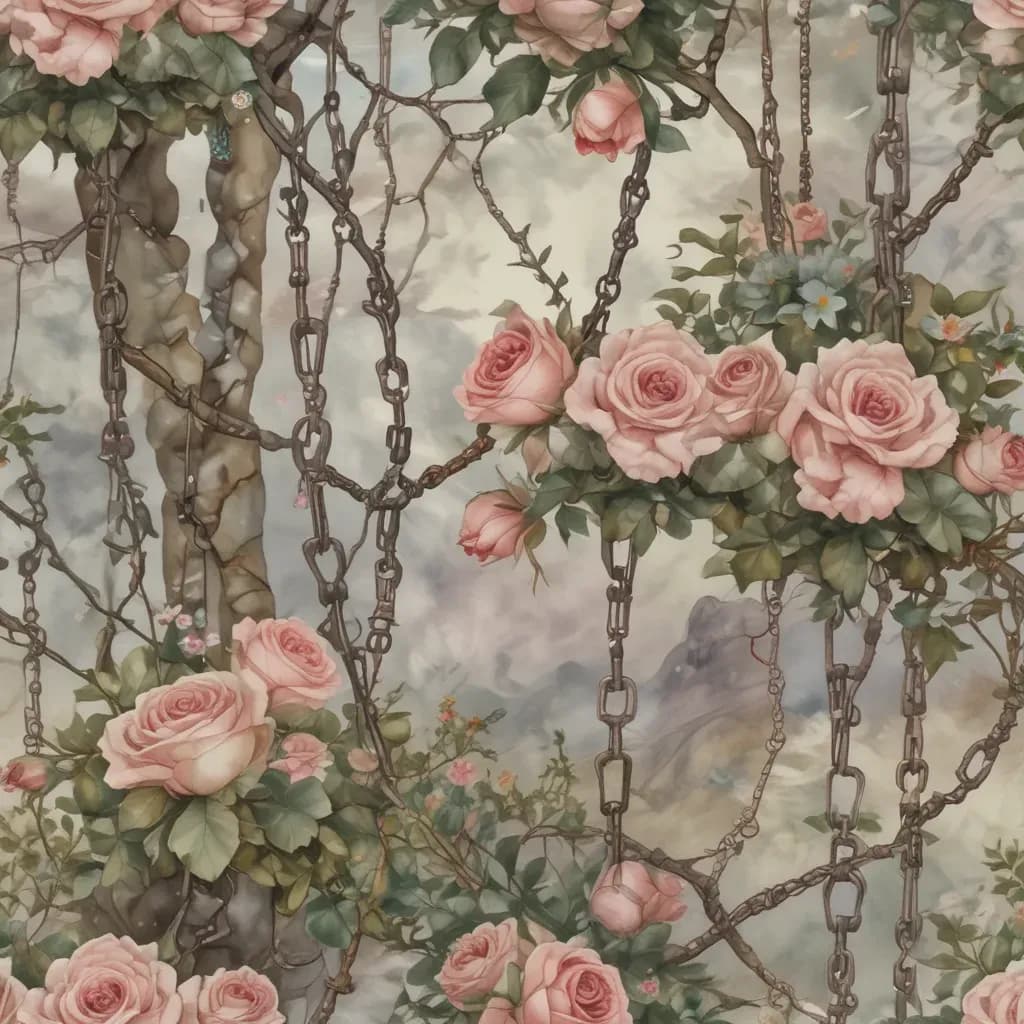
The song's central metaphor is built into its title, and it earns that directness. Chains are not subtle imagery. They suggest constraint, the surrender of agency, and being bound by something you cannot overpower. But the lyrical framing complicates this reading immediately: the narrator is not lamenting their captivity. They are declaring it, almost defiantly. The chains are not forced on them. They are accepted with full knowledge of what they mean.
This is precisely the psychological territory that Bronte's novel excavates so effectively. The love between Catherine and Heathcliff in Wuthering Heights is not gentle or nurturing. It is consuming and destructive. Catherine famously struggles to articulate where she ends and Heathcliff begins, not as a romantic ideal but as a frightening dissolution of individual selfhood. Charli's song captures this same dynamic in compressed pop form. The narrator expresses willingness to endure extremes of physical suffering rather than be separated from the object of their love. Love here is not comfort. It is a condition, as fundamental and as irresistible as gravity.[1]
A recurring motif in the lyrics is the use of extreme physical imagery to measure emotional commitment. The narrator invokes willingness to endure bodily harm as proof of the love's depth, describing scenarios of pain and submersion as preferable to absence. This is traditional gothic and Romantic literary territory: pain as devotion, suffering as declaration. But "Chains of Love" does not deploy these images ironically or at a distance. They land with genuine weight, carried by a vocal performance that makes the extremity feel earned rather than theatrical.[1]
This connects to a broader tradition in gothic literature: the idea that ordinary language cannot contain certain emotional extremes. You can only gesture toward what a feeling is like by reaching for the most intense physical correlatives available. Charli XCX, working directly from Bronte's source material and from Emerald Fennell's cinematic interpretation of it, understood this and deployed it without embarrassment.[2]
Beautiful Brokenness: The Sound
Charli stated that it was important for "Chains of Love" to feel "like it was on the brink of brokenness whilst being totally luscious, sumptuous, and orgasmic."[5] This is a precise description of what the track actually accomplishes. The arrangement begins as something cinematic and swirling, a melodic grandeur that signals emotional seriousness. Then the chorus opens with a force that sits somewhere between euphoria and despair. The orchestral swells carry genuine weight, and beneath them, the electro textures maintain a roughness that prevents the song from becoming purely theatrical.
Beats Per Minute noted the song's "80s keyboards and emotionally charged vocals" and described it as capturing the feeling of being "imprisoned by one's feelings."[6] The production draws on the emotional vocabulary of artists like Kate Bush, Patrick Wolf, and Bat for Lashes: artists who built careers at the intersection of the personal and the mythological. But there is something specifically contemporary in how Charli delivers the song's central declarations. It does not feel like period costume. It feels immediate.
NME described the song as "haunting,"[7] and that word is worth sitting with. Haunting does not simply mean sad or atmospheric. It means the thing follows you. You do not finish listening and return to your previous state unchanged. "Chains of Love" works this way partly because the arrangement builds so deliberately, drawing the listener deeper with each section until the chorus releases with more force than seemed possible from the opening bars.
Cultural Significance
The song arrived at a precise moment in Charli's career. Fresh from the commercial and cultural peak of Brat, she faced the inevitable question of what came next. "Chains of Love" announced the answer forcefully: not more of the same, not an extension of the "brat" aesthetic, but something entirely different. The gamble paid off.
Critics responded strongly. Consequence described the album as "a lush pop odyssey that's as sensual and unsubtle as the movie it accompanies" and positioned "Chains of Love" as a standout single.[8] Rolling Stone called the full record a fully realized artistic achievement.[9] Wuthering Heights debuted at number one on the UK Albums Chart with 21,071 units in its first week, Charli's third chart-topping album in Britain.[2]
The cultural resonance of "Chains of Love" also taps into a broader revival of gothic sensibility in contemporary pop. Artists like Florence + the Machine, Lana Del Rey, and Bat for Lashes had long occupied this territory, but Charli's arrival in it, carrying the cultural momentum of "brat summer," represented a significant expansion of the gothic pop audience. A song about beautiful, tormented captivity delivered by the woman who had recently embodied carefree hedonism carries a particular charge. It suggests range, emotional seriousness, and a willingness to complicate a public persona that had been, until now, primarily defined by ironic confidence.
The music video, released four days after the single on November 17, 2025 and directed by C Prinz, translates the song's themes into a single extended visual event.[10] Set in a grand, nearly empty gothic dining room and filmed in something close to a continuous shot, it shows Charli dressed entirely in white, moving across a long table as escalating physical chaos closes in: cutlery launching through the air, candles toppling, wind intensifying, the table itself lifting off the floor. At the climax, she stamps on the glass table and sends a storm of shards upward. The symbolism is not subtle, but it does not need to be. The chaos is not something she flees. She inhabits it, and eventually provokes it herself.
Other Ways to Read the Chains
The most obvious reading of "Chains of Love" centers on romantic obsession, the Catherine-Heathcliff template of love so consuming it destabilizes identity. But the song also sustains a reading as a meditation on artistic surrender. The creative process at the level of ambition Charli was operating at while making Wuthering Heights, constructing an entirely new sound world mid-tour, requires a similar kind of captivity. Becoming so absorbed in a project that it takes over. Returning to the work even when it resists you. The chains as the binding force of creative necessity, chosen and unchosen simultaneously.
There is also a more culturally expansive reading available. The Gothic tradition in British literature, from Bronte to Angela Carter, frequently uses love-as-captivity as a way of writing about larger questions of freedom and selfhood, particularly for women. Charli XCX, as a British artist returning to that tradition via an adaptation of the most iconic British gothic novel, is engaging with a long lineage. These chains are not only romantic. They can be read as the constraints of social expectation, artistic obligation, or historical inheritance. The brilliance of the song is that it does not force a choice between these readings.[3] The chains are all of them at once.
Conclusion
"Chains of Love" works because it is honest about a feeling most people prefer to euphemize. To describe yourself as willing to lie in thorns for someone is not charming. It is alarming. And yet it names something recognizable: the way love at its most intense can function less like a gift and more like a force of nature you can neither resist nor fully understand. Charli XCX and Finn Keane found the musical form for this recognizable alarm, swelling, beautiful, slightly broken, asking nothing of the listener except that they sit with the feeling and not look away.[4]
In choosing to follow Brat with a project rooted in gothic surrender rather than hedonistic liberation, Charli demonstrated something about her artistic identity that no amount of chart success could prove: that she can hold contradiction. She can be the pop star who defined a summer and the one who wants to feel like she is on the brink of brokenness. The chains, it turns out, are optional. She keeps putting them on anyway.
References
- Chains of Love (Charli XCX song) - Wikipedia — Song details, lyrical themes, release information, and critical reception
- Wuthering Heights (album) - Wikipedia — Album details, recording context, chart performance, and critical reception
- Charli XCX Wuthering Heights Interview - Letterboxd Journal — Charli discusses the album's gothic British world and her creative vision for the project
- Charli XCX and Finn Keane on the Wuthering Heights soundtrack - MusicRadar — Joint interview discussing production philosophy, the violin story, and the elegant and brutal principle
- Charli XCX Shares Chains of Love Single and Wuthering Heights Trailer - Rolling Stone — Single announcement including Charli's quote about the song feeling on the brink of brokenness
- Charli XCX: Wuthering Heights Review - Beats Per Minute — Album review noting 80s keyboards, emotionally charged vocals, and the imprisoned feelings theme
- Listen to Charli XCX's Gothic New Song Chains of Love - NME — Single review describing the song as haunting
- Charli XCX: Wuthering Heights Review - Consequence — Album review describing it as a lush pop odyssey with Chains of Love as a standout single
- Charli XCX: Wuthering Heights Album Review - Rolling Stone — Full album review praising the record as a fully realized artistic statement
- Charli XCX Releases Chains of Love Music Video - Rolling Stone — Music video release coverage with details on director C Prinz and visual description