Crown In The Grave
There is an old, dependable shape to stories about ambition: a person is handed a prophecy, grabs for what it promises, and discovers that the prize is already a burial. Trivium's title track on their eleventh album builds a heavy metal song on that shape. It gallops, it wheels through layered riffs, and it carries the sense of a man walking toward a destiny that he cannot quite see is also his ruin.
The song is not a confessional in the usual sense. It is a story, and the band has been unusually direct about where the story comes from.
A film as north star
Bassist Paolo Gregoletto has said that the album's central inspiration is Akira Kurosawa's Throne of Blood, the 1957 film that transplants Shakespeare's Macbeth into feudal Japan. He described it as the record's north star, and he singled out two qualities: minimal dialogue paired with a powerful storyline, and haunting elements of a man being tempted by fate and then undone by it.[1]
That description is the best key to the title track. A story about temptation and downfall does not need a long speech. It needs atmosphere, momentum and a sense of dread that accumulates. The song takes the same approach, moving from layered riffs into what press materials call a wall of metal, with galloping rhythm guitars, solos, heavy drumming and vocals split across three tiers of delivery.[1]
The band has not published a line-by-line account of the lyrics, so the safest way to hear the song is through its stated source. What the title promises is clear enough: a crown placed on a head that is already bound for the ground, with reward and burial treated as the same destination.
That framing also explains the pacing. A story built on inevitability suits music that never quite lets up, where each section hands momentum to the next the way a prophecy hands responsibility to the person who hears it.
The Macbeth shape
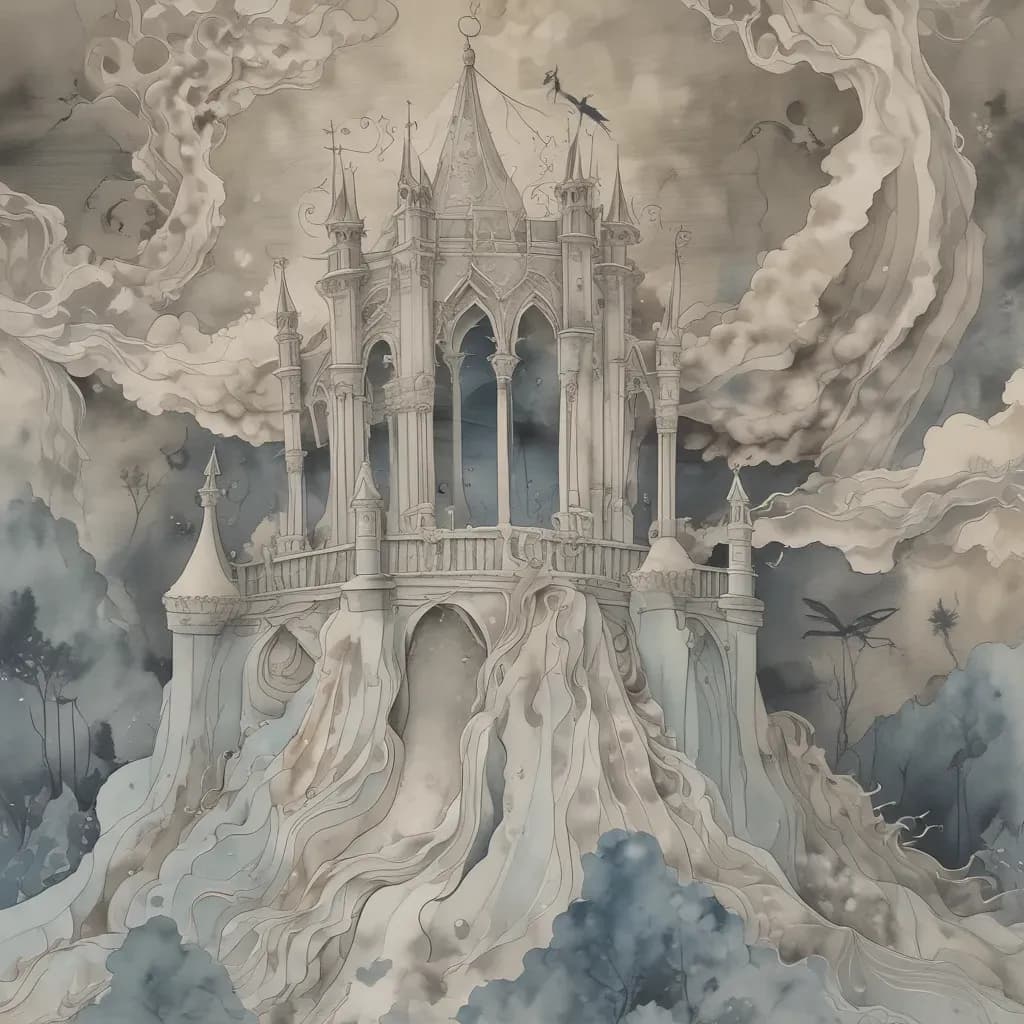
In both Shakespeare and Kurosawa, a warrior is told what he will become. The prophecy does not force his hand. It plants an idea, and ambition (along with a nudge from someone close to him) does the rest. Kurosawa's version strips away much of the poetry and leans on fog, silence and stylized movement, borrowing from Noh theater. The result is a tragedy that feels less like a plot than like a curse being slowly enforced.
Trivium's song works in that register. Rather than narrating each beat of the tale, it dwells on the feeling of being swept along. There is the thrill of rising, the creeping suspicion that the signs were warnings rather than promises, and finally the recognition that every step toward the throne was a step away from any chance of rest.
That is why the crown and the grave sit so close together in the title. They are not opposites. In this telling, power is simply the most elaborate way of arriving at the same end.
Fate and free will
The most interesting question the song raises is whether its central figure is a victim or an author. Tragedies of this kind live in that gap. If fate is fixed, then he is only acting out a script. If he chose each step, then the downfall is earned. Kurosawa and Shakespeare both refuse to settle it, and the song inherits that ambiguity.
Gregoletto's wording, a man being tempted by fate, leans toward the second reading. Temptation implies a choice that can be refused. The tragedy is not that he lacks options but that he cannot see them while the offer is glowing in front of him.
Heavy metal has always been comfortable in this territory. The genre loves a doomed protagonist, and it loves the idea that grandeur and ruin arrive together. What distinguishes this song is its discipline. It does not wallow. It moves forward with the same tight, relentless pace as the character it describes.
The band behind the story
Context matters here, because the story arrives at a turning point for the group. Frontman Matt Heafy has spoken openly about a rough stretch in 2024, which he has described as a midlife crisis and mental breakdown. He had stacked a huge number of projects on top of the band, including game and film scoring, producing, managing and writing a children's book, and anxiety, ADHD and OCD pushed him into depression.[3]
The band's own announcement ties that struggle to a crossroads, from which he chose therapy, found a medication routine and changed his mindset. In the press materials he frames the process in terms of confronting oneself as a final quest.[2][1]
Heafy's accounts of that period also include physical damage from training, including herniated discs and other injuries.[5]
It would be too neat to say the song is secretly about him. The band points to a film, not a diary. But a record made by people who describe feeling like a brand new band is bound to have some of that energy in it.[2][5] A narrator undone by overreach is a figure Heafy has good reason to understand, and an album about facing consequences, written by a band that has just faced its own, gains weight from the overlap.
A new room, a new drummer
The album was also made differently. For the first time, Trivium wrote and recorded in their own space in Orlando, a self-built studio and rehearsal room called The Hangar, and the songs were written collectively there.[6][4] Gregoletto has said building the space gave them the time to work out what an eleventh record should be.[6]
The lineup is fresh as well. Drummer Alex Rüdinger, formerly of Whitechapel, joined after the departure of Alex Bent in late 2025, and the reviewer at Blabbermouth credits his arrival with helping spark another era for the band.[2][4] Josh Wilbur, a longtime Trivium producer, returned behind the desk, and Jacob Hansen mixed the record for the first time with the group.[2]
The band has said it looked to 1990s albums for the balance it wanted, naming Metallica's self-titled record, Megadeth's Countdown to Extinction and Soundgarden's Superunknown, with an emphasis on big riffs, big hooks and strong choruses.[6] The title track delivers on that brief while staying firmly in the band's thrash and melodic metal tradition, an Orlando group that has been building that sound since forming at the turn of the millennium.[7]
The video and the visual world
The accompanying video, directed by Pavel Trebukhin, sets its action in a smoke-filled dojo where figures prepare for a coming showdown. It is described as post-apocalyptic and inspired by Noh theater, which makes sense given the source material.[1][2]
The choice reinforces how deeply the Japanese angle runs through the project. Gregoletto has said that Throne of Blood led the group toward Japanese horror and the cinema of the 1950s through 1970s, producing a darker, ghostlier atmosphere that served as a set of guardrails for the music, lyrics, artwork and identity of the album.[1]
In other words, the title track is not an isolated experiment. It is the anchor for a whole aesthetic.
There is also a craft argument here. Metal bands often treat mythology as costume, but a film like Throne of Blood offers structure: a rising action, a point of no return and a collapse. Borrowing that arc gives the song a sense of narrative weight that a generic tale of darkness could not supply.[1]
It helps, too, that the source is a film about restraint. Kurosawa let silence and stillness do much of the work, and a band known for speed and density has to find its own equivalent. The layered build the band describes, from interlocking riffs into a full wall of sound, is one way of creating that tension.[1][6]
Other ways to hear it
One reading takes the song literally as a retelling, a metal version of a classic tragedy. That is the interpretation best supported by what the band has said.
A second reading treats the story as an allegory for the creative life. Anyone who has chased a goal until it consumed them, whether a career, a reputation or a perfect performance, will recognize the shape of a crown that turns out to be heavier than expected. Heafy's description of no longer needing to be safe and perfect at every show points in that direction, though he is speaking about himself, not about this song.[2]
A third reading is more communal. Every long-running band faces the question of what happens when a record is supposed to be the biggest thing it has ever done. The phrase about the grave could be a warning about repeating yourself, and the fresh studio and drummer could be a way of refusing that fate. None of this is confirmed by the band, so it is best held loosely.
It is also worth being honest about what is not known. No band member has publicly explained the title phrase line by line, and the lyrics are best understood through the stated inspiration rather than through any supposed hidden code.
Why it lands
Reviewers have been warm toward the album. Blabbermouth's Dom Lawson gave it 8.5 out of 10 and praised the heaviness of the songs and Heafy's vocal performance, concluding that the band has seldom done it better.[4]
Part of the appeal is that the song gives listeners something to hold. A tale of temptation, prophecy and ruin is old enough to feel inevitable, and metal is a good delivery system for inevitability. The riffs move like fate. The choruses feel like declarations that cannot be taken back.
The other part is timing. Hearing a band describe a downfall while sounding energized, rebuilt and openly pleased to be working together creates a productive tension. The story is about collapse. The performance is about recovery.
Conclusion
"Crown In The Grave" is a song about the moment a prize and a punishment become indistinguishable. It borrows its skeleton from one of cinema's great adaptations of one of theater's great tragedies, and it dresses that skeleton in galloping guitars and hard-won hooks.
Knowing the circumstances around it, a band rebuilding itself after a difficult stretch, adds a layer without turning the song into a diary entry. The tragedy it tells belongs to a fictional warrior. The way it is played belongs to people who have looked at their own versions of that story and chosen a different ending.
References
Keep reading
More Heavy Metal
- Black Dog Led Zeppelin
- Dead Inside Of Me Trivium
- Speaking in Tongues Bruce Dickinson
- Down in a Hole Alice in Chains
- Devise/Destroy Lamb of God
- St. Catherine's Wheel Lamb of God