Dead Inside Of Me
Most songs about hiding your feelings keep the hiding quiet. "Dead Inside Of Me" does the opposite. It arrives as a wall of stomping, thrash-edged riffs and a chorus built to be shouted back by thousands of people, and it uses all of that noise to describe a man who has stopped being able to feel anything underneath the performance.
It is a fitting opening statement for a band at a turning point. Trivium released it on 16 September 2026 as the first new music from their eleventh album, and the first since 2021.[1]
Where the song came from
The origin story is refreshingly practical. Bassist Paolo Gregoletto has said the track came together at the end of a long writing day the previous summer, built from a riff he had carried around for five or six years under the working name "Slam," looped over a simple groove.[1] The idea was to take something with the DNA of death metal and play it with the swagger of a stadium rock song, while weaving the screamed and sung vocals into a single voice.[1]
That balance (brutal material, anthemic delivery) became the thesis of the whole record. Gregoletto has said the band looked to 1990s landmarks such as Metallica's Black Album, Megadeth's Countdown To Extinction and Soundgarden's Superunknown, and that choruses and relatable songs were the goal.[3]
The setting matters too. Crown In The Grave is the first Trivium album made in the band's own Orlando space, The Hangar, written collectively with new drummer Alex Rüdinger, formerly of Whitechapel, and produced once again by Josh Wilbur.[2][3] It is also the first record since the band's long-running drummer Alex Bent departed in 2025.[3]
Two faces: honne and tatemae
The most useful key to the lyrics comes from Gregoletto himself. He has described the song as loosely inspired by the Japanese concepts of honne and tatemae, the gap between what a person truly feels and the face they present to the world to conceal it.[1]
That framing explains the title's strange grammar. The phrase does not describe a person who has died, or even one who is numb in general. It describes something hollowed out within the self, a presence that has gone dark while the exterior keeps functioning. The narrator is not mourning someone else. He is reporting from inside his own emptiness.
Honne is the private truth, tatemae the public composure, and in Japanese social life the skill of moving between them is often treated as a form of courtesy rather than deceit. What makes the song bite is that it imagines the courtesy curdling. When the mask is worn long enough, the question stops being what the narrator is hiding and becomes whether anything is left to hide.
Thematically, the song moves between three ideas. The first is the mask, the polite and capable surface that gets a person through the day. The second is the cost of maintaining it, the slow erosion that happens when the public self and the private self drift too far apart. The third is a confrontation, a refusal to keep pretending, delivered with all the aggression the band can muster.
A band that wears its darkest year openly
It would be a mistake to read the song as pure fiction. Matt Heafy has been unusually candid about the period leading into this album. He has described a crisis involving mental health struggles, physical injuries and anxiety, and said that therapy and medication helped him free his mind from the constraints of constant worry.[4] A Metal Hammer cover story lists injuries including herniated discs and torn hips, and describes a breakdown tied to mental health and overwork.[5]
Heafy has summed up the record's spirit with the line that facing yourself is the final quest.[4] Read against that, a song about the distance between the mask and the true self sounds less like a character study and more like a band describing what it means to keep performing while something inside has gone quiet.
He has also described Trivium as feeling like a brand new band at this stage.[4] Whether or not the lyrics are autobiographical in the literal sense (the band has not said so), the emotional logic is clearly shared.
The ghost story around it
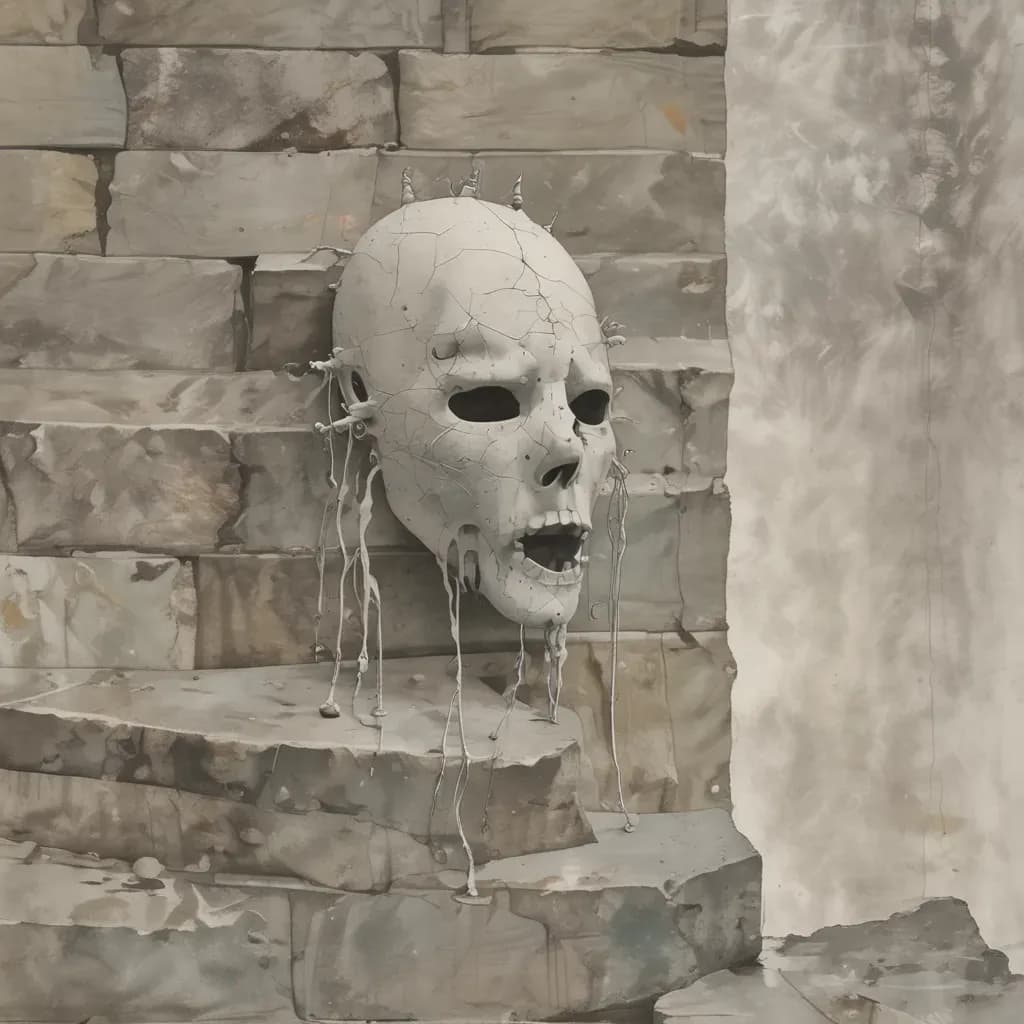
Crown In The Grave has a larger conceptual frame, and the single sits comfortably inside it. Gregoletto has said the "north star" for the album was Akira Kurosawa's film Throne Of Blood, a Japanese retelling of Macbeth, with its haunting sense of being tempted by fate and a man's downfall.[3] That led the band toward Japanese horror and cinema of the 1950s through the 1970s, and toward a darker, ghostly atmosphere that shaped the lyrics, the artwork and the identity of the record.[3]
Seen that way, the idea of being dead inside is almost literal in the album's world. Ghosts, in Japanese theater and film, are often people who could not express what they felt in life. A narrator who is a hollow shell, still moving and still speaking, belongs to the same tradition. The album's track list reinforces the mood, with titles like Jorōgumo (the name of a spider-woman from Japanese folklore), The Haunting Never Ends and The Terror.[2]
The music video leans into the horror. Directed by Pavel Trebukhin, it has been described as a creepy journey into the darkest depths of the human psyche, and one account describes the band playing in run-down underground tunnels while a figure in a devil mask pursues a terrified man.[1][7] The chase works as a plain visual translation of the theme: the thing you are running from lives in the same body that is running.
Why the sound matters to the meaning
It is worth saying how unusual it is for a song about numbness to be this physical. Critics heard the track as primed and ready to demolish arenas, with a snarling, stomping gait and a chorus that arrives like a brick through the window.[2] The same review rated the album 8.5 out of 10 and said Trivium have seldom done it better.[2]
That contrast is part of the meaning. Depression and emotional shutdown are often imagined as quiet, slow and grey. Here they are loud, driven and almost combative. It suggests a more accurate picture for many people, where the hollowness is not stillness but a kind of grinding momentum, a person who keeps pushing forward because stopping would mean looking at the emptiness directly.
The decision to merge screaming and clean singing into one voice supports this. The two registers, which many metal bands treat as separate moods, become two aspects of the same person. The roar and the melody are both the self, and neither is allowed to be the whole truth.
Alternative readings
Because the band has pointed to honne and tatemae rather than to a specific event, the song is open to more than one reading.
One reading is personal and clinical: a portrait of burnout and depression, in which the narrator has lost the capacity to feel joy and is trying to say so honestly. Given what Heafy has shared publicly, this is the most natural interpretation.[4][5]
Another is social. Honne and tatemae describe a cultural habit of smoothing over private feeling for the sake of harmony, and the song can be heard as a critique of any performance that demands constant composure, whether on stage, online or at work. For a band that spends its life on tour, the mask of the professional entertainer is an obvious candidate.
A third reading is narrative and mythic, in line with the Throne Of Blood inspiration. Here the voice belongs to a doomed figure, someone who has made a bargain or followed an ambition and discovered that the cost was the self. The "dead" part of him is the price already paid.[3] These readings are not mutually exclusive, and the song is stronger for holding all three.
Why it resonates
Trivium have been a fixture of heavy music since forming in Orlando in 1999, and their career has included both critical triumphs, such as Ascendancy being named Kerrang!'s album of the year, and a Grammy nomination for Betrayer.[6] A band with that history could easily have returned with a nostalgia exercise. Instead the first single is about the least nostalgic subject imaginable, the uncomfortable gap between how things look and how they feel.
That is what gives the song its staying power. Plenty of listeners know what it is like to do everything required of them while feeling absent from their own life. A chorus big enough for an arena gives that private experience a communal outlet, and shouting along to a description of numbness is, paradoxically, a way of feeling something.
Conclusion
"Dead Inside Of Me" turns a quiet, familiar kind of suffering into something loud enough to confront. Its inspiration in the idea of the public mask and the hidden truth, its place within an album shaped by ghost stories and fate, and the openness of the musicians about their own recent struggles all point the same direction. The song does not offer a cure. It offers an honest report from the hollow place, delivered at full volume, and that honesty is the point.
References
Keep reading
More Heavy Metal
- Black Dog Led Zeppelin
- Crown In The Grave Trivium
- Speaking in Tongues Bruce Dickinson
- Down in a Hole Alice in Chains
- Devise/Destroy Lamb of God
- St. Catherine's Wheel Lamb of God