Dead Vine
Some songs arrive with a campaign behind them, and some arrive quietly near the end of a record. "Dead Vine" is the second kind. It is the thirteenth of fourteen tracks on David Kushner's second album, a short piece of roughly two and a half minutes that sits just before the closing song.[2][3] There is almost no published commentary on it yet, which makes it a good test of how much a title, a placement and an album's stated purpose can tell a listener.
This essay works from those pieces of evidence. It does not quote the lyrics, and it does not claim to know what Kushner has said about the song, because as of this writing he does not appear to have said anything on the record. What follows is an interpretation built on the album's themes, the artist's history and the imagery in the title.
Where the song sits
Devotion was released on November 13, 2026, and was announced in September of that year.[1][4] The tracklist runs from "Ritual" at the start through songs such as "Electrified," "Godsent," "Cycle of Life" and "Worship Me," with "Dead Vine" arriving at number thirteen and "As I Hold My Breath" closing the set.[2][3] Read in order, the second half of the record turns toward big, almost liturgical words: worship, truth, cycle, godsent.
That context matters. A song called "Dead Vine" in that neighborhood is unlikely to be a botanical observation. It reads as part of an argument about what happens to the things we tend, serve and give ourselves to. The song is also short, and short songs late in an album often work as a hinge, a brief, concentrated image placed before the final statement.
The credits list Kushner as a writer alongside Matt Cohn and Jacob Olofsson, and he is the performer.[2][9] Olofsson also appears in the credits for the album's lead single "Ritual," which Clash described as a delicately composed return in which Kushner opens up as rarely before.[1] That suggests a consistent, intimate sonic world across the record, though the details of this particular arrangement are not documented.
What the album says it is about
Kushner has given a clear statement of purpose for the record. In the announcement coverage he said the album is about devotion and how it can either complement and elevate a person or destroy them, and that some songs are positive while others are sad.[1] He added that even if being devoted to another person could consume or ruin you, he believes it is still worth trying.[1]
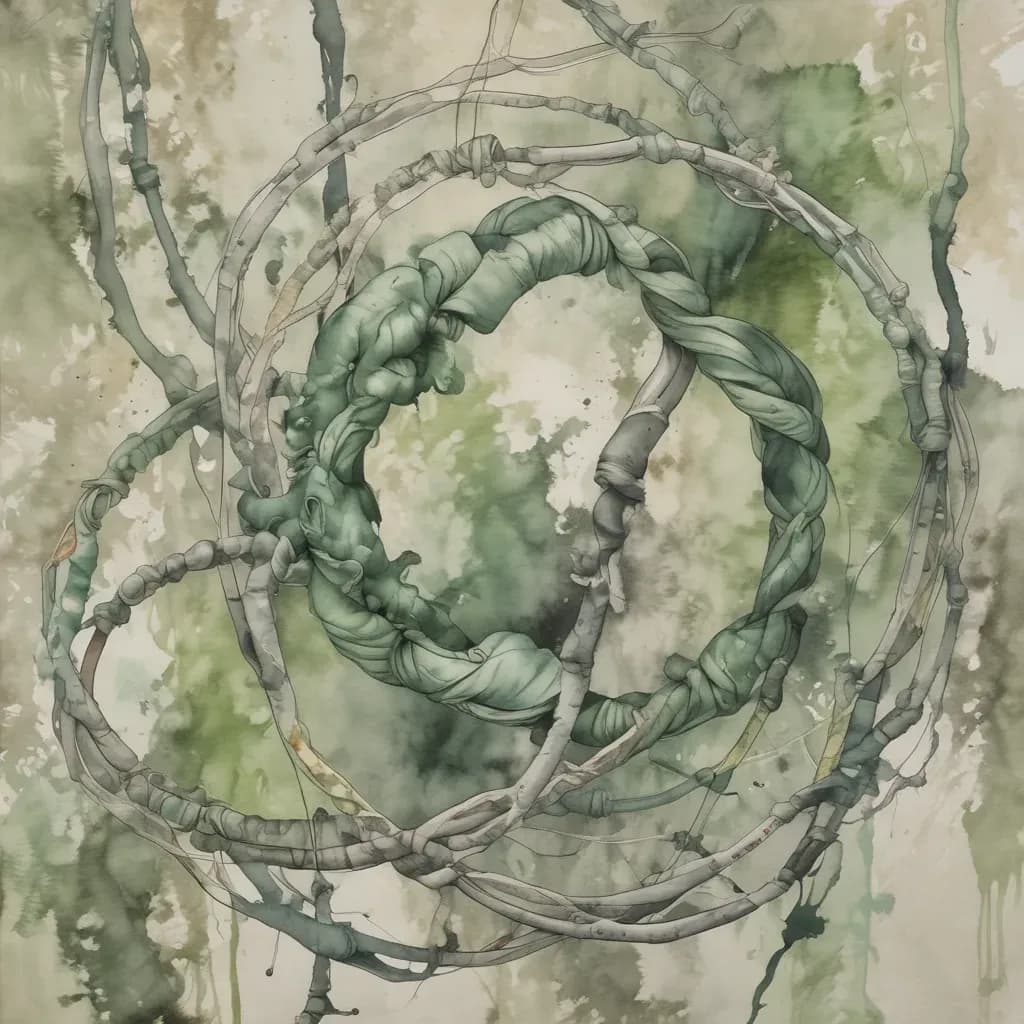
That is a useful key for a song about a dead vine. A vine is a living thing that only exists by attaching itself to something else. It climbs, wraps and depends. It is nearly a perfect image for devotion in the romantic sense, a life wound around another life. A dead vine is what remains when that attachment fails: something still clinging to its support, no longer drawing anything from it.
The album's own description, a set about the constructive and destructive sides of love, fits this reading neatly.[3] If the early tracks lean toward the elevating half of Kushner's equation, a song this late in the sequence plausibly sits on the other side, in the territory of what devotion costs when it is not returned or cannot be sustained.
The vine as a double image
There are at least two ways a listener might hear the title, and the album's logic allows both.
The first is romantic. A relationship can keep its outward structure after the life has left it. The trellis stays up, the stem stays tied, and everyone can see the shape of what used to be there. In this reading the song would be about the particular grief of staying attached to something that is no longer alive, and the question of whether to cut it away or keep tending it.
The second is spiritual, and it matters more once you know who Kushner is. He is openly Christian, has said his faith has been foundational in his life, and has described his debut as dedicated to his relationship with God.[4][6] Vine imagery has deep roots in Christian scripture, where a vine and its branches stand for dependence on a source of life. A dead branch in that tradition is one that has been cut off from the source. A listener familiar with that language may hear the song as a confession about spiritual drought, or about devotion that has become habit without substance.
These readings do not compete so much as stack. Kushner's work has long treated romantic and religious longing as neighbors. His debut, The Dichotomy, was built around a struggle between darkness and light, and one reviewer felt its first thirteen songs dwelt heavily on the fight with sin.[5][7] A song that uses a single plant to hold both kinds of devotion would be consistent with that habit.
A writer who keeps returning to desire and ruin
Kushner was born in Chicago in 2000 and grew up in its suburbs.[4] He taught himself guitar, never worked with a vocal coach, and rose quickly after "Miserable Man" spread on TikTok in early 2022.[4] "Daylight" followed in 2023 and became a major hit, reaching the Billboard Hot 100 and earning multi-platinum certifications.[4]
Across those years, a theme keeps surfacing. He described "Skin and Bones" as capturing the electric tension of desire and redemption.[8] That phrase could stand as a summary of his whole catalog, and it points to why a dead vine feels at home in it: his songs tend to find the moment when wanting something tips into being harmed by it.
His public life has carried the same tension. He has spoken openly about anxiety, and in March 2025 he cancelled the remaining dates of a UK and European tour, saying he needed to step back and focus on getting better.[4] Devotion arrives after that stretch. It would be unfair to assign any song to a specific episode, but it is reasonable to say that an album about what devotion can do to a person was written by someone who has had to think about what his work and his relationships take out of him.
Brevity as meaning
The song's length is itself a clue. At about two minutes and eighteen seconds, it does not have room for an extended narrative.[2] A song that short tends to do one thing. It states an image, turns it once, and leaves.
That economy suits the subject. Decay is not usually dramatic, and a dead vine is a very quiet kind of ending. There is no collapse, only a stillness where growth used to be. A brief, restrained track placed just before the album's closing statement would let the listener sit with that stillness without the song overstaying it.
Why it may resonate
Listeners who come to Kushner through his biggest songs know him as a writer of heavy, confessional material about guilt and longing. What a song like this adds is the aftermath. Most pop songs about love are about the beginning, the loss or the fight. Fewer are about the long period in which something is plainly finished but still attached.
That is a recognizable experience, whether the attachment is to a partner, a habit, a belief or a version of oneself. It is also one the album's central question invites. If devotion can elevate or destroy, the dead vine is the reminder that the process is not always a sudden break. Sometimes devotion simply stops being fed, and the evidence is slow to show.
Other ways to hear it
A more hopeful reading is available. Gardeners know that a vine that looks dead in winter can be alive at the root. Kushner has said that devotion is worth attempting even when it could consume you.[1] A song placed late in the album could be testing that belief at its lowest point, with the closing track offering the answer.
There is also a reading that has nothing to do with love or faith. A vine may stand for inherited family patterns, for an addictive habit, or for an industry that fed on a young artist's energy. The title is open enough to hold any of these, and the lack of official commentary means listeners are free to bring their own.
Closing
With so little documented about the song, the honest conclusion is a modest one. "Dead Vine" is a short, late-album track on a record that Kushner has framed as an examination of devotion's power to build or ruin a person.[1] Its title gives the clearest hint: a living thing that depends on another, now cut off from its source. Whether that source is a lover, a faith or a self, the song seems to ask what it means to keep holding on once the life has gone out of the thing being held.
As more interviews and reviews of Devotion appear, the picture may sharpen. For now, the song is best approached as a small, dense image inside a larger conversation, and one worth listening to alongside the songs that surround it.
References
Keep reading
More by David Kushner
More Indie Pop
- The Truth David Kushner
- Worship Me David Kushner
- Cycle of Life David Kushner
- Made of Glass David Kushner
- Godsent David Kushner
- Need Someone David Kushner