Don't Hate Me
A Plea Written in Organ Smoke
There is something almost confessional about the way Miles Caton opens his debut solo single. The organ pulses low and steady, and when his voice enters, the weight of it goes far beyond the typical first-single swagger of a rising star. At twenty-one years old, just weeks after performing at the Academy Awards and accepting a Critics' Choice Award for his film debut[1], Caton chose not to announce himself with something triumphant. He chose honesty instead.
"Don't Hate Me," released on March 20, 2026, is a quiet song about an uncomfortable truth: sometimes you love someone and still cannot give them what they need.[2] The narrator does not claim innocence. He does not assign blame. He asks only for something close to mercy.
Gospel Roots, Secular Wounds
To understand what Caton is doing on this track, you have to understand where he comes from. He was born in Brooklyn on March 3, 2005, into a family where music was not a hobby but a spiritual practice.[1] His mother, gospel singer Timiney Figueroa, and his aunt, Anaysha Figueroa-Cooper, are both accomplished vocalists in the tradition.[3] His grandfather is a senior pastor and archbishop, and by his own account every member of his family sings or plays an instrument.
At five years old, he was performing Sam Cooke songs at the NAACP Freedom Fund Awards Gala. At twelve, a video of him interpreting Nina Simone's "Feeling Good" went viral online and was later incorporated into the opening sequence of Jay-Z's album "4:44."[1] These are not the origins of a conventional pop career. They are the origins of something older and more serious.
The gospel tradition runs through "Don't Hate Me" in both its instrumentation and its emotional register.[4] The moody organ that anchors the track is not incidental. It is the language of confession, of reckoning in sacred spaces. Caton takes that language and turns it toward something entirely human and secular: the failure to be someone's everything.
The Career Arc That Made This Song Possible
By his late teens, Caton was touring as a background vocalist with H.E.R., a Grammy-winning artist known for deeply personal R&B.[5] That experience, he has suggested, broadened his understanding of what a modern soul record could be and provided a frame of reference well outside gospel. He also opened for Coldplay, a reminder that his ambitions extended far beyond any single genre.[1]
Then came "Sinners," Ryan Coogler's supernatural horror film released in 2025. Caton was cast as Sammie Moore, a preacher's son drawn to music despite the weight of his family's spiritual expectations. Coogler famously described discovering a once-in-a-generation voice in Caton.[6] The film earned Caton the Critics' Choice Award for Best Young Performer, nominations at the SAG Awards and for a BAFTA Rising Star Award, and a performance slot at the 98th Academy Awards ceremony.[1]
The story Coogler told, and Caton's character within it, turns on the same tension that animates "Don't Hate Me": the collision between what you were raised to be and what you feel pulled toward.[6] Sammie Moore is a preacher's son drawn toward the blues and its pleasures. Miles Caton, a gospel child, is drawn toward the vulnerability and openness of secular R&B. Both navigate a world where devotion and desire do not sit easily together.
What the Song Is Actually About
The song positions its narrator in a complicated emotional space. He is not callous. He is not cruel. He is someone who understands that the person across from him wants a commitment, a promise, a certainty, and who knows with painful clarity that he cannot offer it.
The chorus distills this into a direct, almost raw appeal for understanding. The narrator frames his emotional unavailability not as a choice but as a condition, something inherent to him that frustrates and exhausts the people who love him. And yet he does not leave. He stays, loves in the way he can, and asks the other person not to hate him for it.
This is a psychologically sophisticated position for a debut single. It refuses the easy resolution of either reconciliation or breakup. The narrator occupies the uncomfortable middle, where two people can remain together and still be failing each other. It is a feeling that listeners across ages and circumstances will recognize instantly.
The production supports this emotional suspension. Producer JT Daly uses organ and swelling strings to build a sound that neither fully resolves nor escalates.[4] The song feels like being held in a moment of suspension, waiting for something that may not arrive.
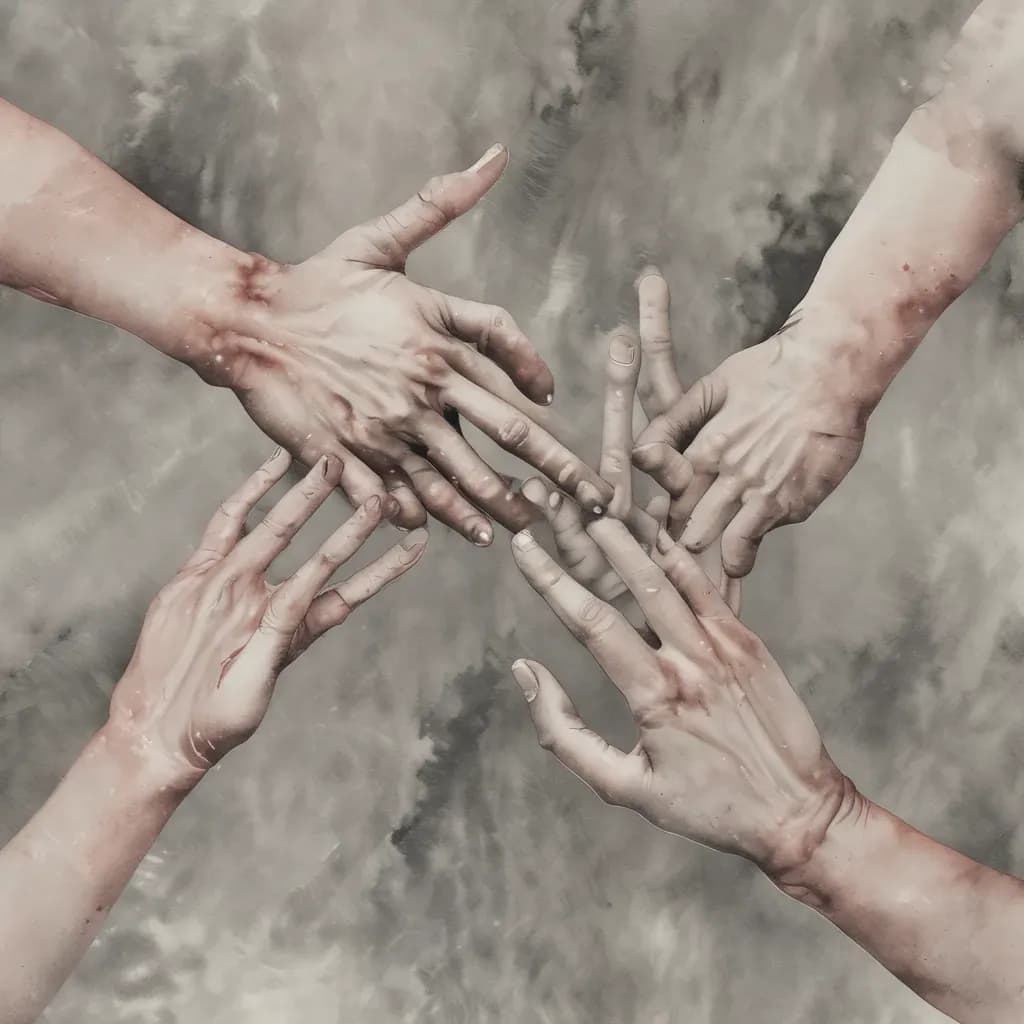
Confession Without Absolution
There is a long tradition in gospel and soul music of the confessional mode. Sam Cooke, one of Caton's primary vocal influences, understood that the most powerful songs often admit weakness rather than project strength.[5] Donny Hathaway, another clear influence, built much of his catalog on emotional transparency that bordered on ache.
Caton is working in this tradition. But "Don't Hate Me" is distinct from the gospel confessional in one crucial way. In gospel, confession is directed upward, toward forgiveness from a divine source. Here the confession is directed at another person. The pleading is the same, the emotional posture is the same, but the target has shifted from God to a lover.
That shift is what makes the song feel both deeply rooted in Caton's background and entirely his own.[7] He is not making gospel pop, nor simply borrowing a sonic aesthetic. He is applying a spiritual emotional language to a secular human situation. That translation is where the artistry lives.
Why This Song Resonates
Songs about romantic failure tend to fall into predictable patterns. Someone is wronged. Someone was wrong. Anger or grief follows. "Don't Hate Me" refuses those patterns. Its narrator is not wronged, and he is not wrong in the way that villains are wrong. He is simply limited, and he knows it.
That kind of emotional self-awareness is rare in pop music, and almost unheard of as a debut statement. Most artists arrive with confidence, with swagger, with the sound of someone who has something to prove. Caton arrives with an apology. And paradoxically, that makes him more compelling, not less.[2]
Initial reception has been warm. One outlet noted that if this single is any indication of what his forthcoming EP holds, Caton is on the verge of something significant.[2] Another described the performance as "emotionally beautiful soul-bearing."[4] The announcement of the single generated over 326,000 views and 19,000 likes on social media before the song was even available to stream.[8]
An Unexpected Debut
For a young artist who could easily have packaged himself around the excitement of "Sinners" and the Oscar-night performance, the choice to lead with something this introspective is deliberate and telling. At the Grammy Awards red carpet, Caton spoke of his forthcoming EP as something that would be "very, very different" and "a little bit unexpected."[9] "Don't Hate Me" confirms that instinct. This is not the sound of someone riding a wave. It is the sound of someone choosing depth over spectacle.
The music video, directed by Geoff Sean Levy and filmed at the Abrons Arts Center in New York City, reinforces this stripped-down sensibility.[4] The intimate space reflects Caton's Brooklyn origins, and the visual presentation is deliberately stripped of the cinematic grandeur that his film work might have licensed. The song carries the weight on its own.
A Promise Deferred
"Don't Hate Me" is a debut single that does what only the best debut singles do: it tells you exactly who an artist is while leaving most of the story still untold. Miles Caton arrives not as the star of a blockbuster film or the child prodigy who went viral at twelve, but as a singer who understands that love at its most complicated is not a feeling you can master, only one you can honestly describe.[10]
The song will almost certainly not be his most polished or technically accomplished work. His forthcoming EP will expand on these sonic textures and emotional territories. But as a first word, as a statement of intent, "Don't Hate Me" is something worth paying attention to: a young artist confessing to his limits and betting that honesty, by itself, is enough. Given the response so far, that bet appears to be paying off.
References
- Miles Caton - Wikipedia — Primary biographical reference covering career milestones, family background, viral moments, and awards
- Sinners' Breakout Star Miles Caton Debuts New Single 'Don't Hate Me' — Release coverage from The Quintessential Gentleman with critical assessment and EP anticipation
- Seven Things to Know About Sinners Star Miles Caton — Revolt TV profile covering family background including his mother Timiney Figueroa and aunt Anaysha Figueroa-Cooper
- Miles Caton Delivers Emotionally Heartfelt Cinematic New Video/Single, Don't Hate Me — Hip Hop Democrat review including production details, producer credit, and music video context
- Miles Caton On 'Sinners', H.E.R., And Loving Blues Music — Interview covering musical influences including Sam Cooke and Caton's experience touring with H.E.R.
- Interview: Miles Caton's Spiritual, Musical Connection to Sammie — AwardsWatch interview about the Sinners role, Coogler's discovery of Caton, and the spiritual dimensions of the character
- Who Is Miles Caton? — L'Officiel USA profile on Caton's background, artistic identity, and the translation of gospel influences into secular work
- Miles Caton - Don't Hate Me (2026) — Community reception and social media engagement data around the single announcement
- 'Sinners' Star Miles Caton Is Proof That Dreams Can Become a Reality — Hollywood Reporter interview including Grammy red carpet comments about the forthcoming EP being 'very different'
- Sinners' Star Miles Caton Drops 'Don't Hate Me' Debut Single — Hip-Hop Vibe coverage of the single release and Caton's emergence as a solo artist