El Vacio
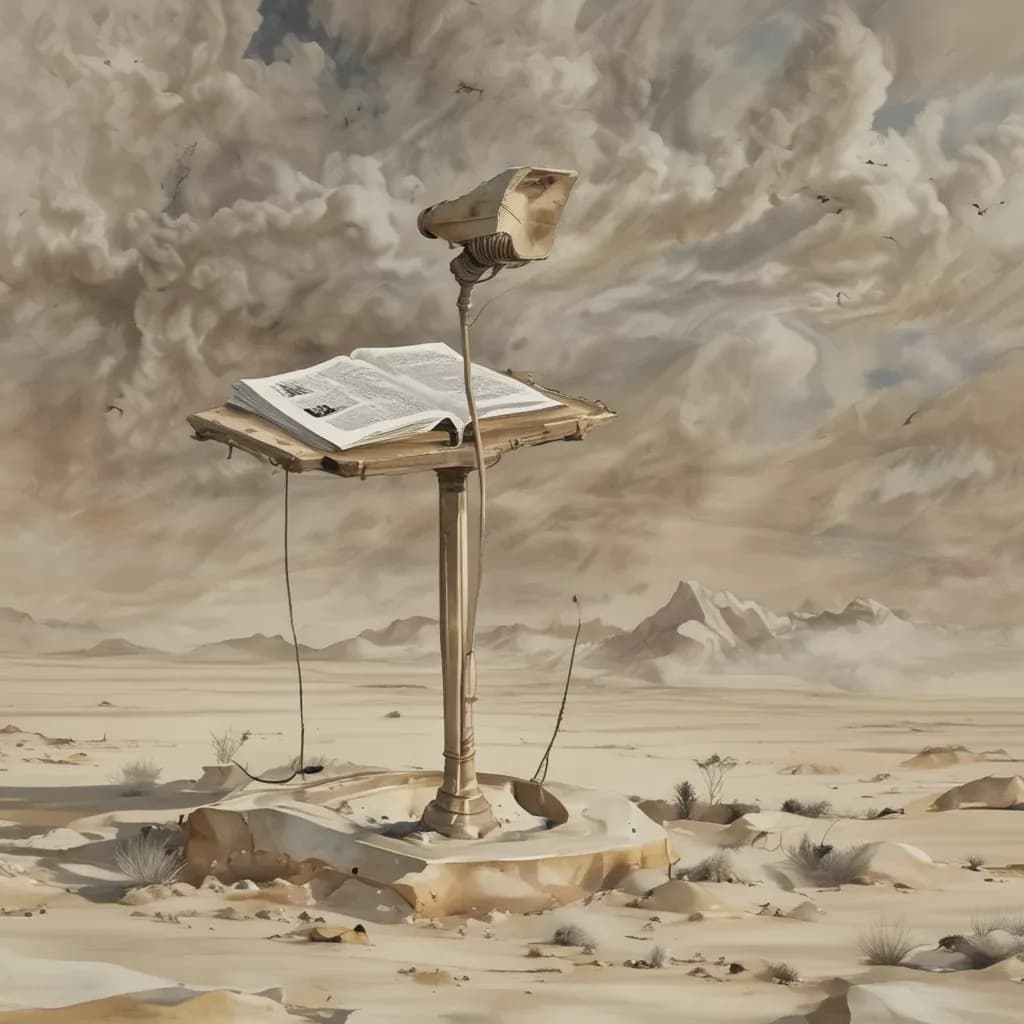
The Voices We Can't Replace
There is a particular cruelty in imagining what certain people would say about the world they are no longer alive to see. Hunter S. Thompson, the founding father of gonzo journalism, died in 2005 before smartphones became surveillance devices, before social media dissolved the boundary between opinion and reality, before American political discourse descended into a theater of absurdity that would have furnished him with material for decades. Dave Brockie, the velvet-tongued alien provocateur behind GWAR, died in 2014 before the culture wars curdled into their present, more nakedly authoritarian form, before the satirical targets grew so grotesque that genuine satire began to feel inadequate.
"El Vacio" mourns them both.
A Grave and a Title
The Spanish phrase "el vacio" translates to "the void" or "the emptiness." Randy Blythe chose a Spanish title for a song that is deeply, unmistakably American in its grief, and the choice feels intentional. Placing an American eulogy inside a foreign language introduces the perspective of an outsider, or of someone standing outside their own culture trying to describe its loss from a distance.
The personal act that preceded the writing is remarkable on its own terms. Blythe reportedly sat at Dave Brockie's grave in Hollywood Cemetery in Richmond, Virginia to compose the lyrics for this song.[1] Both men were products of Richmond's heavy music scene. GWAR was formed in that same city. The gesture of composing at a friend's burial site suggests not simply tribute but conversation, an attempt to speak to someone who can no longer respond, and to describe the vacancy their absence leaves behind.
Two Men, Two Verses, One Wound
The song is structured as a dual eulogy. The first verse concerns Thompson, the Kentucky-born journalist who invented gonzo as both a literary form and a way of life.[1] Thompson's genius lay in locating the absurdity and menace lurking inside American power, writing about corrupt institutions and deranged political figures with an acid clarity that made the reader feel the full weight of what was wrong. He did not merely observe; he flung himself into the chaos and reported back from the inside. Blythe has stated he would love it if Thompson had been alive to comment on the current political situation, believing the coverage would have been savage.[1]
The second verse turns to Brockie, the artist Blythe knew personally and mourns in more intimate terms. Brockie operated through the most outrageously theatrical possible framing: a latex-armored alien warlord using costume and excess to deliver some of the sharpest political satire in heavy metal. As Blythe has put it, beyond the rubber monster suits and stage-blood spectacle, GWAR was razor-sharp social commentary.[1] The satire was real, and it was effective precisely because of the absurdity surrounding it. The song contains a lyrical reference to Virginia that functions as a knowing geographical marker, acknowledging that both men were Richmonders, both cultural monsters in the most complimentary sense of the word.[1]
Together, Thompson and Brockie represent a shared tradition: truth-telling through artistic chaos, the use of transgression and excess as vehicles for precision. Both understood that the most damaging critique of power often needs to be delivered obliquely, through an angle of approach that the powerful do not immediately recognize as an attack. Blythe has described both figures as possessing a genius insight and ability to read people and situations, combined with the gift of delivering their thoughts with remarkable astuteness.[1]
What the Music Chooses Not to Do
Strategically, the most striking thing about "El Vacio" is what it refuses. Lamb of God is a band built around propulsive rhythmic violence, the kind of groove-metal architecture that punishes at live volumes and has remained a genre benchmark since Ashes of the Wake established them as a principal force in American heavy metal. Given two figures whose legacies deserve fierce defense, you might expect something relentless.
Instead, the band strips back. The track opens with a clean guitar lead that recalls the atmospheric work of Tool's "Schism": slow, deliberate, and quietly unsettling before any words arrive.[2] Reviewers at Distorted Sound described the soundscape as eerily gothic and industrial. Blabbermouth noted Blythe's clean vocals resonating over downbeat, sinister guitar figures and near-chewable, simmering tension.[3] The verse sections take on what Kerrang! described as a doomy, almost Alice In Chains-ish crawl.[1] The PRP drew an explicit comparison to Alice in Chains' "Rooster" as a memorial ballad of comparable emotional weight.[4]
The song does not abandon Lamb of God's sonic identity entirely. It eventually opens into full-throated roaring and solid riffs, as Ghost Cult Magazine noted.[5] But it takes its time, and that willingness to take time is where the emotional intelligence of the song lives. "El Vacio" arrives at track five, mid-album, where Distorted Sound described it as appearing like a clearing in a storm.[2] Hushed clean vocals giving way to full force is the sonic equivalent of grief itself: quiet, then overwhelming, then quiet again.
Into the Album's Larger Argument
"El Vacio" does not exist in isolation. It sits inside an album Blythe has described as an examination of the breakdown of the social contract, particularly the American social contract, accelerated by technology and the collapse of shared reality. The thematic seeds were planted on election night in November 2024, when Blythe took a solitary drive through rural North Carolina listening to The Cure's most recent album and began drafting lines.[6] He has estimated that roughly seventy-five percent of Into Oblivion engages directly with the ongoing breakdown of institutions, norms, and basic collective agreements that once governed public life.[6]
"El Vacio" contributes a specific argument to this reckoning: that the crisis is made worse by the absence of certain kinds of critical intelligence. The void of the title is partly the void left by Thompson and Brockie, but it maps onto a wider cultural vacuum. The voices that could most effectively name what is wrong, that could deliver their analysis with clarity and force, are no longer here to do it.
Critics received the album as one of the strongest of Lamb of God's career. Blabbermouth called it potentially the band's finest since at least 2015's VII: Sturm und Drang.[3] Metal Hammer described the record as a mallet to the back of the skull for anyone who believed the band's best days were behind them.[7] Ghost Cult awarded nine out of ten.[5] "El Vacio" was cited across multiple reviews as one of the album's most unusual and emotionally affecting moments, described by Blabbermouth as darker and more enigmatic than the surrounding material, layered and genuinely moving.[3] Riffology characterized it as part eulogy, part horror story.[8]
On the Choice of Spanish
It is worth returning to the title. Blythe could have called this song "The Void" or "The Emptiness" or any number of English equivalents. He did not, and the choice does real work.
The first effect is tonal. "El Vacio" sounds more elegiac than its English translation. The vowels carry a different weight. The phrase suggests the feeling of absence in a way that blunter English words do not.
The second effect is more critically loaded. American culture's reckoning with its own breakdown often comes most clearly from those positioned at its edges: from outsiders, from people the mainstream refused to take seriously, from artists who had to work in costume or at an oblique angle to say true things. Thompson wrote from the fringes of political power. Brockie wrote from behind a mask that most of the mainstream refused to engage with directly. Putting their eulogy in another language is a small act of solidarity with that tradition, a way of framing their work as belonging to a perspective that American culture, as currently constituted, has never fully welcomed.
Alternative Readings
The song's emotional territory is sufficiently open that it supports other readings alongside its biographical core. "El Vacio" can be heard as a meditation on the general scarcity of genuine critical voices in the current media environment, not just the loss of two specific individuals but the loss of a mode of engaging with public life that they exemplified.
It can also be read as Blythe's own reckoning with the limits of what he can do in the absence of these voices. He is not Thompson. He is not Brockie. He is a metal vocalist writing about the breakdown of American society, and "El Vacio" is partly about the gap between what the moment requires and what any single artist can provide. That gap is another kind of void.
The song's musical restraint supports this reading. A more aggressive track would assert capability, power, the ability to meet the moment with force. "El Vacio" pulls back instead, dwelling in the space where the loudest voices should be. The quiet is deliberate. It is the sound of absence made audible.
What the Song Holds
"El Vacio" is not Lamb of God at their most technically demanding. It does not announce itself immediately as a highlight of a record full of more overtly aggressive material. But it earns its position in the album's architecture precisely because it is willing to be quiet in a way the surrounding tracks are not.
Distorted Sound wrote that the grief in the song is real, and that it changes how everything around it sounds.[2] That is the most concise available description of what the track achieves. Grief, when it is genuine and specific, radiates outward. It makes the material on either side of it mean something different. "El Vacio" functions as the emotional axis of Into Oblivion, the point around which the album's broader argument about cultural collapse and lost community turns.
The image of Blythe sitting at his friend's grave in Richmond to write these words is, in the end, the key to understanding the song. It is not about death in the abstract. It is about specific human beings who understood something important and took that understanding with them. It is about the sensation of knowing exactly who you wish were still here, and having no way to call them back.
That is what el vacio means. That is what the song holds.
References
- Kerrang!: Lamb of God Cover Story Interview (Randy Blythe on Into Oblivion) — Primary source: Blythe discusses El Vacio's subjects (Thompson and Brockie), writing lyrics at Brockie's grave, and both figures' importance as critical voices
- Distorted Sound Magazine: Lamb of God - Into Oblivion (Review) — Review describing El Vacio as eerily gothic and industrial, a clearing in the storm mid-album, with grief that changes everything around it
- Blabbermouth: Lamb of God - Into Oblivion (Review) — Review calling El Vacio darker and more enigmatic, praising Blythe's clean vocals over sinister guitar figures; rated album 8.5/10 as potentially finest since VII
- The PRP: Lamb of God - Into Oblivion (Review) — Review comparing El Vacio to Alice in Chains' Rooster as a weighty memorial ballad
- Ghost Cult Magazine: Lamb of God - Into Oblivion (Album Review) — 9/10 review praising El Vacio as a highlight, noting the transition from hushed clean vocals to full-throated roars
- Consequence of Sound: Randy Blythe Interview - Into Oblivion — Interview where Blythe discusses the album's genesis on election night 2024 and the themes of social contract breakdown
- Louder Sound / Metal Hammer: Lamb of God - Into Oblivion (Review) — 4/5 review calling Into Oblivion Lamb of God's best album in over a decade, a mallet to the skull of doubters
- Riffology: Into Oblivion by Lamb of God (Album Review) — Review characterizing El Vacio as part eulogy, part horror story contemplating what Thompson and Brockie would make of the world today
- Wikipedia: Into Oblivion (album) — Album overview including recording details, track listing, and reception summary