Flyway
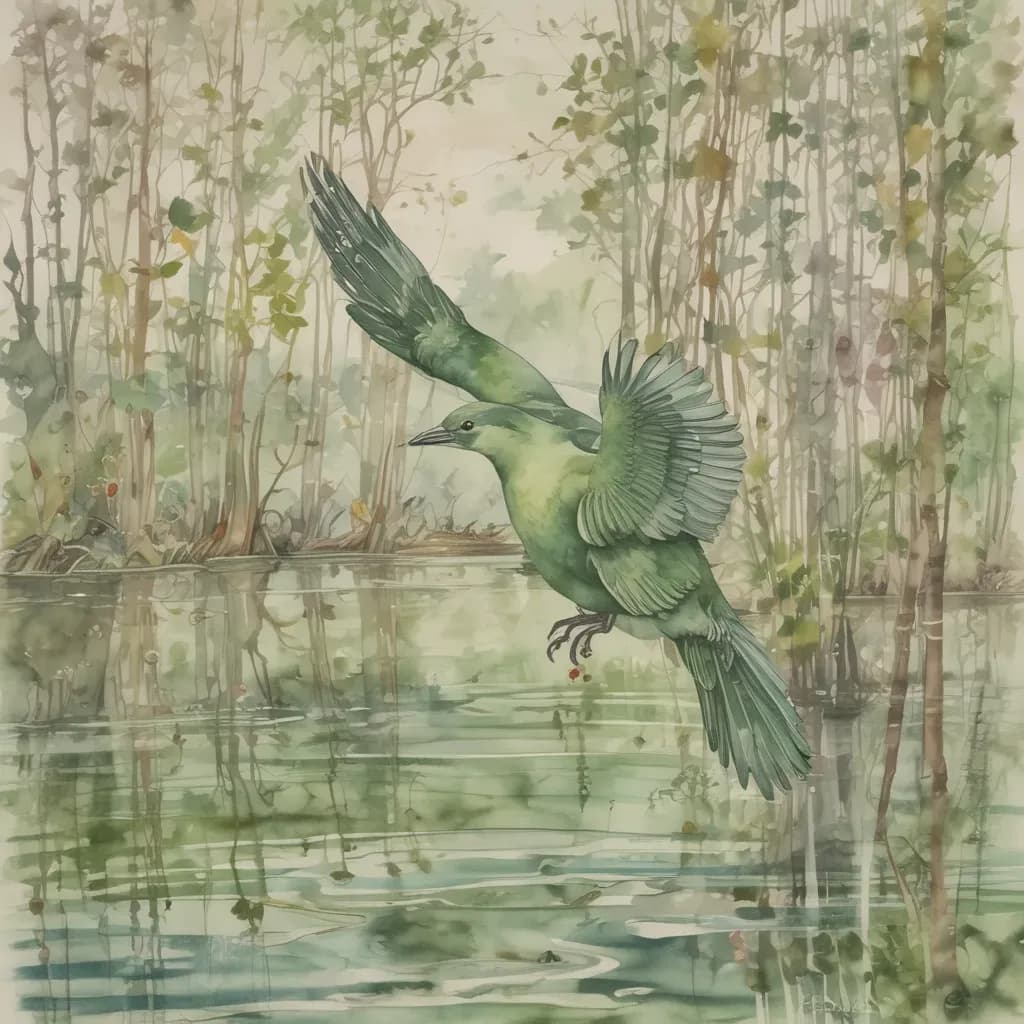
The rose-ringed parakeets of South London do not belong here, at least not in any conventional ecological sense. They are refugees from subtropical regions of Asia and Africa, somehow established in the parks and gardens of Bromley, Richmond, and Kensington, a persistent flash of tropical green against the grey English sky. Nobody entirely agrees on how they arrived. Some stories credit a film set accident; others point to the 1960s, when parakeets were fashionable pets and escapes were common. Most likely they are simply the accumulated descendants of birds that slipped their cages over decades, building a life in a place that was never meant for them.
Sarah Midori Perry was sitting on a bench in Church House Gardens in Bromley when she wrote the lyrics to "Flyway" in essentially one sitting. She was watching these parakeets. The band confirmed this origin during a Tim's Twitter Listening Party session in February 2021, noting that the song references those specific gardens directly.[1] In that single afternoon, Perry captured something that takes many artists entire albums to approach: the quiet, specific ache of watching something free move through space you cannot follow it into.
Written on a Bench
"Flyway" is the fourth track on Kero Kero Bonito's second studio album Time 'n' Place, released as a surprise on October 1, 2018, with no traditional advance announcement. At just under two minutes, it is one of the album's briefest pieces.[2] That brevity is not a limitation; it is the song's method. It arrives and disappears like something seen from the corner of your eye.
The word "flyway" is an ornithological term: a migratory corridor, a highway through the sky that birds follow season after season by instinct. Some flyways connect Arctic breeding grounds to equatorial wintering sites across thousands of miles. The parakeets of London do not technically migrate. They are permanent residents of the city's parks and gardens. But the concept of the flyway, a path through the air that belongs to you by biological inheritance, gives the song its central tension between freedom and rootedness.
Perry wrote the song during a period of concentrated personal loss. In the years before the album, she learned that her childhood home in Otaru, Japan had been demolished. Her primary school was closed.[3] More intimately, her budgie named Nana, a bird she had received shortly after moving from Japan to England at age thirteen, died in 2017.[4] Nana had been a companion across the disorientation of adolescent immigration, a living connection to the life Perry had left behind. When Nana died, something specific and irreplaceable went with her.
The song does not name any of this directly. On its surface it is about watching birds in a park. The emotional freight beneath that watching is what gives it weight.
The Weight of Watching
A flyway is not just a path. It is the recognition that birds carry their routes within them, an inherited knowledge of where to go encoded before any individual bird takes its first flight. The narrator watches the parakeets cut across the South London sky and feels something shift, a wistfulness at the sight of creatures that know exactly where they need to be.
The parakeets are a particularly resonant image for Perry. They are non-native, like herself: a Japanese woman who has lived in Britain since her teenage years. They did not originate in the English landscape, yet they have adapted to it and made it home. They move through Bromley with total confidence, a confidence the song's narrator, watching from the bench below, does not seem to share.[5]
At its emotional core, "Flyway" is about wanting to leave without quite having the courage to go. The music video, shot on Hi-8 tape in a grainy 4:3 aspect ratio by Jamie Bulled, reinforces this reading.[6] It places Perry in the park among the birds themselves: feeding them, moving through the same grass and air. The analog video format, with its VHS warmth and soft focus, gives the footage a quality of memory even as it is being recorded, as though the moment is already receding as you watch it.[7] Here is someone close to the birds, in the same space as them, but still earthbound.
Grief operates in the song at one remove. Perry does not sing about Nana directly, but the loss of a pet bird, of a creature that offered daily intimacy with something representing lightness and movement, shadows the whole piece. There is a particular bittersweet quality to watching wild birds fly freely when you have just lost one that lived beside you, dependent on your care. The wild birds cannot be held. Your bird could be. Both facts carry a specific kind of sorrow.
The specific geography matters enormously. Time 'n' Place is, at its heart, an album about vanishing physical spaces, and Church House Gardens anchors "Flyway" in one that still exists. The lyrics reference those gardens directly, describing a quality of the water there.[1] Perry wrote the song on a bench at that exact spot. The song does not travel; it is rooted to one bench, one afternoon, one particular flock overhead. Its longing for flight is all the more acute for being so precisely located.
The Sound of the Suburbs
One of the ways Time 'n' Place distinguishes itself from Kero Kero Bonito's earlier work is its willingness to sit with a feeling rather than redirect it into brightness. The band's 2016 debut Bonito Generation was built on what they called radical positivity, a deliberate and philosophically committed cheerfulness. For Time 'n' Place, that philosophy bent under the pressure of real events: the demolished home, the closed school, the hospitalized father, the dead bird.[5][3]
"Flyway" is the album's most compact expression of what might be called watchful mourning. It does not perform sadness; it observes something in the world and lets that observation carry the weight. The two-minute runtime is exactly right for it. More would dilute it.
Critics recognized the track's particular quality. AllThingsLoud described it as a piece that "feels like it could have come from a completely different Britpop band," praising its direct, guitar-forward approach within an otherwise sonically adventurous album.[8] That framing is apt. Gus Lobban has spoken about deliberately maintaining what he called the "sound of the suburbs" on the record, the guitar band aesthetic of Bromley and areas like it. "Flyway" is suburban in the best sense: specific, quiet, observational, aware that the world is larger than your immediate situation.[9]
The album was recorded partly in Lobban's bedroom in Bromley and partly at Press Play Studios in Bermondsey, where a five-day live session captured the full band's performances. The sonic palette throughout draws on My Bloody Valentine's layered noise, Lush's melodic shoegaze, and the emotional candor of Mount Eerie, and "Flyway" carries all of those influences in its brief runtime.[2]
Other Ways to Read It
"Flyway" is open enough to sustain multiple readings. Heard one way, it is a song about immigration, about being, like the parakeets, a non-native presence that has adapted to a place without fully belonging to it. Perry grew up in Japan, lives in England. She exists between two cultures and two linguistic identities, a condition the parakeet metaphor handles with quiet precision. Those birds did not choose London. They adapted to it. They thrive in it. But they remain, visually and taxonomically, creatures of somewhere else.
There is also an environmental reading available in the image. Rose-ringed parakeets are one of the more visible examples of introduced species in urban England, and their presence is an index of a world in which climate change and human movement have scrambled what belongs where. The song does not foreground this dimension, but the image of a bright tropical bird against a grey British sky carries the thought.
The simplest reading is perhaps the most durable. This is a song about wanting to go, to move, to change, and finding yourself instead sitting on a bench watching others do it. That experience of inertia adjacent to longing is one of the most universal feelings there is. "Flyway" names it without explanation and without self-pity, and it is over before you can fully register what it has just said.
Still There
Church House Gardens in Bromley is not famous. It does not feature in tourist guides or critical surveys of important music locations. But because Sarah Perry spent an afternoon on one of its benches watching parakeets, it has become a specific coordinate in the emotional geography of modern British indie music.
"Flyway" is a small song that does large work. It holds a death (a budgie named Nana), a displacement (Japan to England), and a fundamental human longing (to follow the birds upward) inside a runtime that most artists would spend on a single chorus. The compression is the achievement. Nothing is explained, nothing is resolved, and the song ends before you can ask it to.
The parakeets of South London are still in those gardens, still living year-round in parks never designed for them, still flashing green against the English grey. They did not choose their flyway. They follow it all the same.
References
- Kero Kero Bonito on X (Tim's Twitter Listening Party, Feb 2021) — Official band statement on the origin of Flyway: written on a bench in Church House Gardens, Bromley, while watching parakeets
- Time 'n' Place - Wikipedia — Album overview, recording context, chart performance, critical reception
- Kero Kero Bonito Talks Traversing Time 'n' Place - KEXP — Sarah Perry on the demolition of her childhood home and school closure as catalysts for the album
- Flyway | Kero Kero Bonito Wiki | Fandom — Song details including personal context of Nana the budgie's death in 2017
- Kero Kero Bonito Are Smiling Through It All - The Fader — 2018 interview on personal losses and the emotional foundation of Time 'n' Place
- Video: Kero Kero Bonito - 'Flyway' - SPIN — Coverage of the Flyway music video premiere, Hi-8 tape, 4:3 aspect ratio
- Kero Kero Bonito share VHS-like video for 'Flyway' - HighClouds — Description of the Flyway video's analog aesthetic and park footage
- Kero Kero Bonito - Time 'n' Place review - All Things Loud — Review noting Flyway feels like a Britpop track from a different band, 9/10 rating
- Kero Kero Bonito finds solace in chaotic sounds - i-D — Interview covering Lobban on the suburban guitar sound aesthetic