Time 'n' Place
About this Album
A Departure Driven by Grief
When Kero Kero Bonito released Bonito Generation in 2016, the band had found a precise creative niche: bubblegum synth-pop inflected with the energy of Japanese idol music, delivered with Sarah Midori Perry's bilingual charm. It was a debut that generated real affection. Two years later, Time 'n' Place landed on October 1, 2018, via Polyvinyl Record Co.[1] Everything had changed.
The shift was not aesthetic restlessness. In the period between albums, all three band members experienced significant personal loss.[2] Gus Lobban's father was hospitalized; the experience of sitting in a waiting room while a parent's condition hung in the balance became direct material for the record.[3] For Perry, the catalyst arrived in the form of a text message from her brother: a photograph showing that the family home in Japan, the house where she had grown up, had been demolished and reduced to bare earth.[2] Something that had always existed as a background certainty, a place one could theoretically return to, was simply gone. The album was built around that feeling.
The Impossibility of Return
The album's central preoccupation is the impermanence of physical places, and what it means to lose access to the sites that shaped you. Perry has described the experience as a feeling of irrevocability: not just sadness, but the specific grief of knowing you cannot go back. The places that once held your memories are no longer there to receive you.[2]
Woven into this is a pointed tension between physical reality and its digital representations. The very scenario that inspired Perry enacts this tension: a childhood photograph, analog in origin, converted into a text message, arriving as pixelated news of permanent erasure. The album's cover extends the metaphor, assembling personal objects that have been scanned, digitized, and reconstituted into a collage.[4] Physicality as a theme runs throughout the record. The band was consciously working against the increasing migration of life and music into virtual space, insisting on the weight and irreplaceability of things that exist in three dimensions.[2]
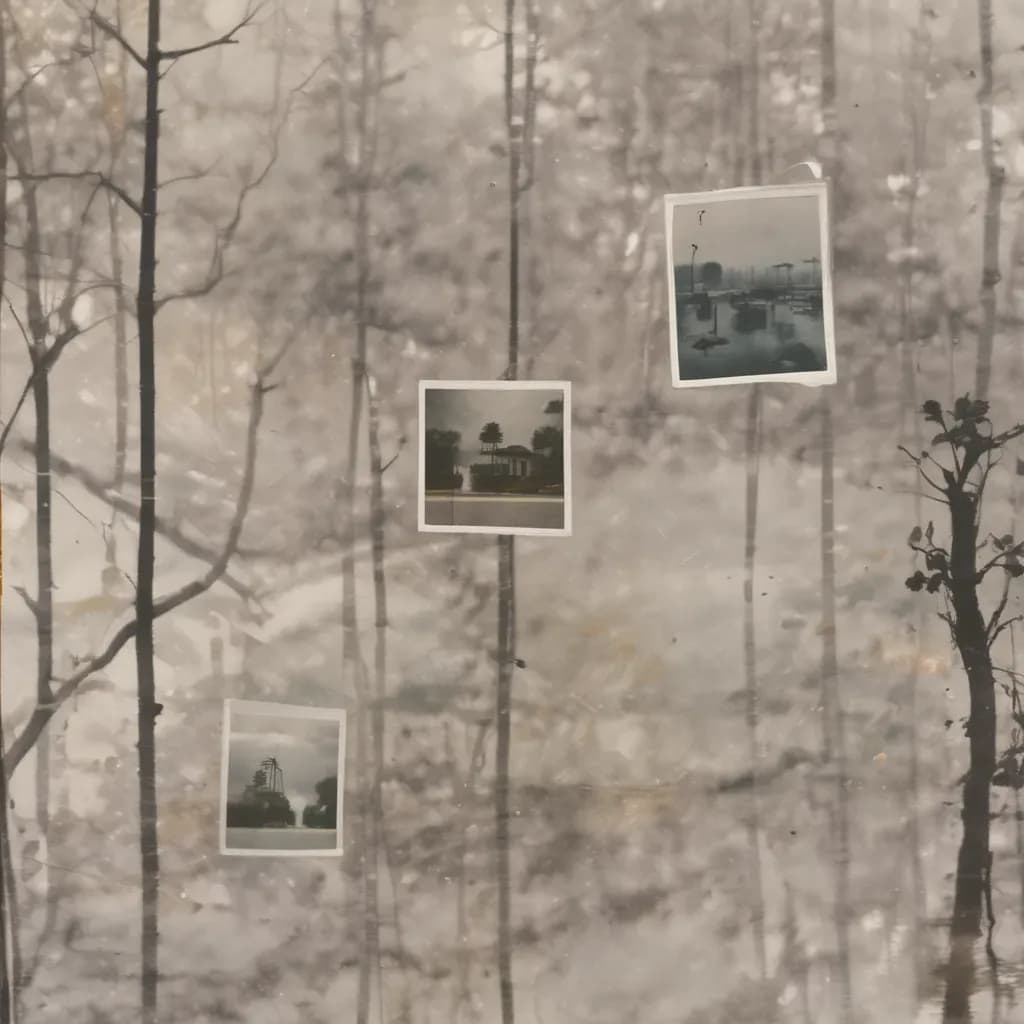
Dreaming in Suburban Time
Perry has described experiencing recurring dreams during the writing period in which past locations and present-day people coexist. A water park from her childhood, populated by her current bandmates. Her primary school's hallways, but the people moving through them don't belong to that time.[4] It is the logic of memory rather than chronology: everything collapsing into the same undifferentiated space, the timeline bending under its own emotional weight.
The settings throughout the album are notably ordinary. Water parks, primary schools, rest stops, suburban streets: not glamorous or poetically elevated, but precisely the kinds of places that shape a childhood without making any particular claim to importance. The album insists that these unremarkable spaces carry real emotional weight, and that their loss constitutes genuine grief. The band has described the record as "very suburban," rooted in their own backgrounds in south London and provincial Japan, and that rootedness is part of what gives it its specificity.[3]
Shoegaze as Emotional Language
The sonic transformation is inseparable from the thematic one. Gone are the laptop-processed synths and J-pop structures of Bonito Generation; in their place, guitars distort and shimmer, drums crack with analogue warmth, and the whole production reaches toward the guitar-based indie rock the band grew up with. My Bloody Valentine, Lush, CSS, and the American duo Crying are all touchstones they have explicitly named.[3] These are genres that carry their own temporal associations, their own relationship to a specific era of guitar music, and drawing on them is itself an act of musical memory.
The band expanded for live performances to include drummer Jennifer Walton and guitarist James Rowland.[1] The recording process itself took a collage approach: layering home demos with studio sessions, incorporating contributions from musicians who in some cases never physically met the band.[4] This tension between presence and absence, between people playing together in rooms and the disconnected fragments of remote collaboration, echoes the album's broader concerns. The production method and the album's themes are mirrors of each other.
Hope as the Other Side of Loss
It would be a mistake to receive this as a purely elegiac record. Lobban has been explicit about the emotional position the band was trying to occupy: not resignation to darkness, but a refusal to let grief foreclose on hope. The acknowledgment that things are difficult, combined with a genuine belief that better times can return.[3] Perry has articulated a similar view, framing darkness and light as genuinely interdependent rather than opposed.[2]
This balance shows up in the structure of the music. Songs end abruptly, cutting off before any easy resolution. The 32-minute runtime keeps the listening experience dense and slightly disorienting.[1] But the record was also deliberately conceived as an album in the fullest sense, a cohesive arc with its own internal logic, released in deliberate opposition to a streaming landscape that had largely dissolved the album format into atomized singles.[4] That conviction, the belief that a record could still make an argument, carries its own kind of hope.
A Record That Knew Its Moment
Critical response was mixed-to-positive, aggregating to a score of 69 on Metacritic.[5] Pitchfork gave it a 6.5, praising the conceptual framework while arguing the melodies didn't always match the ambition.[6] Exclaim! was warmer, calling it probably the most cohesive album Kero Kero Bonito had made.[7] Sputnikmusic ranked it among the year's best, describing it as the darkest thing the band had ever done.[8] Commercially, it performed well for an indie record, reaching number one on Billboard's Heatseeker chart and placing in the top five on the Vinyl Albums chart.[1]
In retrospect, Time 'n' Place reads as an artistic inflection point, the record on which Kero Kero Bonito decided, clearly and irreversibly, what kind of band they wanted to be. The willingness to abandon the bubblegum formula that had defined them, to follow grief into new sonic territory, produced an album that takes seriously the emotional weight of ordinary places and the specific, irretrievable quality of time. It is a record about the impossibility of going back, made by artists who, in making it, found a way forward.
Songs
References
- Time 'n' Place - Wikipedia — Release date, chart performance, track listing, critical scores, touring musicians
- Kero Kero Bonito on 'Time 'n' Place' - i-D Magazine — Interview covering personal losses, Perry's demolished childhood home, physicality as theme, hope and darkness
- Kero Kero Bonito Interview - The FADER — Lobban on his father's hospitalization, hope/darkness quote, musical influences including Crying
- Kero Kero Bonito Talks Traversing Time 'n' Place - KEXP — Deep dive into Perry's recurring dreams, collage production approach, album cover as time capsule
- Time 'n' Place - Metacritic — Aggregate critical score of 69/100
- Kero Kero Bonito: Time 'n' Place Review - Pitchfork — 6.5/10 review praising conceptual framework while critiquing melodic execution
- Kero Kero Bonito - Time 'n' Place Review - Exclaim! — 8/10 review calling it probably the most cohesive KKB album yet
- Kero Kero Bonito - Time 'n' Place Review - Sputnikmusic — 4.0/5 review describing it as the darkest thing the band has ever done