Ghost
Some songs begin quietly and build toward a breakdown. "Ghost" starts after the breakdown has already happened. Liv.e's October 2022 single arrives with a yell, a skittering breakbeat and a wobbling synth haze[5], and it never offers the listener a safe place to stand. It is a song about what the first days of a real loss feel like from the inside: loud, disoriented, and strangely hard to describe.
The song and its moment
"Ghost" was the first preview of Girl in the Half Pearl, released on October 14, 2022, months before the album itself arrived in February 2023 on In Real Life[5][1]. Liv.e, a Dallas-raised, Los Angeles-based artist, had made her name on the woozy, diaristic neo-soul and lo-fi psychedelia of her 2020 debut Couldn't Wait to Tell You...[5]. This single was a deliberate swerve away from that sound.
She has been unusually direct about the emotional source. In her own words, the song was made in observation of herself going through the stages of grief after a major loss[6]. She added that the visuals were meant to mirror both the energy of the song and her state of mind when she wrote it[6]. The loss in question sits inside the larger story of the album, which she has described as written after a relationship of roughly four years that pulled her in every direction[1].
It is worth pausing on what that swerve cost her. The debut was frantic and dissociated but also tender, and critics had been quick to file her as an heir to the Soulquarians, a comparison she finds outdated[2]. "Ghost" announced that she had no interest in staying in that lane. By leading with her harshest, loudest material, she told listeners to expect an album built from nerves rather than comfort, and the rest of the record bears that out.
Grief without a straight line
The popular shorthand for grief is a staircase: denial, anger, bargaining, depression, acceptance. "Ghost" treats those stages as a tangle. The FADER's reading is that the song's fury becomes tinged with doubt and fear as it goes on, so the anger is never pure[5]. Liv.e has offered a useful key to this herself elsewhere, describing anger as the shadow of sadness[1]. On that logic, the shouting in the song is not the opposite of sorrow. It is sorrow with its fists up.
The lyrics, described in general terms, trace someone who has registered the departure of a partner in the body before the mind has caught up. There is a physical, almost intrusive awareness that the other person is truly gone. There is also a moment of stubborn independence, the narrator insisting she needs no help, undercut almost at once by a plain wish to return somewhere safe. Pride and exhaustion take turns at the microphone.
That alternation is the song's emotional engine. A reviewer at Spectrum Culture hears the screamed climax as a longing for safety rather than for an actual address, a craving to be held that has nothing to do with a building[3]. It is a good reading of how the track works. Home, here, is a feeling that went missing with the person.
Haunting as a way of describing absence
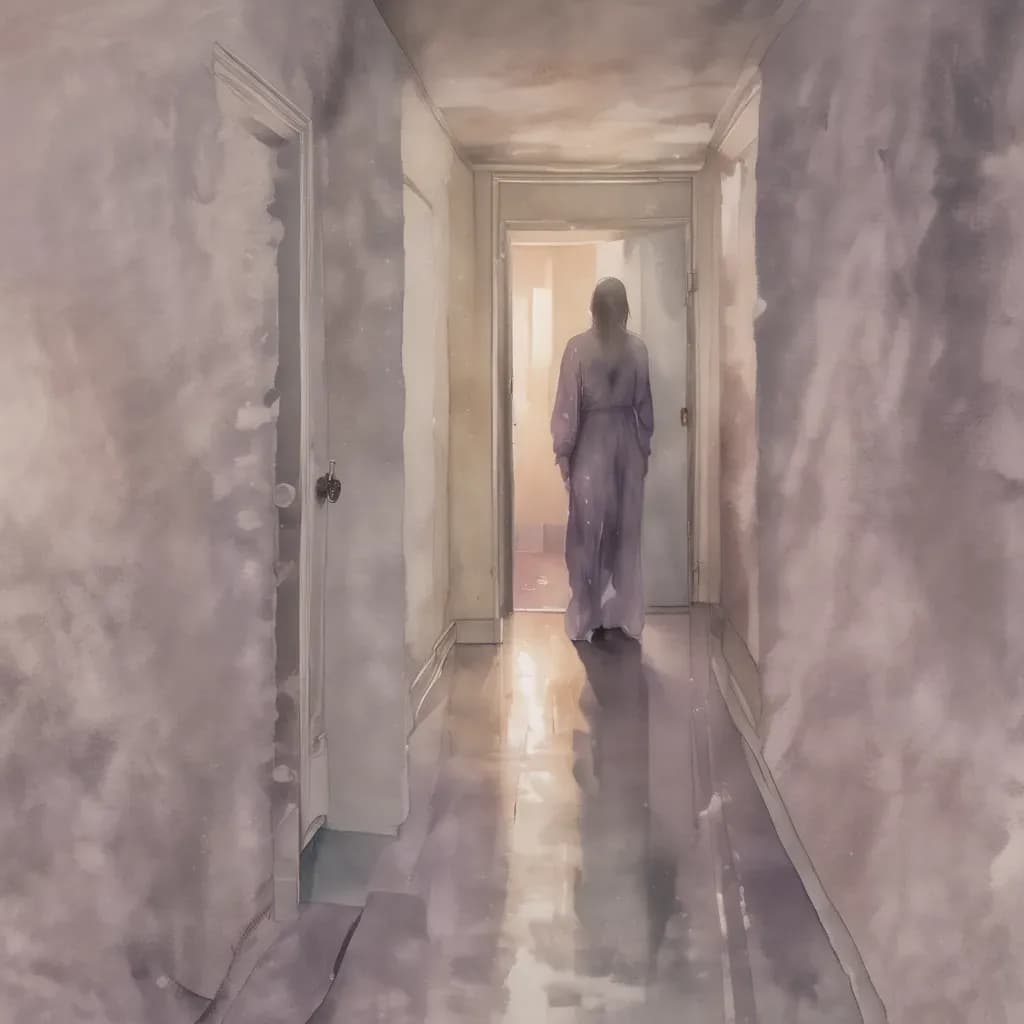
The title carries its own metaphor. A ghost is what remains when something has ended but has not finished leaving. Applied to a breakup, it can point in several directions at once. The ex becomes the ghost, lingering in habits and rooms. The narrator becomes the ghost, drifting through her own life half present. Or the relationship itself turns into the apparition, a thing that no longer exists but still makes noise at night.
The arrangement supports all three. Rather than settling into a groove, the track lurches between a fast, nervy rhythm and softer passages, with the soft hum of electric keyboards acting as a bridge away from the calamity, as the Stereogum interviewer puts it[2]. The track closes by dissolving into twinkling keys[5]. After all that noise the ending feels like a presence withdrawing from the room rather than a problem being solved.
A body made of sound
Musically, "Ghost" is among the most violent turns on a violent record. Stereogum describes it as drum 'n' bass colliding with thrash punk[2]. Spectrum Culture places it with Six Weeks among the album's terror-inducing cuts, with jazz-inflected jungle drums behind a voice that swings between sweet melody and visceral howls[3]. The Line of Best Fit adds that she has never sounded more exposed, even with her voice cracked by distortion, and notes a drunken piano loop beneath her scat-like howling[1].
Those details matter because they show the song is not simply loud. The distortion is a way of showing damage. A voice that cracks under its own volume tells you what the narrator cannot say in complete sentences. Liv.e has said she wanted the album's songs to feel like different drugs, and she cited The Slits, Sonic Youth and Prince's more abrasive side as touchstones[4]. "Ghost" reads as the speed-and-adrenaline end of that spectrum, a track that wants you to feel the panic physically.
It also helps to remember where the debut came from. Liv.e has said she made Couldn't Wait to Tell You... at nineteen in her mother's house, as a fantasy of what love would be, and that the new record is the reality that followed[4]. Hearing "Ghost" against that earlier softness, you can sense how much the idea of love had to be broken before this music could exist.
The sequencing of the record gives the song further context. Spectrum Culture notes that the album alternates sweeter and heavier songs, and that the screamed intensity of "Ghost" is followed directly by a soulful, lovesick track called Find Out[3]. The effect is whiplash on purpose. A person in grief does not stay in one register for long, and the album is built to match that instability, swinging from fury to yearning without a transition.
The same instinct shows up in how the album moves between songs. Liv.e has said the fast run-ins from one track into the next were inspired by cartoons and video games she grew up with, naming Sonic the Hedgehog and The Powerpuff Girls[1]. It is an odd pairing with such raw material, and it is part of what makes the record feel like a childlike mind processing an adult wound. "Ghost" lands inside that frame, a burst of speed that feels both playful in its structure and terrifying in its content.
The visual language of fracture
The video makes the metaphor literal. Directed by Liv.e and shot with the Oakland-based Qlick and Flatspot over two days, it bathes her in red and blue light and shows her through what looks like a fractured, kaleidoscopic lens[7]. Splintered imagery is a fitting match for a song about a self that has been cracked open. It also rhymes with the album's origin story: she has said the title came from a moment of detachment in which she pictured a tiny version of herself inside a shaken snowglobe, and her fourth wall broke[2].
That snowglobe image and the shattered lens are two versions of the same experience. In both, the person watching is also the person being watched, and the world has been shaken hard enough that nothing is settling yet. "Ghost" is the sound of that moment before the flakes fall.
Why it resonates
Plenty of breakup songs aim for catharsis, a clean release that lets the listener move on. "Ghost" refuses the tidy version. It does not tell you the pain will pass. It does not even tell you the pain is justified. It simply lets rage, panic and homesickness occupy the same three minutes, which is closer to how loss feels in the first weeks.
There is also something freeing about the song's lack of self-consciousness. Liv.e has said the album's chaos reflects how chaotic her life was at the time, and she has called the project the death of her past self[1]. The record treats that death as a necessary stage, not a tragedy to be tidied. Hearing "Ghost" as an early step in that process makes its extremity easier to understand. It is not the album's thesis. It is the first shock.
For listeners who have gone through a separation that rearranged their sense of who they were, the song offers something useful: permission to be unreasonable. Nothing in it is polite, and nothing in it is dishonest.
Other ways to hear it
Not everyone will hear a breakup. The artist's own framing, grief after a major loss, is broad enough to include a death, a friendship, a version of oneself or a future one had planned[6]. Because the song's imagery is bodily rather than narrative, it sustains those readings. A listener who has lost a person to something other than a breakup can find the same stages in it.
Another approach treats the ghost as the self the singer is about to leave behind. If the album is a rebirth, as she has framed it, with the half pearl as a womb and the pearl as an egg[4], then the early songs are the labor, and the ghost is what the old self becomes on its way out. On that reading the screaming is not only an expression of pain. It is the effort of passing through.
A third reading focuses on the voice rather than the words. Because so much of the vocal is howl, scat and shout, a listener can take the song as an argument that some feelings resist language. The lyrics supply a few plain admissions, but the real communication happens in timbre. When a voice cracks, no one needs a translation.
A fourth, more cautious reading notes how little the song resolves. Grief is often described as something you work through, yet "Ghost" ends without a lesson. That absence may be the point. Placed early in the album's run, it works less as a statement of conclusions than as a document of a state, and the later songs are free to argue with it.
Finally, there is the question of performance. Liv.e has said she wanted the album to sound like inner thoughts[2], and "Ghost" may be the clearest case. It does not present grief as something shaped for an audience. It presents the unedited version, the one that happens at night and alone, and trusts the listener to stay in the room.
Conclusion
"Ghost" is not the most accessible entry in Liv.e's catalog, and it does not try to be. It is a compact, ferocious portrait of a person in the first weeks after something fundamental ended, still deciding whether she is angry, afraid or simply tired. The breakbeats, the distortion and the sudden softness at the close all serve that single purpose.
What lingers is the ending. After the howling, the track thins into small, bright keys, and for a few seconds the room is quiet. Whatever haunted it has not gone, but it is no longer shouting. That small mercy is the song's most honest gesture.
References
Keep reading
More Alternative R&B
- Whispers in the Wind Jordan Rakei
- butterflies. Brent Faiyaz
- Solar Eclipse Drake & Don Toliver
- point blank heavensouls & Kelela
- Paradise Jordan Rakei
- Gladly Tirzah