Honest
There is a particular kind of fear that comes not from danger but from visibility: the fear of being known completely, without the protective distance of performance or restraint. Dermot Kennedy has built his career around exploring that fear, but on "Honest," he does something more demanding than simply naming it. He follows it to its source, excavating the ways people construct emotional armor and then asking what happens to love when the armor finally falls away.
The Final Signal Before the Album
"Honest" arrived as the third and final single from The Weight of the Woods, released in late March 2026, just days before the album's April 3 debut.[1] Kennedy's choice to hold this track back as the last preview of the album was deliberate. As the song that gives the album's central theme its most concentrated expression, it functions as both invitation and statement. Released via Island Records and accompanied by an official visualizer, the single signaled clearly what kind of record listeners were about to receive: not a stadium-ready polish job, but something more intimate and more risky.
Kennedy described "Honest" as a song he loved profoundly, one he had dreamed of playing live.[2] That kind of statement, rare in its unguarded simplicity, is itself a demonstration of the song's ethos.
Background: Kennedy at a Turning Point
The Weight of the Woods was created during one of the most psychologically and physically turbulent periods of Kennedy's career. After years of intense touring behind Without Fear (2019) and Sonder (2022), Kennedy discovered his voice was failing.[3] The problem wasn't illness, it was technique: years of performing with chronic tension had been quietly strangling his upper register from the inside.[4] The realization led to two weeks of complete vocal silence and an extended period of relearning how to sing from the ground up.[4]
This crisis created the conditions for the album's candor. Kennedy, forced to confront what he had been doing habitually and unconsciously, emerged with a clearer sense of what he actually wanted to make. He worked with producer Gabe Simon, who traveled from Nashville to spend six weeks in Rathcoole, Kennedy's hometown on the southwestern edge of County Dublin.[1] Together they gathered instruments from across Ireland and worked outward from Kennedy's own landscape: the forest behind his house, the walking routes he knew by heart, the particular textures of rural County Dublin.[1]
"Honest" emerged from that context. It is a song that could only have been written by someone who had recently stared down the prospect of losing his voice and found the experience clarifying.
Themes: The Armor and What Lies Beneath
The song's central argument is that emotional guardedness is not a character flaw to be corrected but something closer to an original condition: a deeply human strategy for managing the unbearable risk of full exposure. Kennedy's narrator does not condemn this guardedness. He understands it, even sympathizes with it. But he also traces its cost, the way it slowly places distance between a person and the connections they most need.
Kennedy has characterized the song's emotional core as the "original sin" of relationships: the instinct to hide the most vulnerable parts of oneself precisely in the moments when showing them matters most.[2] The chorus introduces an image of inner color spilling involuntarily outward, the self bleeding through defenses that can no longer contain it. It is a striking metaphor because it frames honesty not as a virtuous choice but as an inevitability. You cannot permanently contain what you genuinely feel. The question is not whether the truth will emerge, but whether you allow it to emerge before the damage of suppression becomes irreversible.
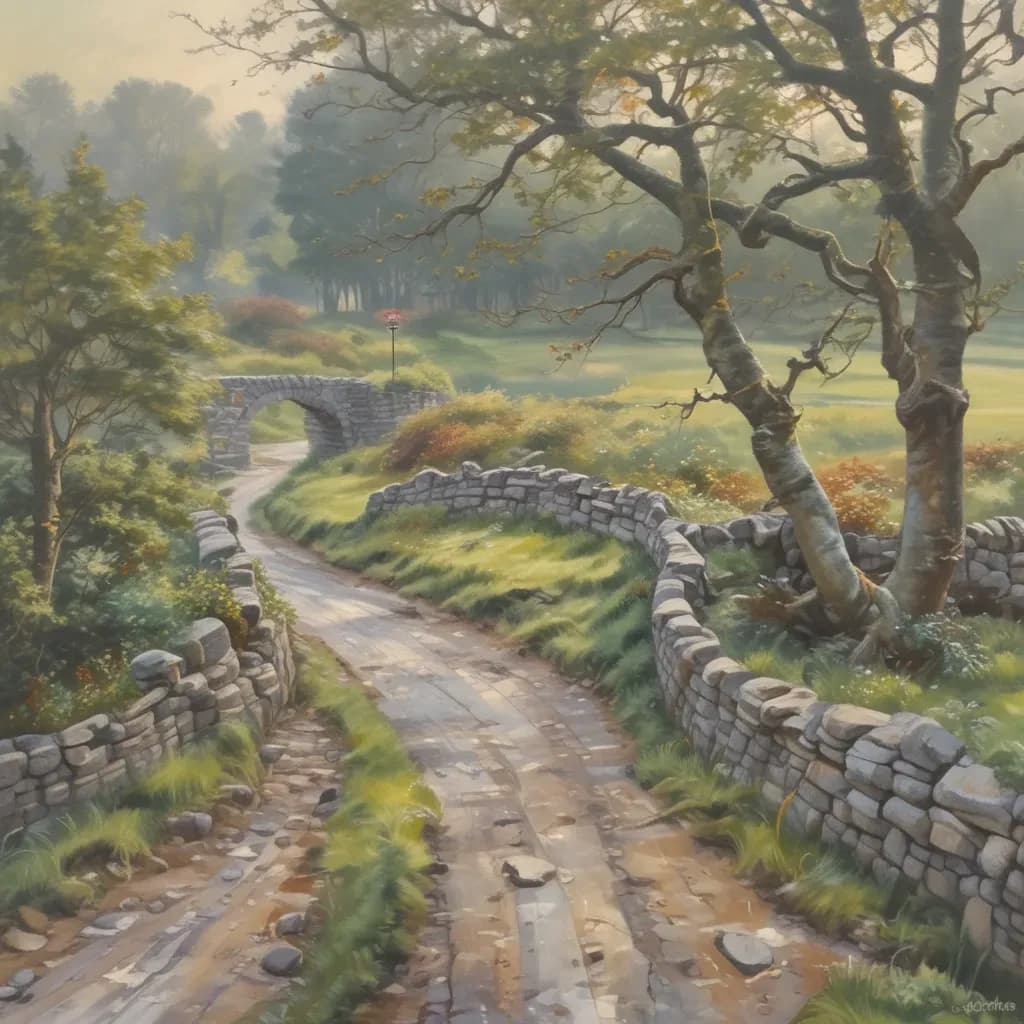
The song anchors this psychological territory in specific Irish geography. References to named roads and local landmarks near Kennedy's home on the Dublin-Kildare border give the song a grounded, almost documentary quality that prevents it from floating off into abstraction.[5] This is emotional philosophy delivered in the accent of a particular county, set at a particular hour of day. The specificity is the point: Kennedy insists that universal feeling must be rooted somewhere real.
The verse material builds quietly, tracing a narrator trying to navigate a relationship from behind self-protective distance. What makes the treatment distinctive is the tension between Kennedy's lyrical restraint and the song's musical urgency. The "galloping rootsy guitar" that Hot Press noted[5] pushes against the contemplative weight of the words. The music insists on movement, on forward motion, even while the lyrics are sitting with something difficult and unresolved. That friction is the song's emotional engine: form and content pulling in opposite directions, the way repressed feeling eventually overtakes deliberate restraint.
The Nashville-Ireland Sound
The sonic texture of "Honest" reflects the album's unusual collaborative geography. Gabe Simon, known for polished work with Noah Kahan and Lana Del Rey, might have seemed an unlikely fit for Kennedy's folk-rooted ambitions.[1] But the pairing produced something genuinely distinctive: a kind of Americana-inflected Irish folk that sounds like two traditions in honest conversation rather than one grafted awkwardly onto the other.
Kennedy had sought this kind of organic hybridity deliberately. His earlier albums had leaned toward a certain stadium-sized emotional grandeur. The Weight of the Woods was an attempt to recover something smaller and rougher, to make music that sounded like it had grown out of actual soil.[4] Kennedy described his vocal approach on this album as prioritizing presence over perfection, wanting to bring the energy of his live performances into the studio rather than smooth everything into something purely radio-ready.[2]
The album also featured traditional Irish instrumentalists and the Maynooth University Chamber Choir, weaving Kennedy's classical training background back into his work in an unexpected way.[1] The result, in "Honest" particularly, is music that feels alive in the way unpolished things feel alive: slightly imperfect, rooted, breathing.
Sincerity as a Cultural Stance
Kennedy is a notably unusual figure in contemporary popular music because he operates without irony. This is not quite the same as being earnest; earnestness can be a kind of performance in itself. What Kennedy does is something more stubborn: he commits to emotional seriousness as a first principle, without hedging or winking at the audience to signal self-awareness.
In a cultural moment when ironic distance is the default register of self-protection, and "Honest" is partly about self-protection, there is something quietly radical about choosing sincerity at the scale Kennedy is working at. He is not performing in small clubs for audiences who have already opted into vulnerability. He is filling stadiums. His forthcoming headline appearance at Dublin's Aviva Stadium was set to mark the first time an Irish solo artist had headlined the venue twice.[4] The intimacy of a song like "Honest" becomes more remarkable in that context, not less.
There is also something worth noting about the gendering of this kind of emotional candor. Kennedy writes about vulnerability from a perspective that has historically been underrepresented in rock and folk traditions: the male narrator not as stoic sufferer but as someone actively examining his own emotional evasiveness. The song's narrator does not present himself as the wronged party. He is the one who cannot quite let himself be known. That specificity matters, and it is part of why the song's audience is so broad.
What Else the Song Might Be Saying
The most direct reading of "Honest" is as a love song about the struggle to be fully present in an intimate relationship. But the song sustains at least two other interpretations without forcing them.
The first is autobiographical in a broader sense. Kennedy spent years developing a public persona shaped by enormous emotional performance: the stadium-filling catharsis of anthemic folk-pop. The song's meditation on what gets suppressed behind a carefully maintained presentation could be read as a reflection on that professional dynamic as much as any personal one. The image of inner color breaking through could be the artist's less marketable, more complicated self finally insisting on being seen.
The second reading positions the song as being, partly, about place. Kennedy has spoken extensively about his deep attachment to Rathcoole and the surrounding landscape, his unwillingness to uproot himself despite the pressures of a global career.[4] A song set on a specific road near a specific bridge, grounded in the particular topography of the Dublin-Kildare border, might be understood as a declaration of fidelity to that landscape as much as to any person. Being "honest" in this reading includes being honest about where you come from and what that place still demands of you.
Why It Stays
"Honest" earns its place as the album's final pre-release statement because it refuses to make transparency look easy or noble. It does not suggest that choosing openness leads simply to connection and relief. It acknowledges the exposure involved, the risk of having your inner life seen before you have decided to show it, and it treats that exposure as both frightening and necessary.
Kennedy wrote the song coming out of a period when he had been forced, medically and professionally, to stop performing and simply exist without the protective mechanisms his career had given him.[4] That enforced stillness appears to have clarified something essential. "Honest" is not a solution to the problem of emotional guardedness. It is a very precise account of the problem itself, written by someone who finally stopped hiding it.
References
- Kennedy Explores Nashville Connection on New Album — RTE article on the Nashville-Ireland creative collaboration with producer Gabe Simon
- Dermot Kennedy Releases 'Honest' — Single announcement with artist quotes about the song's emotional themes and the album's vocal approach
- Dermot Kennedy - Wikipedia — Biographical overview including career history and discography
- Dermot Kennedy: 'I was freaking out about my voice. I did two weeks where I didn't speak' — Irish Times interview covering vocal health crisis, attachment to Rathcoole, and album creation context
- Album Review: Dermot Kennedy - The Weight of the Woods — Hot Press 8/10 review noting the song's galloping rootsy guitar and folk roots