Spinning Without Going Anywhere
There is a particular dread that arrives not when things are going badly but when things are going fine. When the routine functions, when the calendar fills, when the crowds respond and the work continues, and somewhere underneath all of it you notice that nothing has actually changed. Not in the ways that matter. You are older, and the same small fears from years ago are still there, and the motion of living has not taken you anywhere at all.
That specific feeling, so hard to name and so easy to dismiss, is what BTS attempts to excavate on "Merry Go Round," the eighth track from their 2026 comeback album ARIRANG.[1] It is among the most quietly devastating songs the group has ever made. Not because it is loud, or because it announces its concerns dramatically, but because it describes the feeling of going through the motions so precisely, and with such gentle melancholy, that it catches you somewhere unguarded.
ARIRANG and the Return from Silence
BTS released ARIRANG on March 20, 2026, their first full-group studio album since BE in 2020. The nearly six-year gap was not voluntary: beginning in 2022, the group's seven members entered mandatory South Korean military service one by one, a legally required duty that separated them from their music and from each other for an extended period. When they returned, they gathered in Los Angeles for months of collaborative recording, the first time they had lived and worked together in roughly seven years.[2]
The album's title points toward something ancient and communal. Arirang is Korea's unofficial national anthem, a folk song with roots stretching back more than six centuries, traditionally associated with longing, separation, and a particular kind of resilient endurance.[2] By choosing that title for their comeback, BTS was doing something deliberate: placing their own experience of separation and return into a much longer cultural tradition of surviving absence.
"Merry Go Round" was produced by Kevin Parker, the Australian musician and primary creative force behind Tame Impala.[1] Parker's involvement is immediately audible. The track is built from swirling, layered synthesizers, a hypnotic bass pulse, and a gauzy, vintage atmospheric quality that makes time feel both present and slightly out of reach. The production does not merely accompany the lyrical themes; it enacts them. The music itself sounds like something going around.
The Central Metaphor: Movement Without Progress
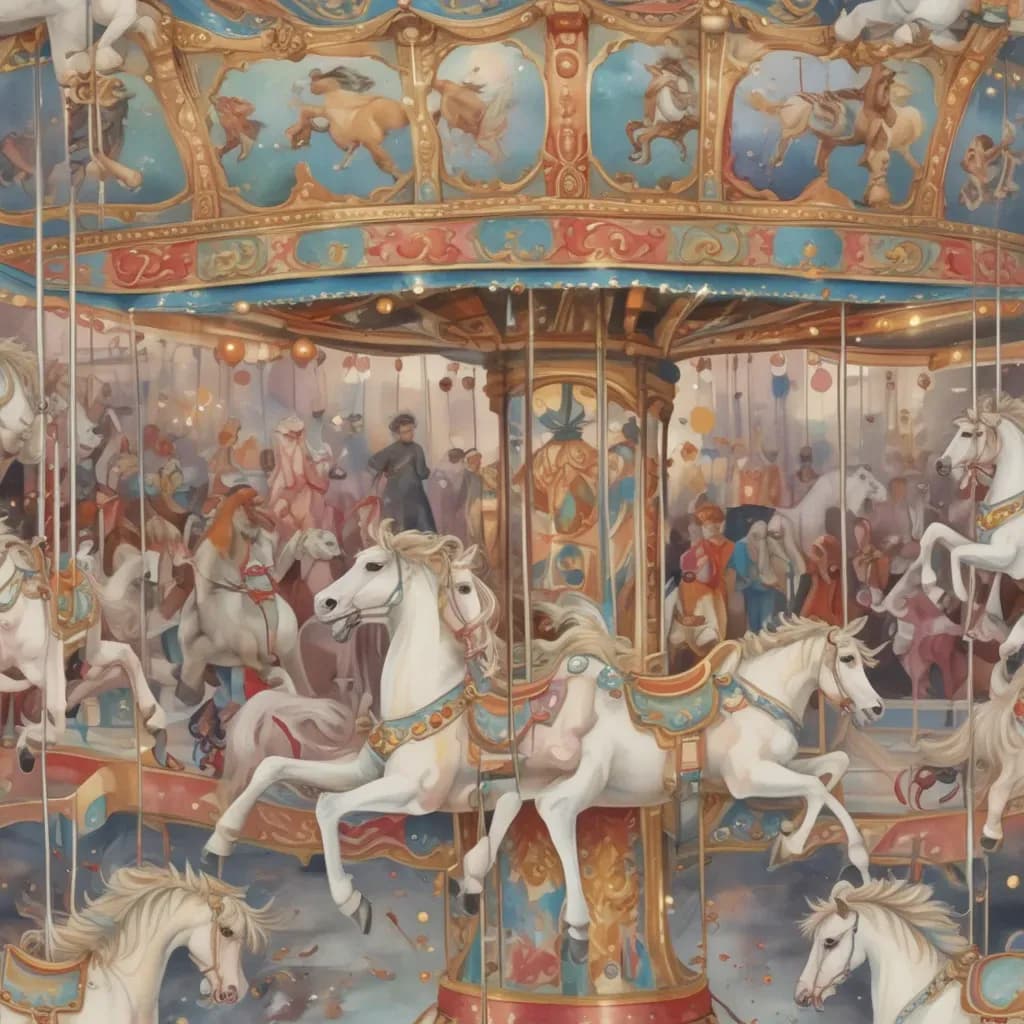
The merry-go-round is a deceptively rich image. It is associated with childhood, with the nostalgic pleasure of carnival motion, with color and music and the particular joy of spinning. But a merry-go-round also goes nowhere. Its motion is circular by design. You get on, the world turns around you, and when the ride stops you are exactly where you started.
"Merry Go Round" uses this image not as simple complaint but as precise psychological description. The song's central subject is the condition of cycling through the same emotional patterns, the same private anxieties, the same interior conversations, despite the external evidence of movement. Careers advance. Years pass. Recognition accumulates. And yet, the song suggests, certain fundamental worries about who you are and whether you are enough tend to persist, immune to achievement. They ride with you.[3]
SUGA's contribution to the track intensifies this through an image that sits at an uncomfortable intersection: the merry-go-round placed alongside the hamster wheel. One is childhood delight, the other is futile adult labor. The song equates them deliberately.[4] Whether the movement looks like play or like work, the result is the same. You are turning in place.
Emotional Stagnation and the Adulthood Paradox
One of the album's most consistent preoccupations is the gap between where you expected to be emotionally as an adult and where you actually find yourself. ARIRANG returns to this theme repeatedly, but "Merry Go Round" is where it receives its most sustained treatment.
The song captures what might be called the adulthood paradox: the discovery, usually arriving sometime in your late twenties or thirties, that growing up did not resolve the internal questions you thought it would. The fears you expected to leave behind turned out not to be transitional. They are structural. They came with you.
Billboard Korea's assessment of the track described it as "a quietly devastating look at emotional stagnation amid apparent success."[5] That pairing matters: apparent success. The song is not about failure. It is about the strange condition of succeeding in the visible ways and finding that the interior weather has not cleared. The surface is in motion. Underneath, the same patterns turn.
j-hope's contributions to "Merry Go Round" have been noted for their particular rawness. Where some of his work on ARIRANG leans into celebratory energy, here he brings something more unguarded, closer to confession.[3] The song uses the social pressure to perform contentment, to smile outward while the interior spins unexamined, as another kind of circular motion: the cycle of concealment and private doubt.
The Military Service Dimension
It would be impossible to hear "Merry Go Round" in 2026 without the context of what BTS spent the preceding years doing. Military service in South Korea is mandatory, structured, and, for artists, represents a particular kind of enforced pause. You do not choose when it begins or ends. You follow a routine determined entirely by institutional requirements. You wake at the same time, eat at the same time, train in the same ways, day after day.
The merry-go-round, in that context, becomes something more than a metaphor for general existential stagnation. It also resonates as a description of repetitive institutional routine: the experience of days that resemble each other completely, movement that is required but not chosen. Whether or not the song is explicitly autobiographical, the resonance is unavoidable.
Jung Kook spoke about this experience in interviews around the album's release, describing how the inability to work on music during service had created a buildup of longing.[6] SUGA, whose candor about mental health has long been a defining feature of his artistic persona, was well-positioned to write about emotional patterns that persist regardless of external circumstances. "Merry Go Round" takes those experiences and asks a harder question than how did you survive the pause: it asks what happens when you return to motion and realize that the motion itself is part of the loop.
Kevin Parker and the Sound of Circular Time
The production choices on "Merry Go Round" deserve attention on their own terms. Kevin Parker is known for creating music that exists in a slightly altered time signature, recordings that feel both contemporary and somehow displaced, as though they are arriving from a recent past or an alternate present.
For "Merry Go Round," Parker uses that quality deliberately. The swirling synthesizer layers do not resolve into clean forward motion; they circle and layer. The bass pattern repeats with the inevitability of a clock hand. The vintage piano elements add a quality of faded memory, the sense of sounds that have been around longer than they should have been.
Consequence of Sound described the track as having "a druggy, psychedelic sway,"[7] and that phrase captures something true. The production is designed to disorient slightly, to make it harder to track where you are in the cycle. That disorientation mirrors the lyrical experience: the difficulty of noticing, while you are inside the routine, that you are moving in circles at all.
Parker's work here is a significant departure from the harder-edged rock production he contributed elsewhere on ARIRANG. Where other tracks push outward with energy and noise, "Merry Go Round" pulls inward, creating an interior space that feels soft and enclosed, like the inside of a thought you cannot quite finish.
Fame, Performance, and the Spiral
For a group that has spent the better part of fifteen years living at the intersection of public life and private experience, "Merry Go Round" carries additional weight. BTS occupies a singular position in contemporary culture: they are globally recognizable in a way that few artists ever achieve, and they have spoken extensively and honestly about the psychological costs of that visibility.
The K-pop system, within which BTS developed even as they eventually pushed against its constraints, operates through a relentless emphasis on the performance of wellness. Idols are expected to appear grateful, composed, positive. The emotional labor of maintaining that presentation is substantial. "Merry Go Round" does not name the industry directly, but its exploration of the pressure to hide private cycles behind public smiles clearly resonates with anyone who has had to perform contentment they do not fully feel.
The Korea Times noted the song's exploration of the tension between fame and ordinary human experience.[8] That tension is not new to BTS's catalog, but here it receives a treatment that feels distinctly post-service, filtered through the experience of having temporarily set everything down and then having to pick it back up. The question the song raises, subtly but persistently, is whether the resumption of motion is necessarily the same as the resumption of progress.
Alternative Interpretations
"Merry Go Round" sustains several readings simultaneously. Some listeners approach it through a relational lens, hearing the song's circular imagery not as a description of individual psychological patterns but as a portrait of a relationship that has become a habit: two people going around together without arriving anywhere new. In this reading, the concealment of true feelings is not about public performance but about the private negotiations of intimacy, the ways that couples can maintain a pleasant exterior while privately sensing that they are spinning.[9]
A second interpretation focuses on the generational dimension. The adulthood paradox at the song's center resonates strongly with millennial and younger Gen X listeners who came of age with particular expectations about what adult stability would feel like, and who have found the reality more restless. In this framing, "Merry Go Round" is not specifically about BTS's situation but about a widely shared experience of a generation that worked toward milestones and found the milestones did not deliver the sense of arrival they implied.[10]
These interpretations do not compete with the more biographical reading. The song holds them all. Its strength is that the circular metaphor is precise enough to describe a recognizable psychological experience and open enough that listeners bring their own versions of the loop.
The Carousel Still Turns
"Merry Go Round" does not offer resolution. It does not end with the ride stopping or with the narrator stepping off. That absence of resolution is part of the point. The song's honesty lies precisely in its refusal to reframe the experience it describes, to find a silver lining in the spinning or suggest that the pattern can be broken through will or awareness alone.
What it offers instead is something quieter: the knowledge that you are not alone on the carousel. That the private cycling you carry with you, the fear that nothing changes underneath while everything moves on top, is not your particular failure but something recognizably human. BTS, having returned from years of mandatory service and institutional routine and enforced silence, could easily have made their comeback entirely about triumph. ARIRANG contains plenty of triumph. But "Merry Go Round" makes room for the thing underneath triumph, the part that keeps spinning even when the crowd is applauding.
The carnival music continues. The horse rises and falls. And Kevin Parker's swirling production holds the whole thing suspended in amber, spinning, spinning, without quite going anywhere at all.[7]
References
- Merry Go Round - BTS Wiki Fandom — Track info, production credits, writing credits for Merry Go Round on ARIRANG
- Arirang (album) - Wikipedia — Album background, military service context, and the Korean folk song connection
- BTS Merry Go Round: Song Meaning, Symbolism — Analysis of song themes including j-hope's raw contributions and the core metaphor of cyclical motion
- BTS Merry Go Round Lyrics Meaning Explained — Analysis explaining SUGA's hamster wheel imagery juxtaposed with the carousel and the theme of emotional stagnation
- BTS' ARIRANG: All 14 Songs Ranked — Billboard Korea's description of Merry Go Round as a quietly devastating look at emotional stagnation amid apparent success
- BTS 'Arirang' Track-by-Track Breakdown — Hollywood Reporter breakdown including Jung Kook's quote about the buildup of longing during military service
- BTS' ARIRANG Is a Reunion Album That Knows It Can't Go Back — Consequence of Sound describing Merry Go Round's druggy psychedelic sway and Kevin Parker's production contribution
- BTS revisits roots, swims forward on new album 'ARIRANG' — Korea Times on the song's exploration of tension between fame and ordinary human experience
- With 'Arirang,' BTS returns to a K-pop moment of its own making — NPR review discussing Merry Go Round's relational and generational interpretations
- BTS 'Arirang' Review: World's Biggest Band Nails Comeback — Rolling Stone five-star album review discussing generational resonance and critical reception of ARIRANG