Rest Stop
There is something philosophically strange about a rest stop. It exists as a designated pause, a pocket of time carved into the momentum of travel, a place where the road itself admits that forward motion cannot be absolute. It is neither origin nor destination, but something in between: a threshold. "Rest Stop," the closing track of Kero Kero Bonito's 2018 album Time 'n' Place, inhabits exactly this liminal territory. As the final word on an album about time, loss, and the disorienting passage of life, it is a song that places the listener at the edge of everything the record has struggled to articulate, and then, with radical honesty, refuses to resolve it.
The Album That Forced the Change
Time 'n' Place arrived on October 1, 2018, on Polyvinyl Record Co., and it was immediately clear that Kero Kero Bonito had fundamentally reconfigured themselves.[1] The trio of vocalist Sarah Midori Perry and producers/multi-instrumentalists Gus Lobban and Jamie Bulled had previously been known for the hypercolor bubblegum pop of their debut Bonito Generation, a record that drew on J-pop, PC Music aesthetics, and cheerful maximalism. The follow-up EP TOTEP, released in early 2018, signaled a seismic shift: the band was pivoting toward noise pop, shoegaze, dream pop, and something rawer and more emotionally direct.[2]
This shift was not aesthetic posturing. It came from genuine loss. Perry had received a photograph from her brother showing the site of her childhood home in Japan: demolished, reduced to a bare flatland. Her primary school had closed. She had also lost a pet named Nana.[3] Meanwhile, Lobban's father was hospitalized, and songs like "Visiting Hours" document those hospital visits with plainspoken grief.[4] The three members were navigating major life changes simultaneously, and Time 'n' Place became the record that tried to make sense of what could not quite be made sense of.
"Rest Stop" closes the album not with resolution but with something more honest: the acknowledgment that resolution is not always available.[5]
Written at 3 AM in Beverly Grove
The song's origins are nocturnal and almost accidental. Lobban wrote the foundational chords late at night, around 3 AM, alone in a studio in Beverly Grove, Los Angeles, when he was actually meant to be finishing a cover of Oasis' "Rock 'n' Roll Star" for a compilation.[6] There is something fitting about this: one of the album's most emotionally consuming pieces born from a detour, from a moment where the work that was supposed to happen gave way to the work that needed to happen.
The title came to Lobban while landing in Madrid for a show. He recognized immediately that it belonged to this specific piece and held onto it.[6] Names do not always arrive with that kind of clarity; this one came with the weight of inevitability.
The production approach is conceptually inventive. Lobban recorded a simple, conventionally structured pop song, the kind of radio-friendly fare associated with groups like Take That or Coldplay, as raw material. The vocal performance was then extracted and placed into what the band themselves described as a nightmare noise quagmire built from a telephone pickup coil, a recording of a Nintendo 64 game crashing, malfunctioning home keyboards, a Game Boy, and various lo-fi samplers.[6] The mainstream and the broken were layered against each other, the familiar voice made alien by its context.
A Voice in the Storm
The structural tension of "Rest Stop" is made audible in its arrangement. As the track develops, Sarah's voice is isolated in the right stereo channel while the rest of the mix fills with increasingly chaotic and abrasive noise.[5] This is not merely a production choice. It dramatizes the song's central emotional state: the individual consciousness trying to hold onto something coherent while the surrounding world comes apart.
The effect is genuinely unnerving on first listen. The voice continues, composed and clear, while the noise escalates around it, as if the world itself is malfunctioning but the inner voice refuses to stop speaking. It is a portrait of continuing forward in the face of chaos, not triumphantly but steadfastly, the way one actually continues because stopping is not possible.
Then, in the final seconds, the noise cuts off completely. Silence drops. Sarah's voice remains for just a moment before the album ends.[5]
At the Edge of the Atlas
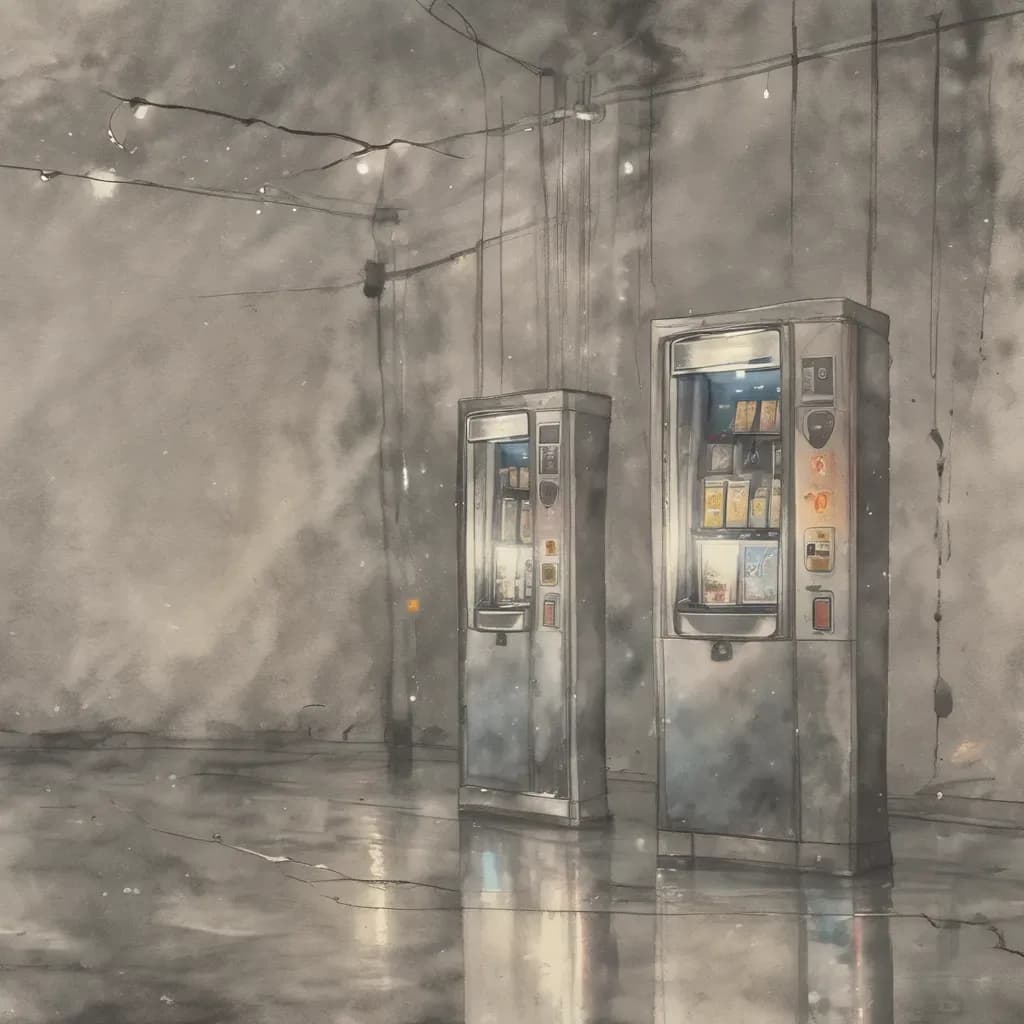
Kero Kero Bonito described the song's setting explicitly during a Twitter listening party in February 2021: a deserted motorway service station at "the edge of the atlas," a place where the maps run out.[6] This is the crossroads as a psychological location rather than a geographical one. The rest stop here is not an ordinary highway pause; it is the point at which the known world ends and the choices ahead are not yet charted.
The band framed the song as an allegory for moments where one must make peace with chaos.[6] This is the central spiritual gesture of Time 'n' Place as a whole: not the resolution of grief, but the confrontation with it. Not the overcoming of uncertainty, but the act of standing in the middle of it and deciding to remain present.
The imagery in the song, without citing a word of it, builds a scene of waiting in a space designed for transit: a crossing point where no other travelers appear and the road ahead offers no obvious direction. It is both lonely and strangely calm. There is something almost sacred about an empty rest stop late at night, and the song captures that quality, the way emptiness sometimes feels less like absence and more like openness.
The Ending That Refuses to Resolve
Lobban has said that there was no other way Time 'n' Place could end, that the record's logic demanded a mess.[6] The final seconds of "Rest Stop" are that mess: the noise cuts, the voice trails off mid-thought, and the album simply stops. No coda, no final chord, no release.
Different listeners have heard this ending differently. Some read the abruptly cut vocal as hopeful, a possibility of survival left open, the sentence interrupted before despair could conclude. Others interpret it as symbolic of finality, of the self overwhelmed by the surrounding chaos.[6] The band does not arbitrate between these readings. Lobban's comment that there is no narrative and that listeners must make up their own story is not deflection but invitation.[6]
This interpretive openness is appropriate for an album about time. Time does not provide narrative closure. Relationships end mid-sentence. Childhood homes disappear without ceremony. Hospital visits do not always conclude as hoped. The form of "Rest Stop" enacts the content of the album: the abruptness of change, the impossibility of tidy endings, and the continuing presence of the person who survives to notice all of this.
Why It Resonates
"Rest Stop" occupies a specific emotional niche that popular music rarely explores with this kind of fidelity. It is not a song about grief completed. It is not a song about recovery or transcendence. It is a song about the moment of genuine uncertainty, the point where you do not know which direction to take and where the only honest response is to sit with that not-knowing.
Kero Kero Bonito's critical reception for Time 'n' Place reflected the ambition of this approach. The record debuted at number one on Billboard's Heatseeker chart and received substantial praise from critics who recognized the coherence of the artistic leap.[1] Everything Is Noise called the album "profoundly human, multifaceted, and complicated," and the closing track was singled out for its chilling effect on first listen.[5] Anthony Fantano awarded the album an 8 out of 10, and Pitchfork acknowledged the conceptual ambition even as it hedged on the melodies.[1]
The song also marks a particular achievement in production thinking. Taking the aesthetic of mainstream pop, a style designed to produce comfort and pleasure, and submerging it in noise says something about the relationship between surfaces and depths. The radio-friendly vocal trying to be heard through the chaos is, in microcosm, the self trying to maintain its voice during periods of life that do not cooperate with composure.
"Rest Stop" earns its position as the final word on Time 'n' Place because it refuses the false promise of an ending. It leaves you where the album has spent its entire running time preparing you to stand: at the edge of the atlas, in the middle of the night, with your own voice in one ear and everything else falling apart in the other.
Kero Kero Bonito made a record about what happens when the irreversibility of time becomes impossible to ignore, and they closed it with a song that does not pretend to have found a way through. That honesty is its own kind of gift. The rest stop is not the destination. But it is where you are right now, and the song asks you to stay there long enough to actually feel it.
References
- Time 'n' Place - Wikipedia — Album release date, chart performance, critical reception overview
- Kero Kero Bonito - Wikipedia — Band history, TOTEP EP, artistic shift context
- Kero Kero Bonito Talks Traversing Time 'n' Place - KEXP — Interview covering Sarah's demolished childhood home and personal losses driving the album
- Kero Kero Bonito Finds Solace in Chaotic Sounds - i-D — Interview covering Lobban's father's hospitalization and the band's emotional context during recording
- Kero Kero Bonito - Time 'n' Place Review - Everything Is Noise — Critical review noting the right-channel vocal isolation, chilling effect of Rest Stop as album closer
- Rest Stop - Kero Kero Bonito Wiki (Fandom) — Song production details, title origin, Beverly Grove recording story, Twitter listening party statements from the band