The Only Time I Prayed
There is a particular kind of prayer that has nothing to do with religion. It happens in the small hours, in rooms that feel impossibly large, when whatever you believe or do not believe seems beside the point. Dermot Kennedy has been writing around this feeling for most of his career, but on "The Only Time I Prayed," the twelfth track on his 2026 album The Weight of the Woods, he arrives at the most unflinching version of it yet. The song is about what we reach for when the darkness closes in, and what we actually find when we do.
From Rathcoole to the World Stage
Kennedy grew up in Rathcoole, on the southwestern edge of County Dublin, in a musical household. His father played guitar and sang in a local band; his mother played piano and sang in a choir. He began writing songs in his early teens and was playing Dublin open mic nights by seventeen, often driven there by his father. His mother enrolled him in classical music studies at Maynooth University, where he spent three years before the pull of busking won out. He performed on Dublin streets and, later, in Boston, honing a voice and an approach to performance that can hold a room through presence alone.[1]
The influences Kennedy cites, Ray LaMontagne, David Gray, Damien Rice, and Glen Hansard, are all writers who treat emotional vulnerability as a craft tool rather than a confession. But Kennedy also absorbed hip-hop as a teenager, beginning with 50 Cent and moving on to Jay-Z and Eminem, and that rhythmic ambition gave his folk bedrock an unusual energy.[1] His debut album, Without Fear, reached number one in Ireland and the UK in 2019. His second album, Sonder, topped three charts in 2022. He had become the kind of singer-songwriter who fills arenas and headlines Coachella.
For his third album, Kennedy made a deliberate turn back toward something smaller and more rooted. He described long walks through the forest near his Dublin home as central to the record's creative process, and spoke about the trees as "a haven for my sense of wonder."[2] Producer Gabe Simon, known for his work with Noah Kahan and Lana Del Rey, spent six weeks embedded in Kennedy's home environment on the Dublin-Kildare border after initial sessions in Nashville, allowing the album to absorb the specific atmosphere of that place.[2]
An Album That Carries Its People
The Weight of the Woods is built around what sustains a person. It incorporates traditional Irish instruments, including uilleann pipes and bodhrán, contributed by traditional musician Cormac Begley, binding the record sonically to the same landscape Kennedy has never left.[3] Kennedy has explained the album title as referring to the weight of everyone he loves and carries with him: "As lovely as it is and as much as I love everybody, sometimes I do feel that pressure."[2] He has also spoken about the darkness running through the album as something other than bleak: "The darkness, to me, is not necessarily a bad thing. Mystical things happen there."[2]
The album's arc moves through grief, longing, memory, nature, and the everyday weight of love. "The Only Time I Prayed" arrives late in that arc, track twelve of fourteen, positioned just before the closing sequence. By that point the album has established its emotional world thoroughly enough that the song's intimacy does not feel like a change of key so much as a deepening of the same note. It is one of the record's quietest and most searching moments, and it earns that place by being utterly specific rather than broadly anthemic.
This song connects thematically to two other pieces on the album that also appear on this site: the title track "The Weight of the Woods" and its reprise, both of which share the album's central preoccupation with what it means to carry love as a burden and a sustenance simultaneously.
Foxhole Religion and the God Who Waits
The song's central idea draws on what has been called "foxhole religion," the phenomenon of people who do not consider themselves religious finding themselves praying in moments of crisis or despair. Kennedy grew up in Ireland, where Catholicism is woven into cultural life even for generations that have stepped back from formal practice. For his cohort, the institution carries far less authority than it did for their parents. But the reflexes remain.[4]
In an interview on the Zach Sang Show, Kennedy described the idea at the song's center: that regardless of faith or the lack of it, when things become truly difficult, almost everyone reaches toward something larger. He found it a powerful and even somewhat ironic notion to imagine a God looking down and recognizing this pattern, watching people turn to him specifically when they have exhausted every other option.[4] The song voices this from the inside, from within the mind of someone praying in the dark of their bedroom with no real expectation of being heard, and yet praying nonetheless.
The song does not condemn this or celebrate it. It simply observes it with the clear-eyed honesty that has always been Kennedy's strongest quality. He is not a song writer who wraps things up neatly. The prayer is described without irony but also without conviction. The narrator does not emerge from the bedroom with their faith restored. What changes is something else entirely.
This spiritual ambivalence has a biographical context. In an earlier interview with Hot Press, Kennedy spoke about his uncertainty regarding what comes after death, resisting easy answers in either direction. He described his mother as someone who modeled the freedom to live on your own terms without bowing to inherited expectations, religious or otherwise.[5] That example of private conscience over institutional obligation, combined with the ambient Catholic presence of Irish upbringing, gives the song a cultural specificity that extends well beyond the personal. Kennedy is writing from inside a recognizable Irish experience, even if the experience is one of ambivalence rather than belief.
Love as the Earthly Answer
The song's opening describes a relationship defined by a particular quality of being seen. The narrator observes the person he loves remarking on how he looks at her, and his response is essentially one of disbelief that he could look at her any other way. There is something devotional in this, the language of worship directed not upward but sideways, toward another human being.
The song's chorus pivots from the darkness of the bedroom prayer toward something that functions as its secular counterpart. The narrator's heart is described as in a continuous state of breaking, a baseline condition rather than a passing crisis. But when the person he loves laughs, the broken pieces find their places again. It is not a healing so much as a restoration, temporary and specific and nonetheless real.[4]
Kennedy has spoken about the song as being about acknowledging the difficult things in life while moving toward the good ones, celebrating what is available to celebrate.[4] This is not optimism in the naive sense. The narrator does not pretend the darkness is not there. What the song does instead is hold both things at once: the prayer that goes unanswered and the laugh that restores the pieces. One is private and uncertain; the other is immediate and physical. The song suggests, without insisting, that the second might be the more reliable form of grace.
This is a recurring structure in Kennedy's writing. Darkness is acknowledged rather than denied. The light that counters it arrives not through transcendence but through human connection. He made a related choice in "Better Days," his Choice Music Prize-winning song, and he makes it again here with greater formal economy. The prayer goes up. The laughter comes back. The song trusts the listener to understand which one has more weight.
Memory, Specificity, and the Weight of a Moment
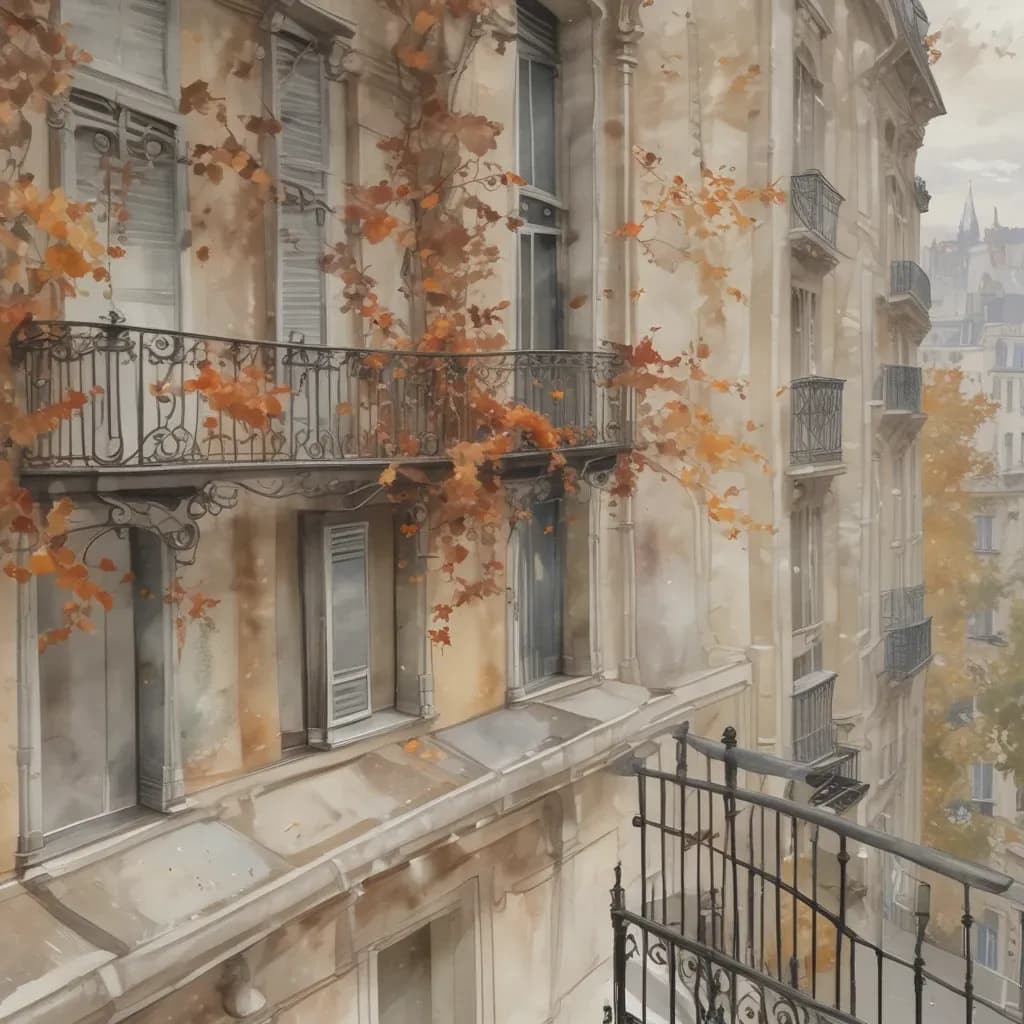
Toward the song's end, Kennedy moves into a passage that feels cinematic in its precision. He describes remembering a particular perfume, landscapes from where they come from, an autumn day, curtains that let light through in a specific way, and the image of someone swaying on a Parisian balcony with the city visible behind her. These details arrive with the texture of genuine recollection. They feel recalled rather than invented.
This kind of anchoring in the physical and particular is central to what Kennedy does best, and it connects him directly to the Irish songwriter tradition he grew up in. Damien Rice and Glen Hansard share this quality: the conviction that emotional truth lives in the concrete detail rather than the abstract statement. A Parisian balcony in autumn light, the scent of someone's perfume, curtains moving in a room, these carry more weight than any declaration because they are irreducibly specific. They could only belong to one person and one time.
Kennedy has spoken about being acutely aware of impermanence: "I'm very conscious of the fact that whether things are difficult or fantastic, they're brief."[2] That awareness gives the memory passage its ache. The perfume and the balcony and the curtains are not available to him now except as memory. The song exists because those things were real and are now past. This is another version of the weight the album is built around: carrying the people you love, carrying the moments you cannot get back, carrying the questions that have no answers.
Critical Reception and Artistic Context
The Weight of the Woods received a genuinely divided critical response on release. Hot Press awarded it eight out of ten, calling it a "magnificent third album" and praising Kennedy's return to folk and ballad-writing foundations after the more stadium-oriented Sonder.[6] The Irish Times was more skeptical, awarding three stars and suggesting the record's nature-and-roots framework occasionally tipped into portentousness, while still singling out individual tracks for genuine praise.[7] Darkus Magazine called it "a triumphant return to form."[8]
What critics across the spectrum agreed on was that the album represented a conscious recalibration. Kennedy himself framed it in terms of liberation from commercial pressure, telling Yahoo that he felt freed from the ambition to chase chart positions.[9] "The Only Time I Prayed" is the fullest expression of that freedom on the album. It is too specific and too interior to function as a stadium sing-along. It was not designed for that. Kennedy wrote it as a piece of honest reckoning, and its power comes precisely from its refusal to be anything else.
An Irish Song for a Post-Catholic Generation
There is a reason "foxhole religion" has its own name. The experience of reaching toward something larger in a moment of crisis is among the most universal human responses, and it is not confined to the traditionally religious. But Kennedy writes it from inside a specifically Irish cultural context, one shaped by the long shadow of Catholicism and the experience of watching that shadow recede.
His generation occupies a distinctive middle ground: too secular to describe themselves as believers, too culturally saturated with religious imagery and reflex to be fully without it. The bedroom prayer in the song is not performed for an audience or offered with conviction. It is something that happens in the dark, almost involuntarily, because the darkness makes it happen. Kennedy makes no judgment about whether that reaching finds anything. He describes the God in the song as aware of the pattern, even amused by it in a cosmic way, waiting for the moment when people who would never otherwise look up finally do.
This is a different kind of religious song than the genre usually produces. It is not devotional. It is not a crisis of faith in the dramatic sense. It is an observation about a very ordinary human behaviour, the way darkness makes believers of us all, temporarily, in rooms where no one else is watching. Kennedy treats this with the same respect he brings to the Parisian balcony and the broken pieces reassembled by laughter. It is part of what it means to be alive and uncertain and still, somehow, reaching.
Conclusion
By the time "The Only Time I Prayed" arrives, twelve songs into an album about roots, weight, darkness, and the things that sustain us, Kennedy has built a world dense enough that the song's intimacy lands with full force. It does not resolve the questions it raises. It asks what we actually believe when the lights go out, acknowledges the prayer that goes out into the dark without certainty, and then turns toward something more reliable: the laughter of someone you love, the autumn light through curtains, the specific gravity of a particular person in a particular moment.
Kennedy has described wanting to die and become part of the landscape near his Dublin home.[2] That is a different kind of faith than the bedroom prayer, quieter and more patient. "The Only Time I Prayed" sits between those two impulses, between the desperate reach toward God in a dark room and the long, patient belonging to a place and the people in it. It is a song about what holds us when we cannot hold ourselves, and it does not pretend to know whether that holding has a name.
References
- Dermot Kennedy Wikipedia biography — Career timeline, influences, biographical background
- Rolling Stone AU: How Dermot Kennedy Returned to His Roots and Found Hope in the Dark — Album recording context, Kennedy on forests, nature, impermanence, and the darkness of the album
- Universal Music Canada: The Weight of the Woods press release — Irish traditional instruments, album themes, Kennedy on the album title and weight
- Zach Sang Show: Dermot Kennedy Talks Funeral, Better Days, Fred Again and New Album — Kennedy's own explanation of the prayer theme, foxhole religion, and the song's core meaning
- Hot Press: Full Cover Story - Dermot Kennedy on Hip-Hop, Religion, and Without Fear — Kennedy on his mother's approach to religion, his own spiritual ambivalence, and Irish Catholic context
- Hot Press: Album Review - Dermot Kennedy: The Weight of the Woods (8/10) — Critical reception, praise for return to folk roots
- The Irish Times: Dermot Kennedy - The Weight of the Woods review (3/5) — Mixed critical reception, skepticism about nature-and-roots concept
- Darkus Magazine: Dermot Kennedy Finds His Roots in the Wild — Positive critical reception, return to form
- Yahoo Entertainment: Dermot Kennedy on Irish Inspiration and Feeling Liberated — Kennedy on feeling liberated from commercial pressures for this album