There Must Be Love
Some songs announce their argument in the title. "There Must Be Love" sounds, at first, like a statement of confidence, and then, on a second reading, like a plea. The word "must" does a lot of work. People rarely insist on something they are sure of. They insist when the evidence is thin and the need is large.
That tension sits at the center of David Kushner's second album, and it is the best way into this track.
Where the song sits
"There Must Be Love" appears on Devotion, released on November 13, 2026[3]. Kushner wrote it with Jacob Olofsson and Billy Walsh[4][5]. Olofsson also co-wrote and produced the album's single "Ritual" with Scott Harris[1], so the song belongs to a small circle of collaborators who shaped the record's hushed, atmospheric sound.
A clip titled with the song's name appeared on Kushner's TikTok in November 2024, well before the album arrived[8]. That lead time suggests the song is not a late addition built to fit a concept, but an idea he carried for a long while before the rest of the album formed around it.
A note on method: the lyrics are not reproduced here, and I could not find an interview in which Kushner explains this song specifically. What follows draws on the album's stated aims, his earlier work, and his public remarks about his life and faith. Where I am inferring, I say so.
An album about giving yourself away
Kushner has described Devotion as a record about how devotion "can either complement and elevate you or destroy you," and he has said that some songs are hopeful while others are sad[1]. He adds that even if devotion to another person can consume or ruin you, he believes it is still worth trying[1]. That last clause is the key to the album's emotional stance. It is not naive about the risk, and it commits anyway.
Retail copy for the album lists love, faith, doubt, longing and surrender as its territory[7]. Those five words describe a single arc more than five separate subjects. Longing leads to surrender, surrender raises the question of faith, and faith keeps running into doubt. A song titled as an argument for love's existence fits neatly into the middle of that arc.
The grammar of insistence
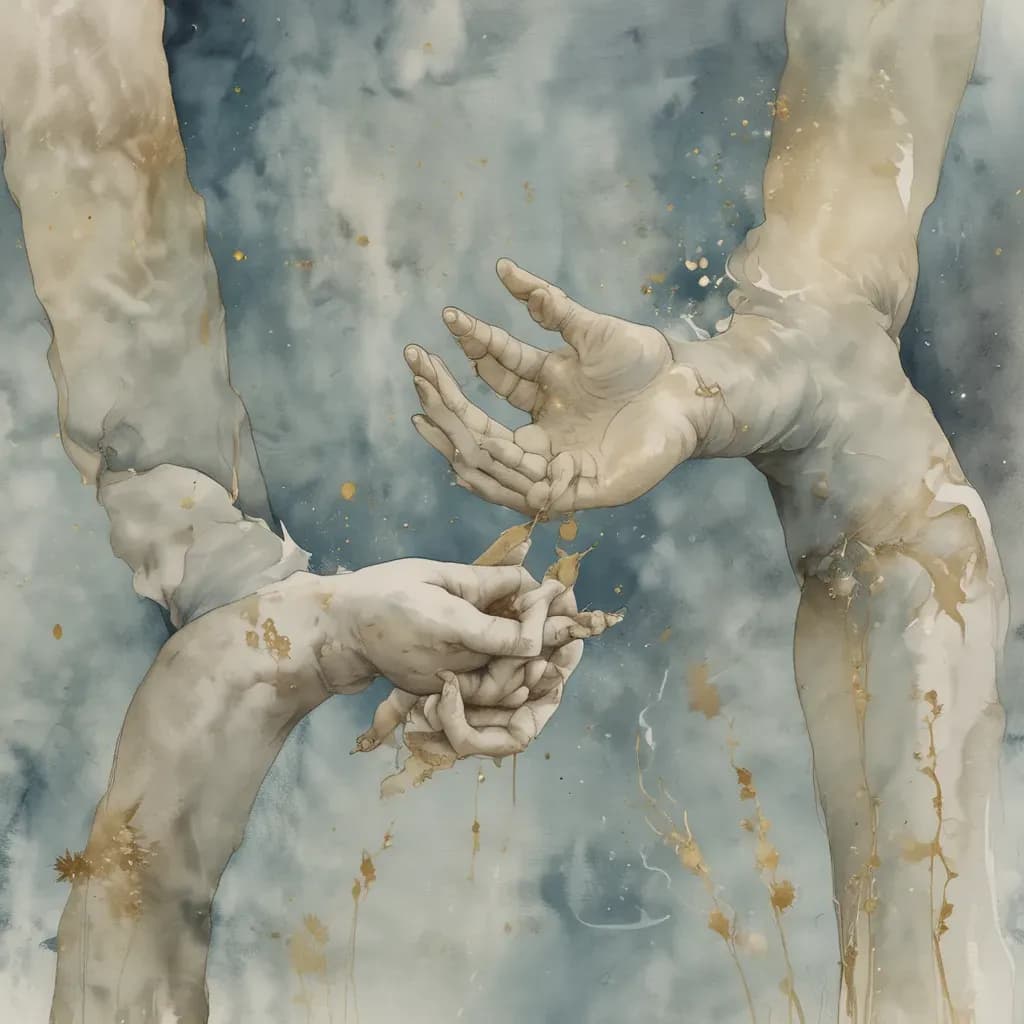
Read as a piece of rhetoric, the title is reasoning from necessity. The speaker is not pointing at love and saying it is here. They are reasoning toward it, as if the world's goodness had to be deduced from the fact that its absence would be unbearable.
This is a familiar move in devotional writing, whether romantic or religious. Believers and lovers alike often arrive at conviction through need rather than proof. Kushner has spent his career in this register. His breakout single "Daylight" turned on the feeling of loving and hating something at the same moment, and his debut album framed its whole project as a study of paired opposites such as hope and despair, and desire and restraint[2].
"There Must Be Love" can be heard as the same habit of mind pointed in a gentler direction. Instead of two opposites held in tension, it reaches for one affirmation and leans its full weight on it.
Love and faith, braided together
Kushner is a Christian, and has said his faith has been a foundational thing in his life, even when it is hard[3]. It would be a mistake to flatten his songs into sermons, and he has said he simply writes music he thinks will speak to people[3]. But the vocabulary of devotion itself comes from religious life, and an album with that name invites a double reading.
On one reading, the love in question is human: a partner, a family, a person who makes a hard stretch bearable. On the other, it is something closer to grace, a love that exists independently of whether any one relationship holds. The title works for both. "There must be love" is what a person might say after a breakup, and also what a person might say in a hospital waiting room or at the end of a bad year.
Earlier work points the same way. A reviewer of his 2025 EP 20 Years From Now heard its love songs as shaped by what a child absorbs from watching the adults around them struggle[6]. That is the reviewer's interpretation, not Kushner's own statement, but it describes a plausible origin for this kind of song. Someone who has watched love strain up close has more reason than most to insist that it exists.
The sound of an argument made quietly
Kushner has described the sound of his debut as dark, ethereal and emotional, blending acoustic elements with atmospheric production[2]. Clash calls the new album's first single a delicately composed return in which he opens up as rarely before[1]. If "There Must Be Love" shares that approach (I have not been able to confirm its arrangement in detail), then its power lies in restraint. A song that pleads loudly sounds desperate. A song that makes the same plea in a low voice sounds like prayer.
His deep, rich voice has been central to his rise[2]. It lends weight to simple statements. A phrase as plain as the title carries an authority it might lack in a lighter singer's mouth.
Context: a young artist and a hard stretch
Kushner was born in 2000 and raised in the suburbs of Chicago, and he began writing songs with a friend in Florida after finishing high school[3]. Self-taught on guitar, he saw "Miserable Man" go viral on TikTok in 2022, and "Daylight" followed in April 2023[3]. His debut album went on to sell three times platinum[1].
Success came with a cost. In March 2025 he cancelled the remaining dates of a European tour, saying he needed to step back and focus on getting better, and he has spoken openly about anxiety and a tic disorder[3]. Against that background, an album about devotion carries extra weight. Devotion, for someone in that position, is partly about the people and beliefs that hold you up when you cannot hold yourself up.
Again, this is context and not confession. I am not aware of Kushner tying this specific song to any single event. But a song insisting that love must exist lands differently coming from an artist who has been public about needing care.
The reviewer of his earlier EP went so far as to call him his generation's Hozier[6], a comparison that points at the shared territory of devotional, quasi-religious love songs delivered in a rich low voice. Whether or not the comparison holds, it shows how listeners already file Kushner: as a songwriter for whom romantic love and spiritual longing are hard to separate.
Why it resonates
The song's appeal is its refusal to be certain. Pop music is full of declarations of love, and far fewer songs admit that love sometimes has to be taken on trust. Listeners who have been through loss, distance or doubt tend to recognize that stance immediately. It is the position of someone standing at the edge of cynicism and choosing, deliberately, to step back from it.
A title this open also invites listeners to supply their own story. It could sit under a wedding, a memorial, or a quiet late-night drive, and each would feel earned.
It also helps to remember where the song sits in the album's sequence of moods. Kushner has said the record contains both positive and sad songs[1], which implies that a song like this one works as a counterweight. After pieces that count the cost of devotion, a track that simply asserts love's existence offers relief, and perhaps a deliberate choice to end an argument with faith rather than with fear.
Other ways to hear it
There is a darker reading available. Because the album openly warns that devotion can destroy a person[1], the insistence in the title could be read as self-persuasion. The speaker may be trying to convince themselves that the thing they have given everything to is worth it. On that reading, "must" is not hope but bargaining.
A third reading is communal. The title makes no mention of who the love is for or from. It can be heard as a statement about the world at large, a refusal to believe that suffering is the whole story. This is the version closest to the religious tradition Kushner draws on, and it may be the most generous one.
None of these cancels the others. The song seems built to hold all three, which is part of why it is hard to pin to one meaning.
Conclusion
"There Must Be Love" earns its place on an album about devotion by naming the thing devotion depends on: the willingness to believe before you can prove. Kushner has said that even when devotion can ruin you, it is still worth trying[1]. This song is that idea turned into music.
It does not claim that love is easy, or that it always arrives on time. It claims only that it must exist, and then it asks the listener to keep faith with that idea a little longer. For an artist whose career has been a long conversation between hope and despair, that is a meaningful place to land.
References
Keep reading
More by David Kushner
More Indie Folk
- Space and Time Big Thief
- The Governor's Waltz Phoebe Bridgers
- Haunted Phoebe Bridgers
- Crazy Girl Gracie Abrams
- Bobby Phoebe Bridgers
- Daughter From Hell Gracie Abrams