The Demand for a Love Song
Some songs find their way to an audience through carefully timed release schedules and industry press cycles. "Waterfall" found its way through a more unusual route: a celebrity's insistence. When Drake sampled the then-unreleased track in the closing minutes of his album "For All the Dogs" (October 2023), he transformed it into an open-air demand, posting on Instagram Stories that Yebba should release the full song immediately[1]. The moment was striking enough to be significant: here was one of the most commercially powerful figures in pop music doing the work of a publicist for a song he hadn't created, making his enthusiasm public and personal in equal measure.
Yebba obliged, releasing "Waterfall (I Adore You)" in late October 2023[1]. And when she assembled her second studio album "Jean" in 2026, the song arrived again, stripped of its subtitle and settled into the wider context of an album about grief gradually transforming into gratitude. It is a song about adoration, and it landed in an era when Yebba was finally making room for joy.
From Grief to Adoration
To understand what "Waterfall" means within Yebba's work, it helps to know the arc that precedes it. Her debut album, Dawn (2021), was named after her mother, who died by suicide in 2016[2]. That album was a reckoning: with devastating loss, with fractured faith, with the question of how to keep singing after the ground gives way. It established Yebba as an artist of uncommon emotional courage, someone who would not flinch from the hardest material.
Jean, released in March 2026 via RCA Records, takes its name from her late grandmother, a quieter and more stabilizing presence. Yebba has described what her grandmother's influence left her with: "a peace" that allowed her to go be curious about the world[3]. The album explores what she has called her "adulting years": the terrain after acute grief, when you are no longer in crisis but instead navigating the strange ordinary of wanting things again. Her stated philosophy for the record is disarmingly simple: "All of it is worship."[4]
The shift in naming between albums is also a shift in emotional register. Where Dawn was saturated with raw mourning, Jean operates in the territory of what follows: the realization that love is still possible, still available, still something to reach toward. "Waterfall" sits at the heart of that realization.
The Language of Adoration
The song is not a straightforward love anthem. Its emotional intelligence lies in how it holds two things at once: profound adoration and the persistence of self-doubt. The narrator does not describe a beloved who has solved her inner struggles. She describes someone whose presence silences that inner critic, or more precisely, transforms it into something closer to reverence. Her doubt and her devotion become the same feeling, pointed in the same direction.
The beloved is described in terms of rawness and unrefined quality, something uncut and prismatic, capable of bending time and perception. This is not the language of idealization. It is the language of awe, and there is a crucial difference: idealization smooths out particularity, while awe is provoked precisely by it. The song is devoted to someone specific, with all their roughness intact.
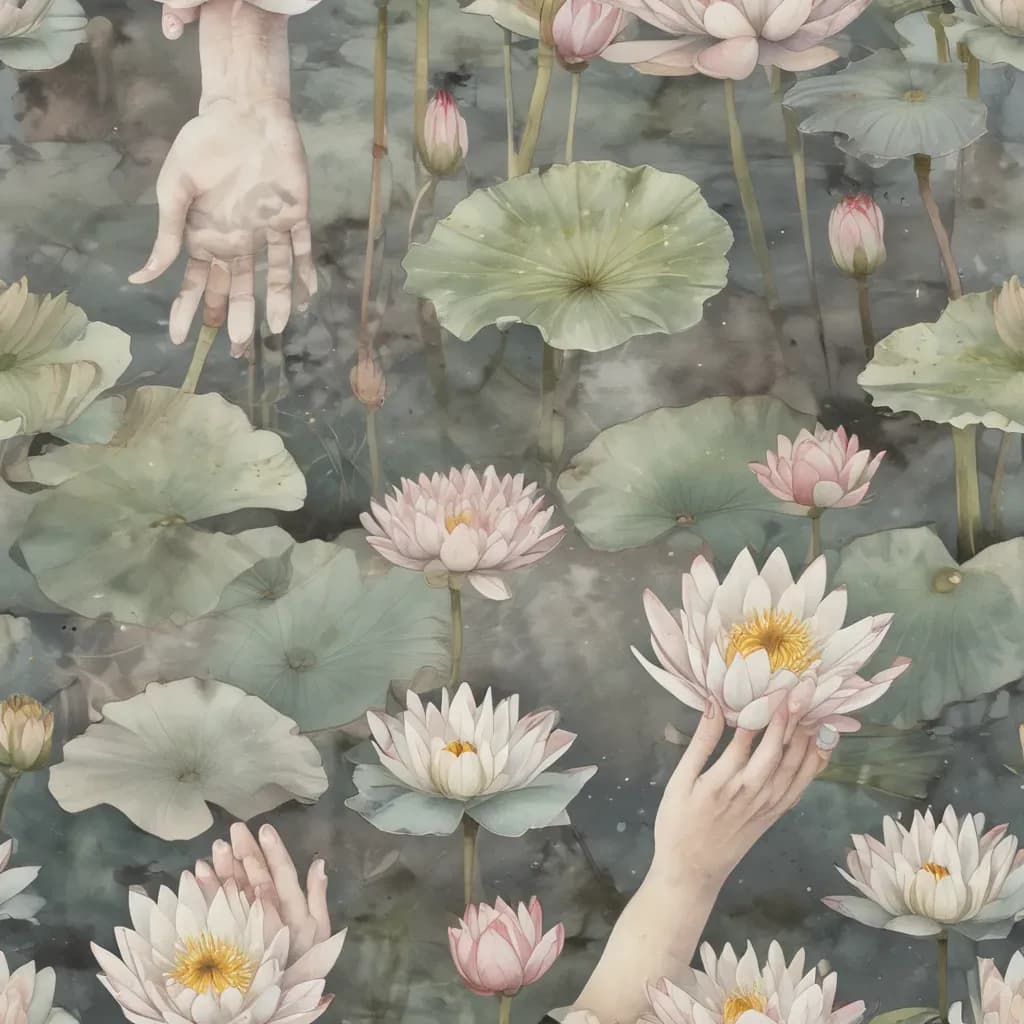
Musically, the production matches the emotional register perfectly. Light percussion, flute, marimba, and Yebba's voice hovering in a gentle reverb create something immersive and unhurried[5]. Critics have described the listening experience as akin to floating down a slow river[6]. The waterfall of the title is not a crashing, dramatic image. It suggests motion with direction and inevitability, something that carves its way through resistance gradually and without fanfare. Adoration that does not ask permission.
Worship as a Double Register
Throughout Jean, the line between spiritual devotion and romantic love is deliberately porous. Yebba grew up singing in her father's church, absorbing the Clark Sisters and Aretha Franklin as formative models for what a voice could carry[2]. Her musicianship is inseparable from that tradition. When she says the album is "all worship," she is not merely describing spiritual content. She is describing a mode of attention: full presence, complete openness, the willingness to be undone by something larger than yourself.
"Waterfall" operates in exactly that register. The feelings it describes, adoration so complete that self-doubt dissolves into mysticism, belong as readily to spiritual ecstasy as to romantic love. This is not accidental. Yebba has built her entire practice around the idea that the two are not as separate as secular culture tends to assume. A love song, approached with enough honesty and enough vulnerability, becomes a hymn. A hymn, approached with enough particularity, becomes a love song.
This duality gives "Waterfall" a quality that outlasts its immediate romantic context. The song does not require you to know the specific person it is about. It requires only that you have felt the experience of being unmade by someone's presence, and discovered that being unmade felt like freedom.
The Drake Co-Sign and Its Meaning
Drake's decision to center "For All the Dogs" on this previously unheard Yebba track was more than a cameo. His public demand that she release the full version was a peculiar and revealing moment in contemporary music culture: an artist of enormous commercial reach essentially functioning as a witness to someone else's genius[1]. The fact that he chose "Waterfall" specifically, a song about adoration in the spiritual-devotional mode, for the emotional closing of one of the most anticipated hip-hop albums of 2023, says something about the song's reach across genre categories.
This moment fits a broader pattern in Yebba's career. She came to wide attention through peers before audiences: she sang backing vocals with Chance the Rapper on SNL in 2016, won a Grammy for Best Traditional R&B Performance alongside PJ Morton in 2019[2], and has been the subject of admiring attention from some of the industry's most significant figures throughout her career. Her influence tends to operate through testimony rather than chart position.
The Drake episode brought "Waterfall" to a global audience that might not have found it otherwise. But it also underlined the paradox at the center of Yebba's public presence: her music is deeply intimate and clearly beloved by those who encounter it, and yet it has never quite broken through to mass commercial ubiquity on its own terms. The song's journey from private composition to Drake's co-sign to standalone release to album centerpiece is itself a kind of story about how vulnerability travels, slowly and sideways, until it finds the people who need it.
What Lingers
Critics who reviewed Jean consistently identified "Waterfall" as one of the album's essential moments[6]. Rolling Stone described the album as "an enthralling account of an artist learning to be less precious about linear healing"[7]. NPR called it "sun-kissed and warmhearted," noting a purposeful restraint in the arrangements[8]. "Waterfall" embodies both qualities: it carries warmth without sentimentality, and it holds back just enough that the moments of full-voiced adoration feel genuinely earned.
The song also demonstrates something particular about Yebba's voice on this album, which critics noted was deployed differently from her debut[9]. Less inclined toward the sustained power note, more willing to flutter, dissolve, and hang in the air. On "Waterfall," this approach yields its clearest reward. The voice is not performing. It is simply present, describing what it feels like to want someone the way you want water: not as something you acquired, but as something you need in order to keep going.
Within Jean's arc of healing and gratitude, "Waterfall" serves as a kind of gravitational center. Surrounded by tracks that grapple with loss, faith, identity, and the complications of growing up inside grief, it provides the point toward which the album quietly orients itself. The grandmother whose name the album bears gave Yebba something steady to stand on. "Waterfall" is what happens when that stability becomes the capacity to love outward, toward another person, with nothing held in reserve.
References
- Yebba - Waterfall (I Adore You) ft. Sweata — HotNewHipHop coverage of the Waterfall release, including Drake's Instagram demand
- Yebba - Wikipedia — Biographical overview including upbringing, career milestones, and Grammy win
- Yebba on Jean and Grandmother's Legacy — Background on Jean album, Yebba's quotes about her grandmother and the album's meaning
- Yebba Announces Sophomore Album Jean — Exclaim! article on Jean album announcement with Yebba quotes about the album's philosophy
- I Adore You: Yebba's Waterfall — Music blog review of Waterfall (I Adore You) describing its instrumentation and emotional impact
- Yebba Jean Album Review - Ratings Game Music — Review highlighting Waterfall as a standout track and praising Yebba's vocal restraint
- Yebba - Jean (Album Review) — Rolling Stone's review of Jean, describing the album as an enthralling account of healing
- Yebba's Jean: NPR Review — NPR review calling the album sun-kissed and warmhearted
- Album Review: Jean by Yebba - Shatter the Standards — Critical review noting Yebba's changed vocal approach on Jean compared to Dawn
- Yebba Unveils New Album Jean - Clash Magazine — Clash Magazine coverage of the Jean album announcement