White Feather Hawk Tail Deer Hunter
A love song that sounds like a haunted house is a rare thing. Lana Del Rey's "White Feather Hawk Tail Deer Hunter" arrives whispered rather than sung, wrapped in strings that tremble at the edges, and it spends its running time praising a husband, a kitchen and a lawn. One critic called it a love song and a horror film at the same time.[1] That tension is the whole point.
The song is also an odd artifact for an artist whose reputation was built on doomed glamour. Here the glamour has moved indoors, and what remains is domestic ritual, treated with the seriousness other writers reserve for tragedy.
Where the song comes from
The single was previewed and released in mid-February 2026 as the lead track of her tenth studio album, Stove.[1][5] Del Rey announced the title herself on Instagram a week or so earlier, calling it her favorite song on the record and saying it was the one she had been waiting for.[5]
The album had a complicated road. It was first titled Lasso and framed as a country pivot, then renamed The Right Person Will Stay, and finally became Stove, with earlier singles "Henry, Come On" and "Bluebird" arriving along the way.[3][5] Against that backdrop of shifting names, this single reads as the moment the project found its center.
That center is a marriage. Del Rey wed Jeremy Dufrene, an alligator tour boat captain from Des Allemands, Louisiana, on September 26, 2024, after the two met in 2019 when she posted photos from one of his swamp tours.[4] He is credited as a co-writer, alongside her sister Caroline "Chuck" Grant and her brother-in-law Jason Pickens.[2][4] Del Rey has said that many phrases and bits in the song were thrown in by other people, which gives it the feel of a family project.[4]
Production came from Del Rey with Jack Antonoff and Drew Erickson, the latter responsible for the cinematic string writing.[2][4][5] In her own note to fans, she said she had finally found a magical chord she had been missing.[2]
Domesticity as mythology
Most of Del Rey's best-known songs treat love as an event, something fatal, cinematic and borrowed from old Hollywood. This one treats love as a chore list. The narrator describes pushing a green mower across the grass, cooking for her husband, and staying cool through a long summer.[1] The images are small, specific and a little comic.
What turns them into something larger is the delivery. Rather than belting, she mutters and whisper-raps, a style one writer compared to Kim Gordon's spoken vocals, before the melody opens into something closer to a show tune.[2][3] The effect is intimate and slightly unnerving, like overhearing someone talk to themselves while they work.
Songfacts describes the result as a domestic and surreal love letter, one in which mowing and cooking become rites of emotional survival.[4] That is a useful way to hear it. These are not chores performed grudgingly. They are the way the narrator proves, daily, that the life she has built is real.
The animal names
The title is the strangest part, and it is deliberately opaque. It strings together a bird of prey, a feather and a hunter, and the common reading is that these are symbols for the husband, an idealized figure drawn from the natural world and from his Louisiana surroundings.[4] Hawks suggest sharpness and protection. A hunter suggests provision, rural masculinity and survival.
The white feather has several possible meanings. Songfacts offers purity, peace, or the calm that follows a turbulent past, and it also notes a more earthbound option, that it might simply refer to graying hair.[4] I find the ambiguity attractive. The song seems built to hold a grand symbolic reading and a plain affectionate joke at once.
There is a broader pattern here. Del Rey has always renamed ordinary people and places as legend, and this title does the same for a man who runs swamp tours. The mythology is homemade, assembled from nicknames, in-jokes and private shorthand rather than from the American iconography of her earlier work.
Devotion and its shadow
Nothing about the song is purely sweet. The strings are eerie and the guitar figures are anxious, which gives the whole piece a fraught undertone.[1] Tobias Hess at The FADER described the song as walking a line between adoration and submission, a push and pull between a couple facing the world together and the labor of being a wife.[1]
The song also lets old troubles hover at the margins. Songfacts notes passing references to drug use and nicotine, and reads them as addiction and self-sabotage pushed to the edges of a life that has otherwise settled.[4] The past has not been erased. It has simply been demoted from the main subject to a footnote, which may be the most believable form of recovery a love song can offer.
Her arrangement choices support this. The instrumentation is sparse, with piano, harp, celesta, brass and woodwinds layered around Antonoff's guitars and drums, producing what Songfacts calls a ghostly, minimalist blend of gothic country and orchestral pop.[4] Clash compared the delicacy of the arrangement to watching a feather float on the breeze.[2] The music is airy, but it never feels entirely safe.
The video and the oven
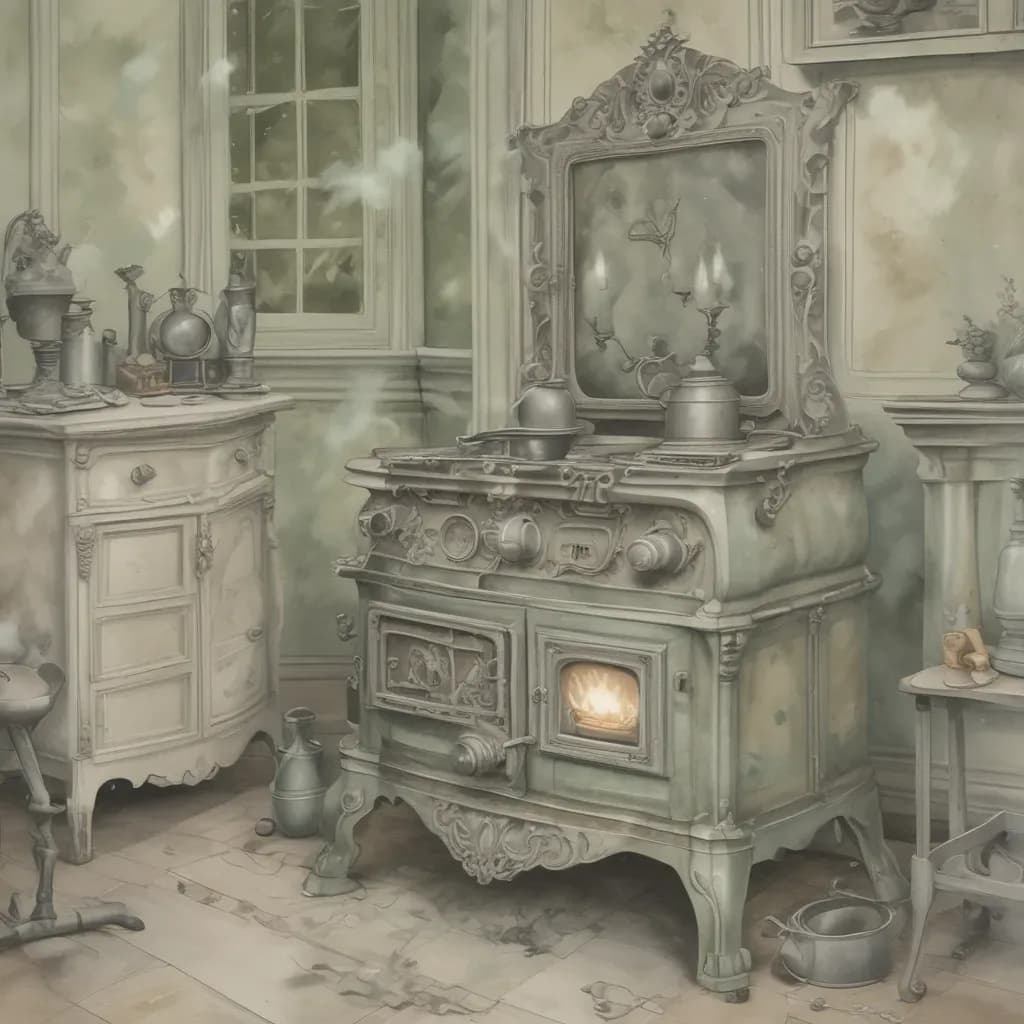
The accompanying video is homemade and unvarnished. Del Rey lip-syncs, eats macaroni and cheese and dances under fake snow in a backyard, and as the clip goes on it moves toward oven and stovetop imagery, with vintage cartoons and old film clips spliced against home-movie footage of her, her husband and relatives dancing.[4]
One moment shows her putting her head into an oven, which Songfacts reads as a wink at Sylvia Plath.[4] That reference lands heavily, because the Plath connection is about a woman whose domestic life and inner life could not be reconciled. Here the gesture is played for deadpan humor, but the allusion keeps the darker question alive. Is the kitchen a refuge, or a trap that has been decorated beautifully?
The album title adds weight to this. Songfacts treats the stove imagery as a metaphor for healing and as the thesis of the whole record.[4] A stove is warmth and nourishment, and it is also the classic domestic site of danger.
A question for the culture
The song cannot be separated from the argument around Del Rey's public image. The FADER connects it to her 2020 social media post defending women who look and act like her, which drew backlash for how it named other artists, and calls the new single a "trad-wife" fantasy turned into a song.[1] Del Rey is a New York-raised artist who made her name mythologizing Los Angeles and who has recently settled in Louisiana, so the move toward rural domestic life felt like a statement.[1]
Whether you hear that as sincere or as performance depends on what you bring to it. Clash heard something carefree and playful in it, a fresh angle on love that is both a stepping stone and a coherent statement.[2] The Needle Drop singled out its quirkiness, calling it the most offbeat tune she had made in years.[3]
Critics were not unanimous, and a few found the melodies less striking than her usual ethereal sound. That split is part of why the song matters. It asks listeners to decide how much irony is in the picture, and Del Rey, characteristically, does not say.
Other ways to hear it
A first reading takes it at face value. This is a woman who has found peace, and she is describing it with the fussy tenderness of someone who did not expect to get it. On that reading, the strangeness is just what happiness sounds like to a person who learned to write about sorrow.
A second reading treats the song as performance, a character study of the devoted wife as folk figure, in the same way her earlier records studied the doomed starlet. The horror-film strings suggest that the fantasy has an edge, and the oven in the video offers a pointed reference for anyone who wants to look for it.
A third reading sits between the two. The song is sincere about the love and honest about its cost, so that the devotion and the unease are both true. This is the reading I find most persuasive, because it matches how people actually feel about the things they have chosen.
Why it resonates
Part of the song's appeal is its refusal of scale. After years of operatic songs about love as spectacle, here is one about weeds, meals and a man who gives her a reason to stay put. It treats ordinary devotion as strange enough to deserve a myth.
It also shows an artist rearranging her own mythology rather than abandoning it. The old cinematic gloss is still present in the strings, and the nod to a classic Ella Fitzgerald recording keeps one foot in the past.[2][4] The subject has simply changed, from the glamour of ruin to the quiet labor of staying.
Whatever one makes of the politics around it, the song succeeds as a portrait of a particular state of mind: grateful, slightly haunted, and determined to make a life out of small, repeated acts of care. It is a love song for people who know how easily a house can feel like a haunted one.
References
Keep reading
More Art Pop
- Lost Weekend Phoebe Bridgers
- Hounds of Love Kate Bush
- On Your Mind FKA twigs
- Won't Stand Down Peter Gabriel
- Alyse Shygirl
- Silver Screen Baby Dove Cameron