Won't Stand Down
Most protest songs arrive with a clenched fist. This one arrives with an open hand. Won't Stand Down, the fifth single from Peter Gabriel's o\i, is a slow-building ballad about refusing to give up on decency, sung in a voice that sounds more tired than angry and more hopeful than either.
It is also, by Gabriel's own account, a deliberate piece of persuasion. He has called it a song meant to encourage some sort of activism[1], and the way it is built says a great deal about how he thinks that encouragement should work.
A song for the full moon
The track was released on May 1, 2026, the night of the Flower Moon, as part of the lunar release schedule that Gabriel began with i/o and repeated for o\i. Each song appears on a full moon in a Bright-Side mix by Mark "Spike" Stent, followed on the new moon by a Dark-Side mix by Tchad Blake[1][3]. The earlier singles that year were "Been Undone", "Put The Bucket Down", "What Lies Ahead" and "Till Your Mind Is Shining"[2].
According to Wikipedia, the song began in February 2025 as a piano sketch under the working title "WSD", which makes it one of the more recent ideas on an album that also gathers material going back to the sessions for Up[4]. Gabriel plays piano, synths and synth strings, with Manu Katché on drums, Tony Levin on bass and David Rhodes on guitar, plus backing vocals from Faye Dolle and rhythm programming shared with co-producer Mike Elizondo[1].
That is the classic Gabriel band, and he says he wanted it to sound like one. He describes the performance as less layered than usual, which "feels more alive", and says he was after real, live emotion more than on any other track on the record[1].
The Elders and the idea of moral authority
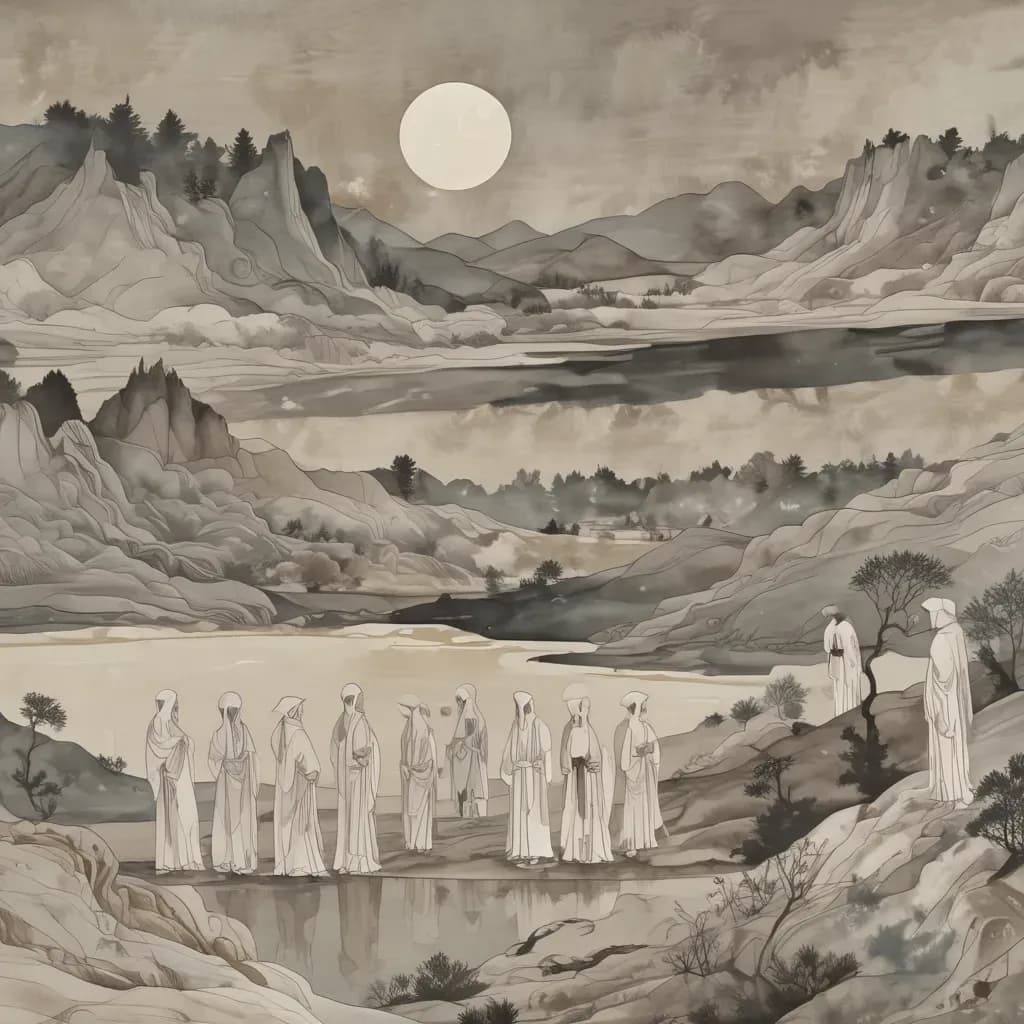
The song's most specific starting point is The Elders, the independent group of senior statesmen and women brought together to work for peace, justice and human rights. Gabriel says he first thought about making music for them, and what draws him is their "currency": moral authority rather than military, economic or political power, earned through lives of service[1][2].
Rolling Stone Italia reads the song as a dedication to these wise elders as a guide in dark times, and names members such as Juan Manuel Santos, Mary Robinson, Graça Machel and Ellen Johnson Sirleaf[5]. Wikipedia adds that Gabriel was himself involved in the group's creation alongside Richard Branson, with Nelson Mandela, Desmond Tutu and Jimmy Carter among its first members[4]. The sources differ on who founded what, but all of them agree on the link.
This matters for how the song sounds. A track written in praise of people who lead by example, not force, could hardly be a shouted anthem. It has to persuade, and persuasion needs patience.
Hope as a strategy
Gabriel is unusually explicit about the psychology behind the song. He says it is "pretty dark out there in lots of places", and that we should nudge both ourselves and our leaders to keep faith with basic values of justice, compassion and democracy[1]. But his argument is practical, not sentimental: people are more likely to engage when they feel hope, and positive visions of the future are not being projected as strongly as negative ones[1][3].
That is a striking position for a songwriter whose catalogue includes some of pop's bleakest studies of power, from the political horror of "Biko" to the paranoia of "Intruder". Here the darkness is acknowledged but not rehearsed. Gabriel says he wanted the song "up and positive even though the subject is quite difficult and dark"[4]. The song's job is to hand the listener a picture of a fairer world worth aspiring to, and to suggest who might help build it.
The structure supports this. NME's Liberty Dunworth described the track as one that gradually builds toward a chorus both euphoric and tranquil[4]. The arrangement does not hurry. It lets the feeling widen, and the chorus lands less as a demand than as a vow, the kind a person makes quietly and then keeps.
A rhythm borrowed from soul
The most surprising musical influence Gabriel names is Marvin Gaye. He says he has always been a fan, and that he loved the Cuban element in "Sexual Healing", the way it lets the rhythm move. He tried to bring some of that looseness into this song while letting it become something different[1][3].
It is a revealing choice. Gaye's "What's Going On" is the great soul-era plea for compassion in a violent time, and it showed how gentleness can carry a political message further than rage. Gabriel's borrowing is subtler than a quotation: a sway in the groove that keeps a serious song physically inviting. Anyone can nod along to it, which is part of how activism spreads.
The artwork and the question of Iran
The single's cover uses a work by the Iranian-born, New York-based artist Shirin Neshat, showing two pairs of hands and an inscription from the thirteenth-century poet Rumi, roughly a plea to be given a hand so as to be held[1]. Gabriel has admired her work since her 1990s series Women of Allah, and calls the image very beautiful, powerful and political. To him the hands suggest protecting a positive future for children, though he allows that Neshat may have meant something else[1].
Sources disagree on the piece's title. Gabriel's own site lists it as "Bonding", while Wikipedia and Rolling Stone Italia call it "Faith"[1][4][5]. Either way, hands are the right emblem: they can hold, build, comfort, or strike, and the song asks which of those we will choose.
Because of the Neshat image, Gabriel expected listeners to wonder whether the song responds to events in Iran. He says it was written before the bombing there and is not a reference to it. But he calls it a real condemnation of humanity that disputes are still not settled without bombing, destroying and killing, adding that we should be well beyond that by now[1][2].
Where it sits on the album
Within o\i, the song is the clearest statement of purpose. Gabriel has framed the record around the future, with a coming wave of AI, quantum computing and brain-computer interfaces, and the album spends much of its time asking what kind of people we will be when those tools arrive. "Won't Stand Down" is where the album stops asking and takes a position.
The Bright-Side and Dark-Side mixes dramatize the same tension. Gabriel says the two mixers took quite different directions, and that emotion can change enormously through what is moved, dipped, brought out and isolated, "by the way you tell the story"[1]. Stent's version leans toward light, and Blake's is expected to bring out different textures[2][4]. The song's subject has not changed between them. Only the angle of the telling has, which is a fair description of how hope and despair relate in the real world too.
Other ways to hear it
A cynical listener might hear a wealthy, famous musician offering comfortable uplift. The song invites that objection by being so gentle. A more generous reading is that Gabriel is working in a tradition he has long respected: using celebrity to point at people with better credentials. The Elders are the subject, not the singer.
There is also a personal reading. Gabriel is in his mid-seventies, and a title about refusing to stand down can sound like a statement about his own work as much as a political one. He is still releasing music on a lunar calendar, still tinkering with mixes, still insisting on large ideas. Reviewers of the album as a whole have found it brilliantly conceived and superbly played but perhaps too controlled[5]. The single's live-band warmth is the counterargument.
Why it resonates
Songs about despair are easy to write, and songs about optimism are easy to make hollow. The harder thing is to be honest about how bad things look and still argue that people can act. Gabriel does this by changing what the listener is asked to do. The song does not ask for outrage. It asks for steadiness.
That may be why it feels timely without being tied to a single headline. Wars, democratic erosion and cynicism about institutions are all in the background, and the song names none of them directly. It simply keeps its eyes on a better version of the world, and on the people who show what moral authority looks like.
In a catalogue full of masks, machines and psychological ruin, Won't Stand Down is one of the plainest things Gabriel has made. It trusts that a good tune, a patient build and a clear idea can still move people to act, and it leaves the rest to the listener's two hands.
References
Keep reading
More by Peter Gabriel
More Art Pop
- Lost Weekend Phoebe Bridgers
- Hounds of Love Kate Bush
- On Your Mind FKA twigs
- Alyse Shygirl
- Silver Screen Baby Dove Cameron
- When in Rome Dove Cameron