Wuthering Heights
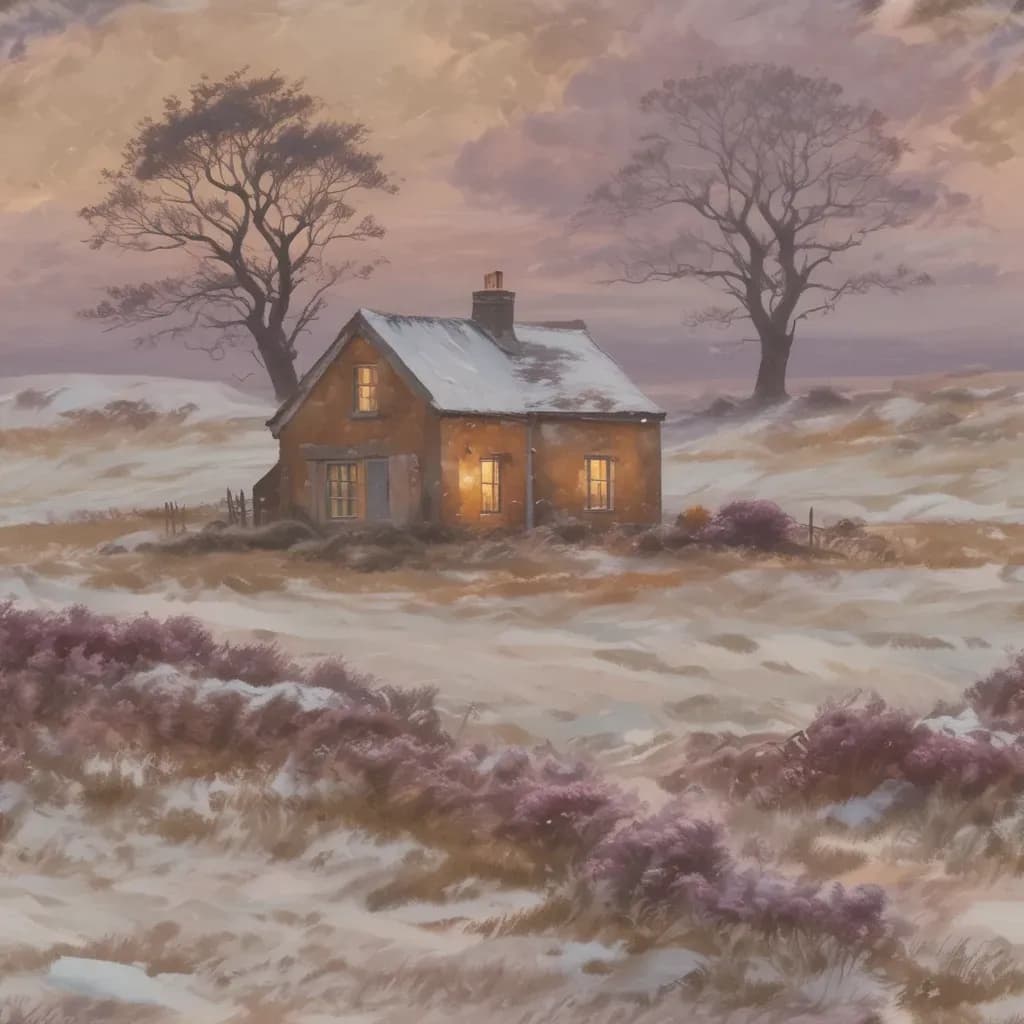
Somewhere past midnight, a teenager sits at an upright piano in a rented flat and writes a song in the voice of a dead woman. The dead woman is not a metaphor. She is standing outside a window in a snowstorm, asking, with perfect politeness and total desperation, to be allowed back into the house where she was happiest and most miserable.
That is the situation at the center of Wuthering Heights, the debut single by Kate Bush, and it is a stranger premise than almost anything else that has ever reached number one on the British charts. It is a ghost story, a love story and a feat of vocal theatre, all compressed into about four and a half minutes.
An eighteen-year-old and a television serial
Bush wrote the song on the night of 5 March 1977, when she was eighteen, in a few hours of late-night work[1].
The trigger was not the novel itself. Emily Brontë's book came into the picture afterward. What Bush had actually seen was the closing stretch of the 1967 BBC adaptation, which she caught as a child, and the image that stayed with her was Catherine outside the window, wide-eyed, pale and wrapped in snow[1].
Only once she had the song did she read the book, to make sure her research held up[1].
There is a pleasing coincidence attached to all this. Bush and Brontë share a birthday, 30 July, a fact Bush discovered once she began reading about the novel[1][3].
Sources disagree on the precise television spark. Some accounts point to a documentary or to a 1970 film rather than the BBC serial, so the safest summary is that a screen version of the story, glimpsed as a child, lodged in her imagination and waited years to be used[1].
A voice that sounds like it is coming through glass
The song belongs to a very particular moment in her life. For years Bush had been writing at the piano, a self-taught pianist who began composing at eleven, and her family had assembled a demo tape of dozens of songs that record companies politely declined[2][5].
A family friend then played the tape to David Gilmour of Pink Floyd, who was intrigued enough to meet the family, pay for better demos and carry them to executives at EMI, who signed her[2].
The company then did something surprisingly patient. It gave her an advance and let her spend time studying dance and mime before recording her first album, which is part of why her early work moves the way it does[2][4].
When the recording sessions finally came, in the summer of 1977 at AIR Studios in London, the producer was Andrew Powell, who also wrote the arrangements and played celesta on the track[1].
EMI insisted on seasoned session musicians in place of Bush's own band. The players included guitarist Ian Bairnson, whose solo has become one of the song's signature moments, though he has said he spent years disliking the tone, and, reportedly, he played it with a broken arm[1].
The vocal itself is the real marvel. Accounts describe it as essentially a single take, with no stitching together of better moments, and the mix running from around midnight until five or six in the morning[4].
Bush sings at the very top of her range in a thin, keening register that manages to sound both girlish and ancient, and she bends the timbre of her voice by reshaping her mouth, a technique that one account compares to the stylized singing of Indian playback singers and Peking opera[1][4].
The ghost at the window
The song is narrated by Catherine Earnshaw, but it is narrated from beyond the grave, and that choice is the key to everything. The novel lets Lockwood, a visitor to the house, glimpse the ghost, while Heathcliff, the man she loved, cannot hear her. Bush instead gives the ghost the microphone[3].
What she delivers is not a spooky story told from a safe distance. It is a plea, and the plea is intimate: a dead woman standing in the cold, begging the man she loves to open the window and let her in. The emotional engine is loneliness more than terror.
Bush borrows a few fragments directly from the spoken pleas in the novel and the television serial, and the borrowing is noted in discussions of the song[1].
She also adds her own dramatic structure. The verses that recall the shared past of the two characters, their childhood on the moors, are set in one key, and the passages in which Catherine speaks as a ghost shift into another. The harmonic jump gives the listener a physical sense of crossing from the living world to the dead one[1].
The song is also unusual in its irregular phrase lengths and its unexpected chord movements, which keep the melody from settling into the comfortable shape of an ordinary pop single. It sounds like something being pulled in two directions, which is exactly its subject.
Love as possession
Tempting as it is to hear a pure romantic ballad, the song is a lot darker than that, and the novel is darker still. Critics who have written about it note that the two lovers are alike and badly matched, both stubborn and quick to anger, and that their bond rests on possession and control as much as tenderness[3].
The ghost in Bush's song reflects this. She calls her beloved cruel, and yet he is also the one person she wants. She wants him badly enough to pull him over to her side, to bring his soul across the boundary so that neither of them is alone. The speaker is lonely and she is also, quietly, dangerous.[3].
A middle section hints at Catherine's illness and death, the part of the novel in which she dies after giving birth to her daughter, who bears the same name. It is a brief glimpse of the story's sickroom and then the song returns to the window[3].
That mix of yearning and menace is why the song has kept its power. A simple tribute to romance would have faded. This one asks the listener to feel the pull of a love that is destructive and to hear its yearning as real anyway.
A girl with something to say
Bush has spoken about what drew her to the book. She thought the story was strong, and she singled out the fact that it concerned a young girl, in a period when women's roles were considered inferior, who was voicing something so passionate and heavy. She called it great subject matter for a song[4].
Seen from that angle, the song is also a piece of self-portraiture. A teenager in the 1970s, a young woman about to enter a music industry that would soon try to market her as a body first and an artist second, chooses a heroine whose defining trait is that she will not be quiet, not even after death. Bush would later say in an interview that she had to prove she was an artist in a female body[5].
The young woman writing the song, in other words, found her way to a character who knows exactly what she wants and refuses to be shut out.
The fight to be first
It was not obvious that this strange piece should be the debut single. EMI wanted the more conventional rock number "James and the Cold Gun" to introduce her. Bush insisted on "Wuthering Heights", saying it had to be the single, and she won[1][4].
The record was released on 20 January 1978. It entered the UK chart at number 42 and within weeks reached number one, displacing ABBA, where it stayed for four weeks. Bush became the first woman to top the UK chart with a song she wrote herself[1].
She was nineteen. The album that followed, The Kick Inside, came out in February, reached number three on the British album chart and went on to be certified platinum[2].
Two videos and a thousand red dresses
The song's image has become nearly inseparable from its sound. There are two promotional videos. One, shot in a dark studio full of mist, shows Bush in a white dress performing choreography that suggests a ghost without ever stating it. Pitchfork ranked it among the best music videos of the 1970s[1].
The other was filmed outdoors on Salisbury Plain, standing in for the moors, with Bush in a red dress[1].
She is reportedly the first performer to wear a head microphone, which freed her hands to mime and dance[3].
Each year, fans now gather in red dresses to recreate the outdoor dance in an event known as the Most Wuthering Heights Day Ever, a flash-mob tradition that began in 2016[1].
The song has been covered by Pat Benatar and others, and has been parodied and imitated in comedy, which is the clearest sign of an indelible performance[1].
Other ways to hear it
The most literal reading takes the song as a straight retelling of the window scene: a ghost, a lover, a storm. A second reading hears it as being about a marriage or a relationship that has ended. The house is the past, the window is the barrier, and the speaker is whoever cannot go back.
A third reading is about memory. The ghost at the window is the memory of a vanished self, the child on the moors who has outlived the person she became. Seen that way, the plea is not directed only at a lover but at one's own earlier life.
Some listeners hear the final stretch as celebration instead of grief, with the possibility that the word "home" gestures toward a reunion rather than a sorrow. One literary critic has even wondered whether a 1966 British television drama about homelessness might echo in it, though he offers that as speculation only[3].
The song is built to support all of these. It leaves out the details that would pin it down and keeps the pleading voice.
Why it still stops people
Nearly five decades after it first appeared, the song remains one of the most recognizable debuts in popular music. In 2016 Pitchfork placed it fifth on its list of the best songs of the 1970s, and a 2020 Guardian ranking of the UK's number ones put it fourteenth[1].
Part of what keeps it alive is how little it resembles anything around it. It arrived in the middle of disco and the first wave of punk, with piano, swooping strings and a voice nobody could place. It then did something rarely managed by an unusual record: it became a hit without softening its strangeness.
The deeper reason may be simpler. Most people have at some point stood outside something, a relationship, a house, a time of life, and wanted back in. Bush gave that feeling a voice, a body and a snowstorm, and then she sang it as though it were the most urgent thing in the world.
Years later she was asked to write a poem for a stone near Emily Brontë's home in Haworth, and she described the invitation as a chance to say thank you to Emily[1].
The thanks, in a sense, were already in the song.
References
Keep reading
More Art Pop
- Lost Weekend Phoebe Bridgers
- Hounds of Love Kate Bush
- On Your Mind FKA twigs
- Won't Stand Down Peter Gabriel
- Alyse Shygirl
- Silver Screen Baby Dove Cameron