There is a particular kind of grief that does not announce itself with drama. It settles into the body like a low-grade fever, showing up in the eyes, in sleepless nights, in the way a person moves through an apartment that no longer belongs to them but still feels like home. This is the emotional territory that Yebba stakes out in "Yellow Eyes," the lead single from her 2026 album Jean: not the acute rupture of loss, but its persistent, strange afterglow.
Arrival
"Yellow Eyes" arrived in February 2026, announcing Jean with an intimacy that felt almost private[1]. The album is Yebba's second studio release, arriving five years after her debut Dawn (2021). It is named for her late grandmother, a figure of settled faith and unwavering conviction who passed down strength and independence rather than unresolved grief. Where Dawn named its anguish directly (the title was also her mother's name), Jean takes a longer view.
Yebba, born Abigail Elizabeth Smith in West Memphis, Arkansas in 1995, grew up in a household shaped by the Black church tradition. Her father served as pastor and organist, and voices like the Clark Sisters and Aretha Franklin trained her ear from childhood[2]. Her stage name reverses the nickname her mother gave her. That mother, Dawn Smith, died by suicide in 2016, roughly one week after Yebba sang her first original song. The loss was total, reshaping not only her personal life but the direction of her entire artistic practice[2]. Her debut album, Dawn, was a record made from inside the wound. Jean lives in its aftermath. Yebba has described this period as the "adulting years," the stretch of life where no one fully knows what they are doing and the emergency has passed but the reckoning continues[1].
Recording Jean took five years. Yebba worked with longtime collaborator John Rooney and composer James Francies, across sessions in Arkansas, Dallas, and Electric Lady Studios in New York. Before writing, she returned from the city to West Memphis, a geographic homecoming that pressed its character into the music. "Yellow Eyes" reflects that returning: acoustic in texture rather than polished, measured rather than expansive, built on the sound of fingers on strings and the resonance of a guitar body held close[1].
The Weight in the Body
The title carries a diagnostic charge. Yellowed eyes are a symptom: of sleeplessness, of too much drinking, of the bodily cost of an emotional attachment held too long[3]. The song does not frame this as failure. It presents it as evidence. Proof that something mattered. That the connection was real enough to leave a mark on the flesh.
The song centers on the tension between departure and return, between the rational acknowledgment that a chapter has closed and the irrational loyalty that keeps circling back[3]. The narrator has, in some practical sense, moved on. But memory has its own physics. It bends back. It returns, uninvited but not unwelcome, with the specific texture of something that once felt safe.
Crucially, the song does not moralize this choice. One reading of the song argues that the narrator chooses not to move on because forgetting would feel worse than holding on[3]. Nostalgia here is not weakness. It is a wager: that some connections are worth the cost they exact from the body. Yellowed eyes are the receipt.
Inhabited Absence
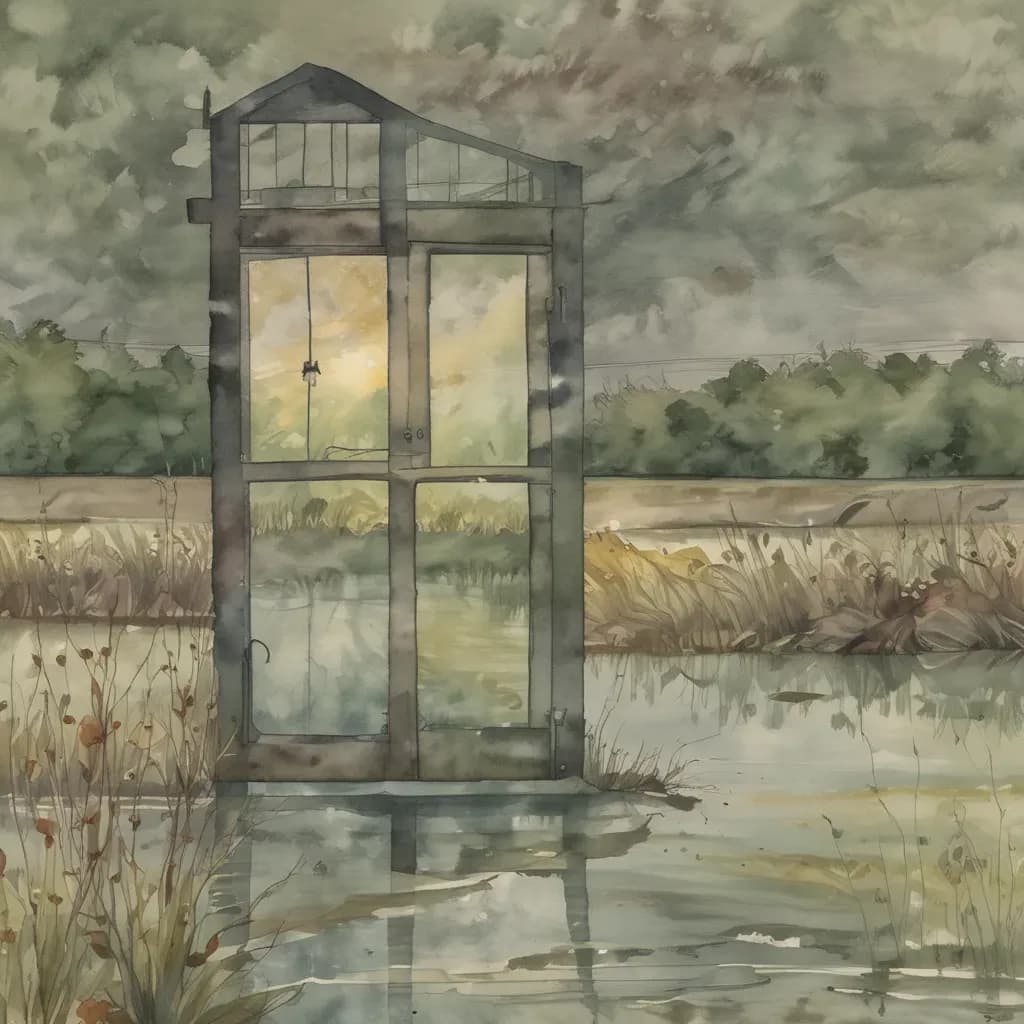
The song grounds its abstraction in physical space. Trophies sitting on a bare floor where furniture once stood, an unfurnished room that still carries the quality of home[3]. These are the artifacts of a life that has been lived in, then vacated. The room is no longer inhabited, but it has not stopped being a place. This is the paradox at the song's center: presence within absence, meaning that outlasts the circumstances that created it.
Against these domestic interiors, the song places natural imagery that signals external threat. A sky gone green, a flooded landscape: the omens of approaching storms[3]. These images collide against the safety of familiar space, creating a portrait of an interior conflict rendered in weather. The elements that should drive a person toward shelter are the same elements the song romanticizes. There is danger in staying. There is also beauty.
One perceptive reading of the song suggests that the coping mechanisms on display go further than sentimentality[4]. The narrator takes up drinking and relentless work in the aftermath, survival strategies that do not resolve anything but keep a person moving. These leave their traces, most visibly in those yellowed eyes. Yebba captures the specific texture of getting by without being honest about why you are struggling: the way grief camouflages itself as industry, as habit, as productivity, until the body betrays you.
Restraint as a Statement
Yebba's voice is one of contemporary soul's most extraordinary instruments. Its range, its gospel-trained power, its capacity for unguarded emotion: these qualities made her debut impossible to ignore. Which is why the approach she takes on "Yellow Eyes" is so striking.
The song opens with acoustic guitar, plucked figures that dance against one another, close enough that you can hear skin against strings and the resonant body of the instrument breathing[1]. Yebba's vocals are soft, close, and restrained. She has described wanting to "experience singing in a different way than I had before"[1]. That different way is whispering. Holding back. Letting the instrument and the voice sit together without reaching for resolution.
The minimalist production mirrors the thematic content. A voice that holds back mirrors a narrator who is holding on[4]. The song does not build toward a cathartic release because catharsis is not the experience being described. What is described is quieter, more stubborn: the ongoing work of someone who has decided, consciously or not, to keep a relationship alive inside their own body, whatever the cost.
In a career built in significant part on extraordinary vocal power, this restraint is its own kind of statement. It belongs to a growing strand of contemporary soul and R&B, alongside artists like Cleo Sol and Sampha, that is exploring what the tradition sounds like when it gives itself permission to go quiet. But where those artists largely came up outside the church, Yebba's decision to whisper is a choice made from inside a tradition that prizes full-throated expression[2]. The silence is not an absence. It is a disciplined act.
Cultural Resonance
"Yellow Eyes" speaks to an experience that is widespread and often undiscussed: the grief that does not have an obvious endpoint. Romantic loss has a social script. Bereavement has rituals. But the ongoing presence of someone or something that is technically gone, the way the past keeps metabolizing itself into the present, rarely gets named so precisely.
The song also arrives from a very specific biographical place. Yebba has spent a decade making music in the aftermath of her mother's suicide, a loss she has described as giving her PTSD and OCD, a loss she spent years not looking at directly[5]. "Yellow Eyes" does not address that loss directly either. But it lives in the same emotional climate, the world where something is gone that your body refuses to accept as gone.
The album's central figure offers a different model: a grandmother who lived a long and full life and died with her faith intact. Jean, as a presence, is a counterexample to devastation, proof that a hard life can end in peace rather than rupture. "Yellow Eyes" is the song that opens the door to that grandmother's world, but it does so by sitting first in the less-resolved terrain of the narrator's interior. You have to know where you are starting from before you can understand where you might arrive.
Other Readings
The song lends itself to readings beyond romantic longing. The relationship the narrator can't leave behind may be with a person, but it may equally be with a place, a version of herself, or the grief she inherited and has not yet set down[3]. The domestic imagery, an apartment that held a life and has since been vacated, could be the childhood home in West Memphis, or the city she left, or the self that existed before grief arrived and changed the light in everything.
A spiritual reading is also available. Yebba grew up in the church and has spoken about how the faith of her upbringing became complicated in the years after her mother's death[5]. The eyes that won't close, the mind that keeps returning: these describe not only the pull of a person or a place but the pull of a belief system that gave you language and structure and community before it stopped being able to explain the worst thing that happened to you. The church gave Yebba her voice. "Yellow Eyes" may be, in part, about the difficulty of leaving any place that was once that foundational.
What the Song Insists On
"Yellow Eyes" does not offer resolution. It offers something rarer: honest description of where a person is, without rushing them toward where they are supposed to be. In its stripped-back production and its close, watchful vocals, it establishes the terms of Jean as an album. This is not a record about arriving somewhere. It is about learning to inhabit the in-between.
Yebba has built a career from making music in the aftermath of the unsurvivable. That she keeps surviving, and keeps making beautiful things from what survives, is the quiet argument the song makes. The yellowed eyes are not a verdict. They are a beginning.
References
- Yebba Announces New Album 'Jean': Hear 'Yellow Eyes' — Lead single announcement with Yebba quote about her vocal approach and song description
- Yebba - Wikipedia — Biographical overview including upbringing, mother's death, gospel roots, and career milestones
- Yebba's 'Yellow Eyes' Lyrics Explained: Nostalgia That Won't Let Go — Detailed thematic analysis of the song's imagery, central metaphors, and emotional arc
- Jean by Yebba Album Review — Critical review discussing Yellow Eyes as an opening statement and its themes of restraint and coping
- With The New Album 'Dawn,' Yebba Sheds Old Beliefs — NPR interview exploring Yebba's personal history, loss, and the artistic philosophy behind Dawn