Look In The Mirror
Some songs open with a breath of preamble. "Look in the Mirror" does not. One reviewer says it begins as if the listener has been dropped mid-flight, or more accurately into the middle of an argument.[1] That sense of arriving late to a fight, with the stakes already raised, is the best way into the eighth track of The Holy Cross Tigers.
It is also a song about a very small act: looking at a reflection. The surviving evidence about its meaning is modest, a pair of reviews and a few remarks from the band about the album around it. This essay works from those pieces, and it tries to be clear about where reporting ends and interpretation begins.
Where the song sits
The Holy Cross Tigers is the third Twisted Teens album of 2026, following Blame the Clown in February and Florida Water Blues in July, and it is the band's first for Sub Pop.[1][3] The group is built around singer and guitarist Caspian Hollywell, who according to one review produced, mixed and engineered the record, alongside pedal steel player RJ Santos.[3][5] Both a New Orleans origin and a habit of working quickly follow the band around in coverage.[3][6]
The thirteen-track record has a clear arc. Its early singles are quick and scrappy, and the middle stretch gets more tense. "Look in the Mirror" arrives right after "I Bring," and one critic calls it even more confrontational than that song.[1] It leads straight into "Lock and Key," which another reviewer hears as similarly melodic.[2] The track therefore sits at a pivot, where the album stops circling its subject and starts addressing someone directly.
A breakup record that resists the label
Much of the album's press frames it as the product of a breakup. Hollywell has pushed back on that shorthand. In a New York Times profile he said the band's albums are closer to a record of what was happening that particular week, and he used "Lock and Key" as his example of a song that is about something other than a lost relationship.[4]
That caution is useful here. "Look in the Mirror" is plainly a song about two people, because a reviewer describes the narrator pleading with someone else to look at their own reflection.[1] But the plea does not have to be about a romance ending. It could as easily be aimed at a friend, a family member, or a version of the singer himself. The title's command is the kind of thing a person says when a conversation has stopped working and they want the other party to see something that words cannot show.
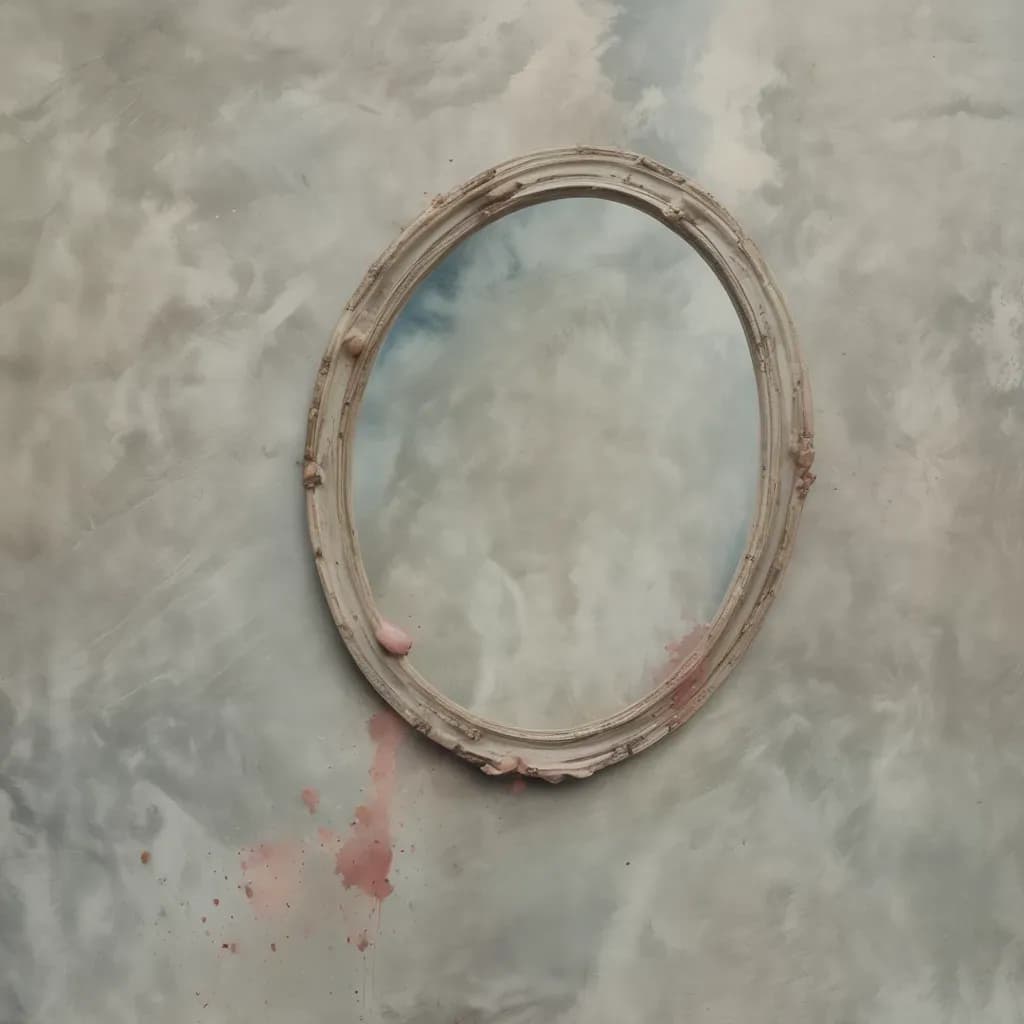
The mirror as a weapon and a confession
The mirror is among the oldest props in songwriting, and it nearly always does one of two jobs. It can be an accusation, a way of telling someone to take a hard look at what they have become. Or it can be a confession, the moment the narrator admits that the person they have been blaming is partly themselves.
This song keeps both meanings alive at once. The confrontational energy points at the first. The reviewer's description of the plea stretching beyond the mirror itself, into reflections on rain-wet pavement, suggests the speaker keeps finding new surfaces in which to make the other person look.[1] Each new reflection adds pressure. It reads as an escalating insistence, not a single line of blame.
At the same time, the insistence has a self-directed edge. A narrator who demands that someone confront their reflection has usually already confronted their own, and the demand carries some of that discomfort with it. When a person says look at yourself, they are often also saying that they have looked and did not enjoy it.
Faces that fascinate and repel
A different review reads the song in a more psychedelic register. It calls the track raucous yet ruminative and says it is built around details that might be magnified in a hallucinogenic state, among them light trails, the way water reflects, and how a person's own face can be both fascinating and repugnant at once.[2]
That last phrase gets at something true about reflections. Staring at a face for too long makes it strange, and the features come apart into shapes that no longer seem to belong to anyone. A song that lingers on this feeling is describing a kind of dissociation as well as a quarrel. The narrator is both furious and unmoored, watching the world shimmer while an argument unfolds.
This also explains why the water imagery matters. Water is a mirror that does not hold still. A puddle distorts and ripples the image it gives back, and every passing footstep breaks it. If the song keeps returning to reflections in water, it may be admitting that clear self-knowledge is not available. The look in the mirror is always a little warped.
How the sound supports the argument
Music carries most of the meaning when the lyrics are this compact, and the arrangement does real work. One reviewer hears the pedal steel take on a dreamy quality over Hollywell's power chords, which then grow more prickly as the plea continues.[1] The steel guitar, with its long, floating notes, provides the dreamy half of the song, and the guitars provide the confrontation. The two never fully merge, which fits a story about someone caught between a hazy feeling and a sharp demand.
Another detail is the vocal. Hollywell's delivery is described as intentionally rushed, tugging at the tempo.[2] A singer who pushes ahead of the beat sounds like someone trying to get a point out before being interrupted. It adds to the impression of an argument already in progress, and it keeps the melody from feeling too neat. The same reviewer calls the tune catchy in an unflashy way, which is a good description of a hook that sneaks in under the tension.[2]
The band's working method probably plays a part too. Coverage of Twisted Teens emphasizes quick sessions, minimal effects and an instinct for immediacy over polish.[6] That approach fits a song that opens mid-argument. Nothing has been smoothed into a gentle introduction, because the feeling it captures does not begin gently either.
Why it resonates
Most listeners know the experience this song describes, even if they have never put it to music. There is the argument that has gone on so long that the room itself starts to feel unreal. There is the moment of asking another person to see themselves as you see them, and the sinking sense that they never will. And there is the older, quieter fear that the reflection you are asking them to examine is partly your own.
The track also gains from where it falls in the album. After "I Bring" has already raised the temperature, "Look in the Mirror" extends it with a more direct accusation, then hands off to a gentler melodic stretch.[1][2] The effect is a short, sharp peak in a record that otherwise moves between humor and heartache. It reminds the listener that the band can be wry and quick, and that it can also stop joking.
Other readings
The first alternative is the literal one. The song is an argument between two people, one of whom is begging the other to acknowledge their behavior. On this reading the mirror and the puddles are simply the narrator's way of insisting on evidence, and the song is about the helplessness of being unable to make someone else see.
A second reading treats the whole thing as an internal monologue. The person being addressed is the narrator in an earlier moment, or in a worse one. The hazy, psychedelic details described in one review support this, since they place the song in a mental state where the line between self and other is thin.[2] Under this interpretation the confrontation is a kind of self-interrogation, and the prickly guitars are the narrator's own conscience.
A third reading is cultural. The album arrives in a year when the band released three records in about nine months, and the speed of that output is part of their identity.[3][6] A song about being forced to look in the mirror can be heard as a small refusal of that momentum. The band stops moving for a moment, looks at itself, and does not like everything it sees. This is speculation, and the band has not said anything of the kind, but the idea is consistent with Hollywell's description of the records as snapshots of whatever was happening that week.[4]
Conclusion
"Look in the Mirror" gives listeners very little to hold onto in the way of official explanation. There is no interview in which the band walks through what it means, and the available writing is limited to a few reviews. What those reviews describe is nonetheless vivid: a song that begins in the middle of a quarrel, wraps a dreamy steel guitar around pointed power chords, and keeps finding new surfaces for a reflection.[1][2]
That is enough to say what the song is about at its core. It is about the pressure of being seen, and of trying to make someone else be seen. Whether the other person is a partner, a friend or the narrator in disguise is left open, and the openness is the point. A mirror shows each viewer what they are prepared to find, and this song asks its listeners to look.
References
Keep reading
More by Twisted Teens
More Indie Rock
- Lost Weekend Phoebe Bridgers
- Horsepower Big Thief
- Muscle Memory Big Thief
- A More Perfect Union Titus Andronicus
- Space and Time Big Thief
- without music the world dies Morrissey