Today More Than Any Other Day
Most songs about the good life reach for the big gestures: love, escape, revolution. This one starts by standing in a supermarket aisle. Ought's "Today More Than Any Other Day" is a long, loosening piece of post-punk that treats ordinary errands as a possible site of wonder, and then, as the music speeds up and the guitars begin to shine, lets that wonder tip over into something close to urgency.
It is the second track on the Montreal band's 2014 debut, and it has become, for many listeners, the song that explains the group. Treble called it the quasi-title track of the record[1], and the name of the song nearly repeats the album's own. That sense of an idea being restated, nudged, and tested is the whole point.
A band formed in the aftermath of something
Ought came together in Montreal around students who had been at McGill University. Their debut, More Than Any Other Day, arrived on the city's Constellation label in the spring of 2014. The band is a mix of nationalities, three Americans and one Australian by Treble's count[1], and the record was written in the wake of the 2012 Quebec student protests, a general strike that reshaped the political mood of the city they lived in[3].
That backstory was folded into the band's mythology almost immediately. Press materials pointed to the strike as a catalyst[1], and early coverage framed the album as a political record about young people in the streets. The band was not entirely comfortable with this. In a 2015 Stereogum interview, the group made clear they did not always like how the album was being described, and singer Tim Darcy has long preferred that the words stay open to interpretation[3].
Understanding that tension helps with this song in particular. It is not a protest song in any direct sense. It is a song about what you do with a day once the marching is over, or before it begins.
The sound of a mood changing
The track follows the album's opener, "Pleasant Heart," which Treble describes as intense and apocalyptic, with scratchy, jagged guitar[1]. Against that, this second song is lighter and more hopeful. The band eases off the accelerator at first, as if clearing its throat, before letting in a rush of jangling guitar that reviewers compared to the Feelies[1].
There is a structural trick that matters here. About halfway through, the tempo picks up, and the bright-toned guitar began to remind one reviewer of Television's Marquee Moon[4]. The change is not just a flourish. The first half behaves like a person talking themselves into a better outlook, and the second half behaves like that person actually getting there, with the rhythm section pulling the whole thing forward.
Darcy's voice carries much of the emotional weight. Reviewers have placed it somewhere between Tom Verlaine and David Byrne[4], and that comparison fits: a talk-sung, slightly strained delivery that sounds more like someone working something out than someone performing. He is wry, but he does not sound like he is kidding.
The sacred in the supermarket
The central move of the lyrics is a list. The narrator catalogues small, almost embarrassingly modest pleasures, including the anticipation of grocery shopping and the minor decision of which kind of milk to buy[1]. These details are played with a wink, yet Stereogum's reading of the album as a whole is that its humor is sincere rather than snide, wry but optimistic[3].
This is the song's real subject: the idea that attention is a choice, and that the dull parts of life contain more than we usually let them. The title itself works like an incantation. Saying that today, of all days, is the one that matters is a way of refusing to postpone your own life to some more important moment.
Treble's description of the lyrics as a blend of the transcendent and the mundane is apt[2]. The song never decides that one cancels the other. A hydrant and a loaf of bread are not elevated into symbols, exactly. They are just allowed to be looked at properly.
The This Is Water connection
The clearest statement the band has made about the song's inspiration came in that Stereogum Q&A. Darcy said that someone had told him, months after the album came out, that the record reminded them of David Foster Wallace's "This Is Water" commencement speech. He replied that some of those thoughts probably did make it into this song. He remembered listening to Wallace deliver the speech around the time the band members were living together, and said he found it very affecting[3].
The link is revealing. Wallace's speech argues that the real work of adult life is deciding what to pay attention to, and that the boredom and frustration of routine, standing in lines, shopping after a long day, is exactly where that choice gets made. A song that opens on a trip to the store and ends in a surge of energy is a natural musical cousin to that idea.
It is worth being careful here. Darcy was equally quick to say that the idea of another literary influence, Don DeLillo's White Noise, had been overblown, and that many songs were written before anyone in the band had read it[3]. The Wallace connection is a stated, specific one, offered with a typical shrug. It is not a blueprint.
A video made of small things
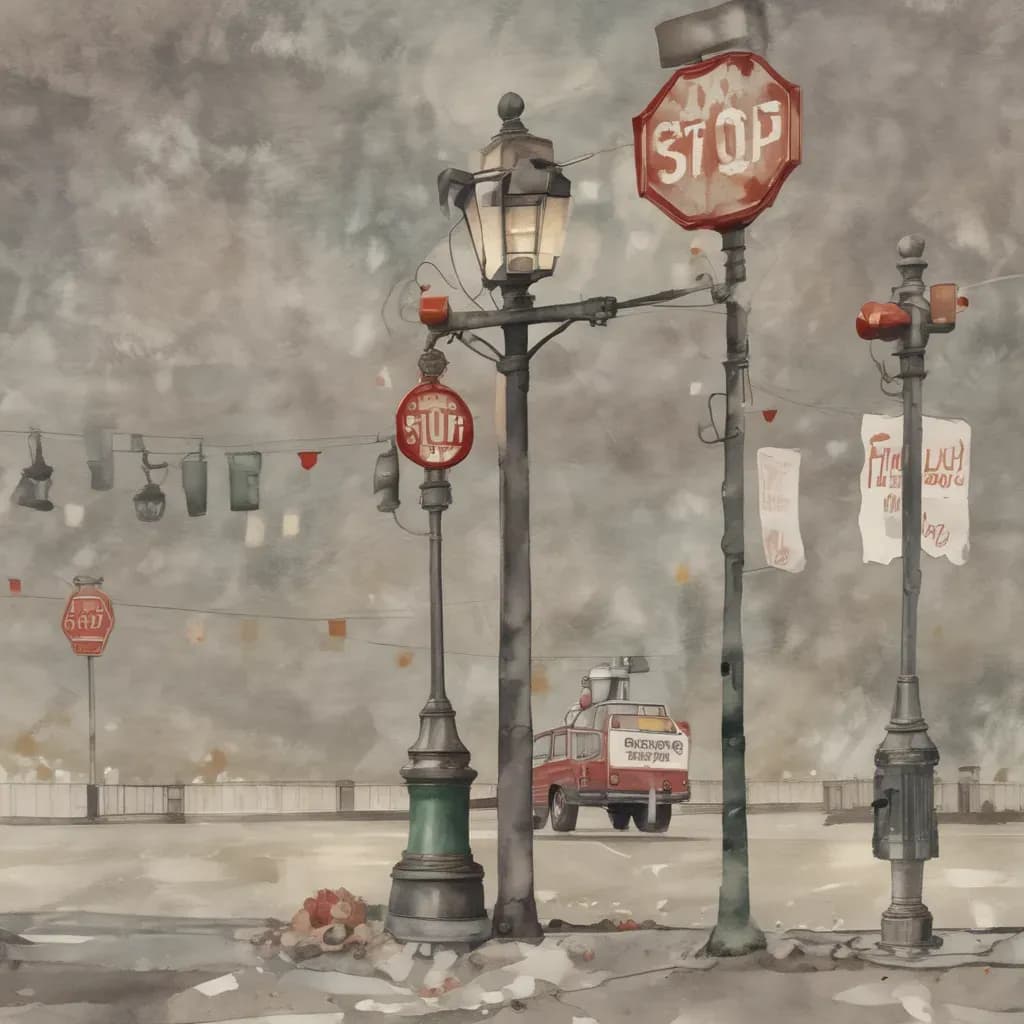
The first video from the album was made for this song, directed by Adam Finchler and published in June 2014[2]. It is not a performance clip or a narrative. Instead it strings together close-ups of everyday objects, among them flowers, bread, cigarette butts, a stop sign, fire hydrants, and the front of a nail salon[2].
The choice suits the music remarkably well. Every object on that list is something you would walk past without registering. Held in focus for a few seconds each, they start to look odd and charged, which is more or less what the song is trying to do to the listener's sense of an ordinary day.
Why it resonates
A lot of music from the post-punk tradition Ought draws on is about alienation and dread. Treble noted that the band sounds steeped in classic post-punk without the baggage of the revival years, and that the songs are labyrinthine and mostly longer than five minutes[1]. Within that tradition, this track is unusual for being so openly hopeful. Its optimism is not naive, because the music around it is tense and anxious. The hope has to be earned inside the song, and it is.
It also landed at a particular cultural moment. Listeners in the mid-2010s were being asked to find meaning in lives structured by screens, precarious work, and constant low-grade distraction. A song that proposed paying close attention to a grocery list as a form of resistance spoke to that directly, without ever sounding like a lecture.
The album as a whole has been read as being about collective hope and the feeling that an ordinary life can be something you actively do. Stereogum summarized its message as roughly that you are given a life and ought to do something with it[3]. This song is where that message becomes most concrete.
Live, the song tends to stretch even further. Because the band prefers playing together to overdubbing[3], the studio version already sounds like a room of people building momentum, and that communal feel is part of the pitch. The hope here is not a solitary epiphany. It is something four people generate by locking into the same pulse and pushing it forward until the ordinary shimmers.
Other ways to hear it
Not everyone hears a gentle affirmation. The playfulness of the list can read as irony, a deadpan joke about how little we have to feel excited about. On that reading, the song's surge is a kind of manic overcorrection, a person convincing themselves out of despair with increasing volume. The band's habit of leaving the words ambiguous supports both versions[3].
A political reading is also available, if you want it. The year of the student strike taught a generation that daily life and public life were not separate. Treating the everyday as worth defending could be a quiet echo of that lesson, even if the song never names the strike. The band's own discomfort with the political label suggests it is better held loosely[3].
Conclusion
"Today More Than Any Other Day" works because it refuses to pick a scale. It lets a glance at the milk aisle and a sudden rush of guitar occupy the same emotional space. For a few minutes, an ordinary day gets treated as the only one there is, and the music makes a convincing case that this is not a small thing.
Years later it remains the track people point to when they want to explain what Ought sounds like. That is partly the tune, and partly the nerve it takes to believe, out loud, that the unremarkable parts of a day might be where the remarkable part is hiding.
References
Keep reading
More Post-Punk
- Stoned and Starving Parquet Courts
- Dum Surfer King Krule
- Dethroned black midi
- Disorder Joy Division
- I Love You Fontaines D.C.
- Processed by the Boys Protomartyr