BLACK SHEEP
Most songs about being an outsider are written from the safety of hindsight, after the scars have faded into a good story. Black Sheep by Make Them Suffer sounds like it was written with the wound still open. It is heavy, dark and melodic, and underneath the weight it is asking a quiet, uncomfortable question: what does it cost to belong to something that keeps you away from everything else?
The Perth metalcore band released the single in November 2026 through Immortal Music Group and SharpTone Records.[1] It arrived as a statement of identity, and the band was unusually direct about what it meant.
Seventeen years at the edge of the room
Make Them Suffer formed in 2008 in Western Australia, one of the most geographically isolated music scenes in the world.[1] They began with a ferocious deathcore bent and gradually widened their sound to include melodic death metal, symphonic touches and the atmospheric electronics that now run through their records.[1] By the time this single appeared, they had five studio albums behind them and more than 400 million streams.[1]
Their 2024 self-titled album charted in the UK, and the track “Epitaph” won a major APRA Music Award in Australia in 2025.[1] They have played sold-out headline shows and shared stages with some of the biggest names in modern heavy music.[1]
Success of that kind sounds like the opposite of being an outcast. That tension is exactly where the song lives. The band describes it as being about the outcast, and as a statement about themselves after years of grinding and feeling they had only recently been recognised.[1] Recognition that arrives late does not erase the years spent unrecognised. It changes how you remember them.
Distance shapes the band’s story in a literal sense, too. Perth sits thousands of kilometres from the next major Australian city, and an Australian band hoping to reach international audiences must travel enormous distances just to be heard. Long flights, long drives and long absences are not a side effect of the career. They are the career, and they help explain why a song about separation and not belonging would feel so natural at this point in their history.
The outcast as a badge and a bruise
The title leans on one of the oldest images for the person who does not fit: the dark animal in a pale flock. Traditionally the image is a judgment, a way for a group to say that someone is wrong. Make Them Suffer take it back and turn it into something closer to a description of origin.
The band has said it believes its distinctive sound comes from not being accepted for so long, and that there is a silver lining in that history.[1] This is the song's most generous idea. Rejection is not romanticised, but it is treated as raw material. A band that is never handed a ready-made home has to build its own, and the things it builds look different from everyone else’s.
That reading gives the song a defiant spine. The pride in it does not come from having won. It comes from having stayed recognisably themselves while the scene around them took years to catch up.
Life on the road, and the loneliness inside it
The more personal layer belongs to vocalist Sean Harmanis. He has described making music full time as a gift he will never take for granted, and in the same breath admitted that the touring life can be deeply isolating.[1] He has seen loneliness, a lack of belonging and a difficulty connecting in himself and in other full-time touring musicians.[1]
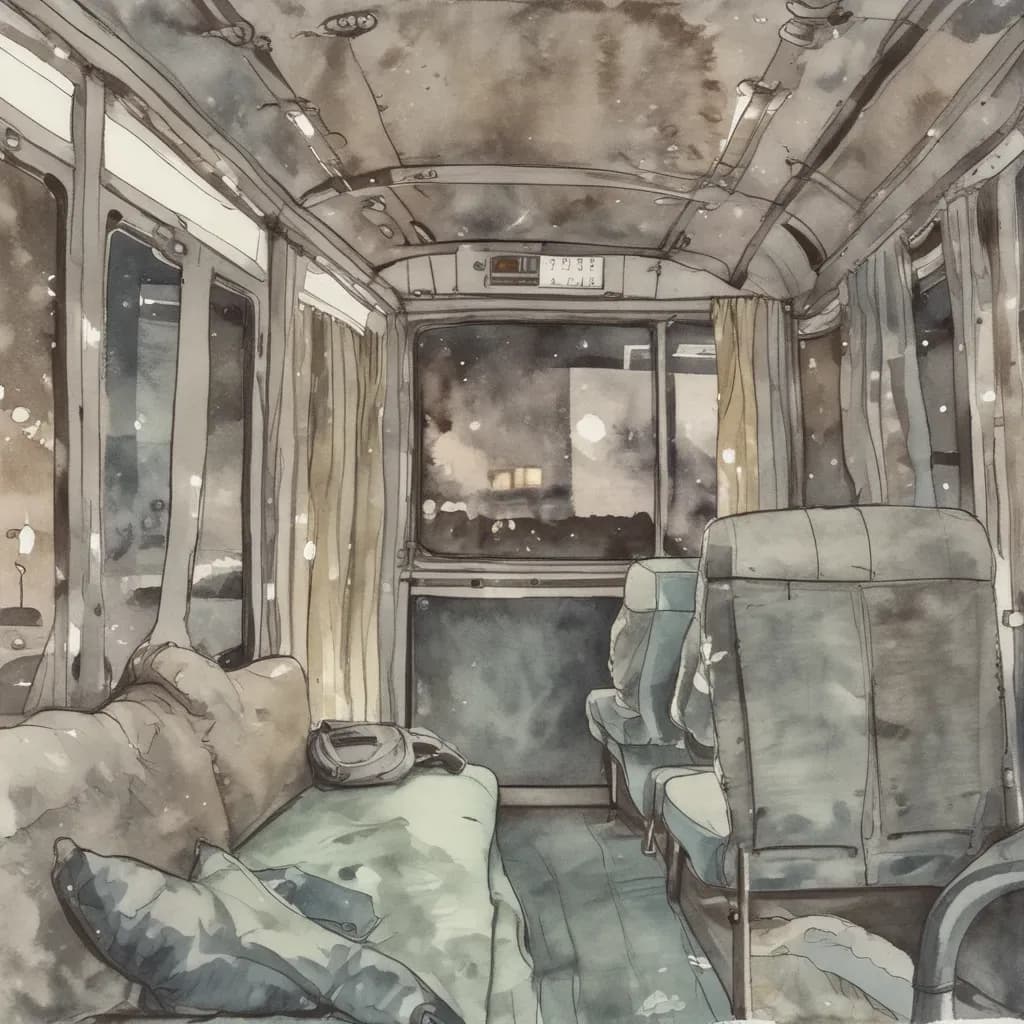
The picture he paints is of a strange inversion. The longer someone spends living in a tour bus bunk, the more foreign ordinary life becomes, and the relationships left at home grow more distant.[1] Home stops being a place you return to and becomes a place you visit. The road, meanwhile, never fully becomes home either. You end up belonging in the gap between the two, which is another way of belonging nowhere.
This is a part of touring culture that rarely makes it into the glossy version of a band’s rise. Crowds see the best hour of a musician’s day. They do not see the other twenty-three, spent in transit, in green rooms and in the blue light of a phone, trying to keep a friendship or a marriage alive from a time zone away.
How the sound carries the theme
The single has been described as brutal, melodic and dark, with dreamlike atmospherics and ambient electronics.[1] That combination is well suited to the subject. Crushing heaviness gives the anger and frustration somewhere to go, while the ambient, drifting layers evoke the dislocation of being physically present and emotionally elsewhere.
Dan Braunstein, who produced and mixed the track, is also credited as one of its writers alongside the band members Nick McLernon, Alex Reade, Sean Harmanis, Jaya Jeffery and Jordan Mather.[2] A song credited to the whole group suits a theme that is, at its core, collective. The outcast here is not one person but a unit that spent years outside the circle together.
The press framing also calls the release a return to form.[1] It is easy to hear why. The record leans back into the band’s heavier, darker instincts while keeping the melodic and symphonic ambition they built up over a decade and a half.
It is worth noticing how little the band leans on spectacle to make the point. The framing around the release is plain: a group of musicians describing a feeling they know well, without asking the listener to feel sorry for them. That restraint gives the heaviness more credibility, because the anger is attached to something specific rather than to a generic pose.
There is also a quiet argument in the song about what an audience owes the people it watches. Fans often meet a band at the moment of release, when everything looks finished. The song gently reminds them that every finished thing has a long, unglamorous prehistory, and that the people who made it were often alone for much of it.
Two ways to hear it
There are at least two honest readings, and they do not cancel each other out.
The first is the career reading. The song is a band looking back over seventeen years and reckoning with a long stretch of being overlooked. The tone is part vindication, part weariness. It says: we were here the whole time.
The second is the human reading, drawn from Harmanis’s comments about the road. Here the outsider is not a band fighting for credit but a person who has quietly drifted away from ordinary life and found that no other place has fully replaced it. The song becomes less about the industry and more about the private cost of the life that success demands.
A third, looser reading is available to any listener who has ever felt out of step with family, hometown or friends. The song does not require you to be a touring musician. It only requires you to know what it is to be somewhere and not quite of it.
Why it resonates
Heavy music has always been a refuge for people who feel like outsiders, which makes this subject something of a homecoming for the genre. What sets the song apart is that it refuses the tidy resolution. It does not claim that success cures isolation, or that finding an audience means finding belonging.
Instead it holds two truths at once. The band is proud of how far it has come, and the journey left marks that recognition cannot remove. That honesty is rare in a genre often associated with pure aggression, and it gives the song an emotional range beyond its surface intensity.
For fans who have followed Make Them Suffer since the early deathcore days, the song also works as a kind of shared memory. For newer listeners arriving through the band’s recent breakthrough, it offers a glimpse of what the long road looked like from inside.
Seen this way, the song joins a long tradition in heavy music of turning private alienation into communal noise. The paradox is the point: a room full of strangers shouting about not belonging is, for a few minutes, a room full of people who belong to each other. That may be the song’s most hopeful gift, and it is available to anyone willing to stand in the crowd.
Conclusion
Black Sheep is a song about the difference between being seen and being known. After seventeen years, Make Them Suffer have been seen by far more people than ever before, yet the track insists that the earlier years of obscurity and the ongoing loneliness of the road remain part of who they are.
It treats the outsider label as both a wound and a source of strength, and it lets the heaviness do what words alone cannot. Listeners come away with a portrait of a band that survived being unwanted, and a reminder that the people on stage may be carrying a distance the applause cannot close.
References
Keep reading
More Metalcore
- Shedding Season Comeback Kid
- I Don't Trust Tomorrow Bullet for My Valentine
- Disguised in Pins concealer
- Blood on My Hands Crowquill
- Dead Inside Of Me Trivium
- Crown In The Grave Trivium