It's All Over Now, Baby Blue
Some songs end an album. A few end an era. This one manages to do both while sounding as though it is only quietly clearing its throat. A single acoustic guitar, a harmonica, a bass line barely there, and a voice telling someone it is time to go.
Nobody has ever agreed on who that someone is. A lover, a friend, a younger self, an entire audience: all have been proposed, and the song supports each of them without ever settling on one. That refusal to name its subject is what has kept listeners returning to it for six decades.
The last song recorded
The master take was cut on January 15, 1965, at Columbia's studio on Seventh Avenue in New York, with Tom Wilson producing[1]. It was the final song finished for Bringing It All Back Home, and it became the record's closing track[1]. Dylan had already tried it twice that week, once alone on acoustic guitar and once in a semi-electric arrangement, before settling on the stripped-down version we know[1]. The only other musician credited is William E. Lee on bass[1].
There is an intriguing reason it was recorded so quickly. According to Clinton Heylin, as relayed on the song's Wikipedia page, Dylan wanted to capture it before he got too familiar with it[1]. He had been playing his other new songs on stage for a while. This one he wanted fresh, and you can hear that in the delivery, which is grave and slightly unhurried, like a person still working out how to say something difficult.
Dylan himself offered one small clue about its origins. He said he had carried the song around in his head for a long time, and that while writing it he thought of a rockabilly number by Gene Vincent that he loved in high school. His own Baby Blue, he added, was someone else entirely[1].
A farewell in a long series
By 1965 Dylan had developed a habit. Each of his previous two albums had ended with a goodbye: one to a whole way of life, one to a particular lover[1][2]. Closing this album with another departure made a pattern, and the pattern tells you something. Dylan was a restless artist who kept ending things, and the endings were frequently the best part of the records.
What distinguishes this farewell is its tone. Others in the series are tender or rueful or even a bit defensive. This one is stern. The narrator does not argue and does not apologize. He catalogs what is gone, what is being abandoned, what the listener will have to carry and what they will have to leave on the floor. Q magazine later described it as the most toxic of strummed kiss-offs, with no chance of reconciliation[1]. That is accurate, but it undersells the tenderness underneath. The voice may be unsparing, yet it also sounds like someone who wishes the person well and who knows the truth is the only useful gift left to give.
Reading the imagery
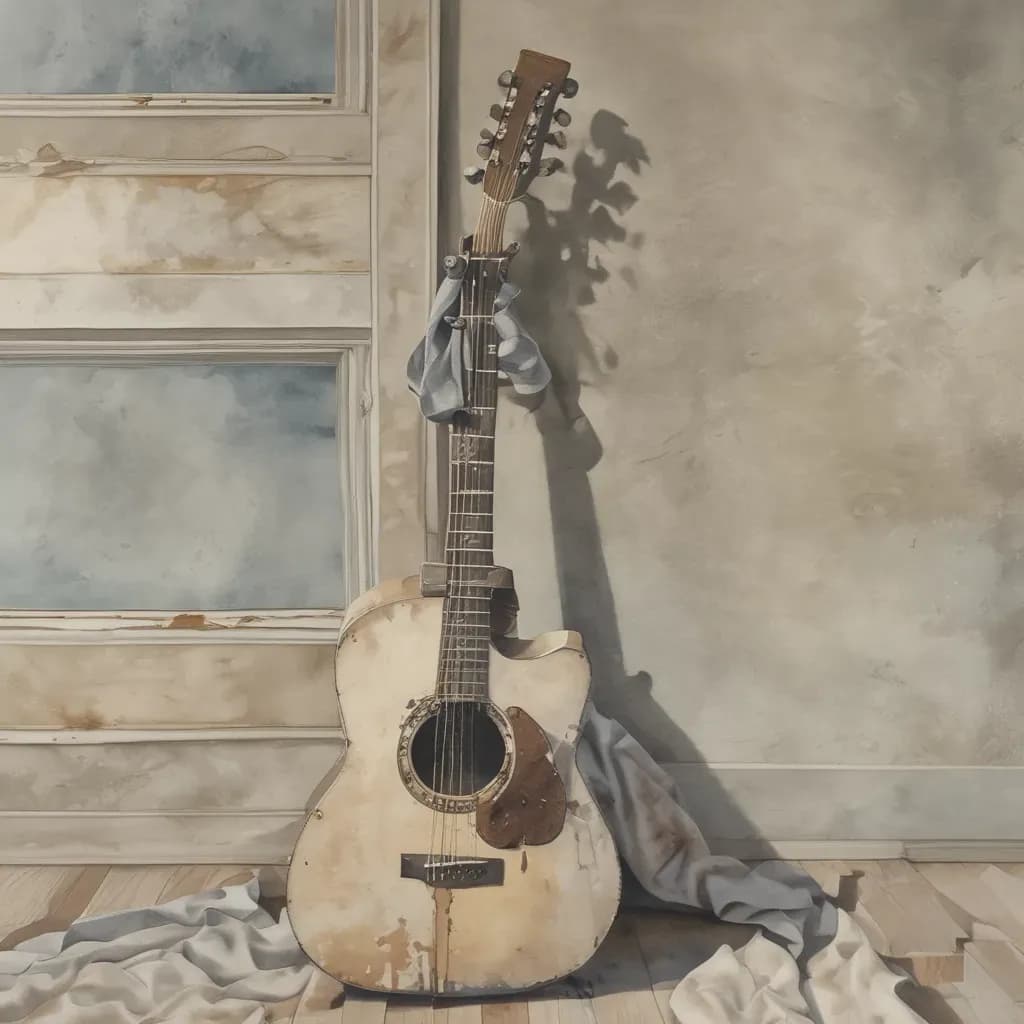
The song is built from pictures rather than a story. In the opening verses the narrator describes a series of abandoned structures and discarded comforts: a shelter that no longer shelters, a bed that belongs to someone else, belongings and supports that will not be there tomorrow. Later he turns to the figures who populate the departing person's world, the false helpers, the ghosts from the past, the people who offered counsel and left nothing behind. Everything in the song is being taken away, and the listener is encouraged to feel that this is a relief as well as a loss.
These images reflect the Symbolist influence that had been working on Dylan since 1964. Critics have long linked the lyrics to the French poet Arthur Rimbaud, who appears behind the surreal pictures in [1]Mr. Tambourine Man and others on the same record[1]. Dylan was explicit about the change. In 1965 he told a university newspaper that his songs of the previous year had been one-dimensional, and that the new ones worked on more than one level[2]. This is what he meant. You can hear the song as a breakup, and you can hear it as a prophecy, and neither reading cancels the other.
One line near the end is often discussed because it echoes an idea from the I Ching, the Chinese book of divination that Dylan was reading around this time: that what looks like coincidence may be worth taking seriously, and that the useful thing to do with accident is gather it and make something from it[1]. The final movement of the song takes up that spirit. After all the clearing out, a new beginning is permitted, even encouraged. The song is as much about what comes next as about what is over.
Who is Baby Blue?
Dylan has never said, and the people who write about him have offered a crowd of candidates[1][2].
The most common guess is Joan Baez. In early 1965 she and Dylan were still entwined and planning to tour together, even if he may already have decided to leave[1]. Another is David Blue, a Greenwich Village singer and songwriter in Dylan's circle[1]. A third is the folk singer Paul Clayton, a close friend through 1964 who travelled with Dylan across the country and who may by 1965 have grown more devoted than Dylan was comfortable with, perhaps also tangled up in drug use that made him difficult to be around[1]. Heylin, for his part, treats it as a Paul Clayton song, and considers it harsher and more demanding than the gentler kiss-offs that came before it[1].
The critic Paul Williams offered a more modest view. Dylan may have had a particular person in mind, he suggested, or may not. The song flows so naturally that it could have more or less finished itself before its author stopped to wonder who he was addressing[1]. That seems right. Whoever sat behind the first draft, the finished song has outgrown them.
The folk audience and the electric turn
The reading that has stuck hardest in popular memory is the one about Dylan's audience. By the time the album came out, in the spring of 1965, he was in the middle of a public break with the folk movement that had made him famous[3]. The record itself embodied the split. One side was electric, with a full rock band behind him, and the other was acoustic, with the quartet of long, dense songs that included this one[3]. The electric side had been recorded with little rehearsal in a single afternoon on January 14, and the acoustic songs followed on the final day[3].
Seen against that background, the song's addressee could be the audience itself: the people who wanted him to remain a singer of earnest topical numbers, who clung to an idea of him he no longer fit. The images of vagabonds, abandoned shelter and false guides fit this reading comfortably. So does the history. At the Newport Folk Festival in July 1965, after a booed electric set, the song was the last acoustic number Dylan played for the crowd, and it is hard to hear that performance as anything other than a goodbye[1]. That footage survives in Murray Lerner's film The Other Side of the Mirror[1].
Dylan himself later said that he had grown bored with performing alone with an acoustic guitar and had even thought about quitting, and that he considered the label folk rock mostly a tool for selling records[2]. None of that is about this song directly. But it supplies the mood in which it was written.
Saying goodbye to himself
A third reading turns the arrow around. The command to leave in the opening could be addressed to Dylan as much as anyone else, and the whole song could be a man instructing his own earlier self to move on[1]. Biographers have suggested other things he may have been leaving behind: certain women he had known, the political left, the illusions of youth[1].
This version of the song is the loneliest. It has no villain and no victim, just a person who understands that remaining who he was would be a kind of death. It also helps explain why the song feels so durable. A breakup song is about one occasion. A song about leaving yourself behind applies every time someone outgrows a role, a place or a community, which is to say frequently.
The Them version and the long afterlife
The song has been covered by an extraordinary list of performers, but one version stands apart. In March 1965 a young Van Morrison bought the album and began performing the song solo in small clubs and pubs[1]. When his band Them recorded it later that year, it took two tries. A first attempt in London, with a tempo borrowed from another of the group's numbers, left Morrison dissatisfied. A second session at Decca produced the arrangement everyone knows, built on a recurring blues riff and Peter Bardens's piano[1]. It appeared on Them Again in early 1966[1].
Critics have been generous to it. Greil Marcus wrote in 1969 that Morrison pushed past the limits of his powers on the track, calling it dramatic and terrifying, and Heylin described it as one of the rare Dylan covers to match the original[1]. Garage bands in 1966 and 1967, including the 13th Floor Elevators, built their own readings on top of it, and in 1996 Beck sampled it for a single of his own[1]. Morrison and Dylan sang the song together in London and at Slane Castle in Ireland in 1984[1].
The Byrds, Joan Baez, Marianne Faithfull and Graham Bonnet are among the many others who have taken their turn[1]. George Harrison borrowed the title for a line in a late song, and the writer Joyce Carol Oates has said it inspired her celebrated story about a girl who accepts a ride from a stranger[1]. Dylan himself has performed it hundreds of times, a count that stood at 588 as of the end of 2024[1].
It has also been ranked repeatedly among his finest work. Readers of Mojo placed it tenth among his songs in 2005, and a poll of musicians put it seventh[1].
Why it keeps working
Part of the answer is musical. Reviewers have praised the folk chord changes, the somber melody and the heartbreaking chorus[1]. The tune is simple enough to be sung by anyone and grave enough to hold the words. There is nothing flashy in the performance, no sense of showing off, only plain strumming and harmonica in service of the sentences.
Part of it is the structure. Because the song never specifies who is leaving or why, it works as a template. Someone leaving a marriage hears it one way. Someone leaving a hometown hears it another. A musician abandoning a genre, a believer abandoning a faith, a student finishing school: each finds the voice addressed to them.
And part of it is the nerve. Dylan ended one of the most important albums of the decade with a song that tells its listener to clear out, burn what is left behind and begin again. He then spent the rest of his career doing exactly that, over and over, to the occasional dismay of his admirers.
Conclusion
It is tempting to settle on one meaning for this song and close the case. The Newport story is satisfying. The Joan Baez story is dramatic. The self-portrait story is quietly devastating. But the song's power depends on the way it holds all of them at once, without apology and without commentary.
What it offers in the end is an experience of being told, gently and without room for argument, that something is over. Most people hear that sentence at some point. This is the recording that says it, and then lets the silence do the rest.
References
Keep reading
More by Bob Dylan
More Folk Rock
- Streets of Minneapolis Bruce Springsteen
- Freedom Bus Sheryl Crow
- Space and Time Big Thief
- Tequila Sunrise Eagles
- Outlaw Man David Blue
- Fairytale of New York Hozier